Public educator selection · preserve first work before criteria or later sources. These pages are public; record prior access.
Day 172 · People chose those partsFoundation Design Tech · T4 W35–36 · Teacher · Teacher / Day 172
Resource Weeks 35–36 · Queensland Prep / national Foundation · flexible session, often 25–35 minutes with pauses. This is a resource sequence, not a school-term date claim.
Useful outcome
Explore a genuinely familiar designed feature when available; distinguish a noticed feature from an attributed use or guessed maker intention.
Before you start
Read Preparation, choose suitable available broad parts or a no-object route, and select C03 / C04 if useful. Keep first ideas before examples.
The session
- Ask whether an actual suitable game, instruction routine or table arrangement is already familiar. The child need not name a household or recount personal play.
- With an adult-approved example, notice one feature: a marked start, separate places or a cue. If no genuinely familiar example is offered, use a new original practice model and leave K01 actual familiarity open.
- Select a mechanism below and preserve what the child actually points out. A picture description can support exploration without making an invented source personally familiar.
- Offer an agreeing arranger's exact use account only if actually available. Keep who said it separate from observed form. Otherwise retain a question.
- After own noticing, show C03/C04 ordinary fiction: a maker says why they chose a cue; another plan has no maker account. Ask what each source can tell us.
- Keep one useful feature/question for the child's own new game. If purpose is guessed as fact, model 'I notice… / this person says… / I still wonder…' on a different ordinary object.
Choose an engagement route
- Find a familiar feature: With an approved genuinely known setup, point to one feature. Draw or describe it, then keep one question.
- Ask an arranger: Ask a willing actual arranger about a feature they chose. Keep their exact reply if given; otherwise keep the question.
- Read two stories: Read C03 and C04. Place or tell what each says and what it leaves open. A new story does not become your familiar game.
Notice and teach next
Contexts: C03 invented broad-card chooser account; C04 pretend board plan with unknown intent. Observe: the real example and actual exploration for K01 only if offered; source interpretation separately. Next teaching: point to one noticed mark without claiming why every maker used it.
Child start · Home offer · Extra project
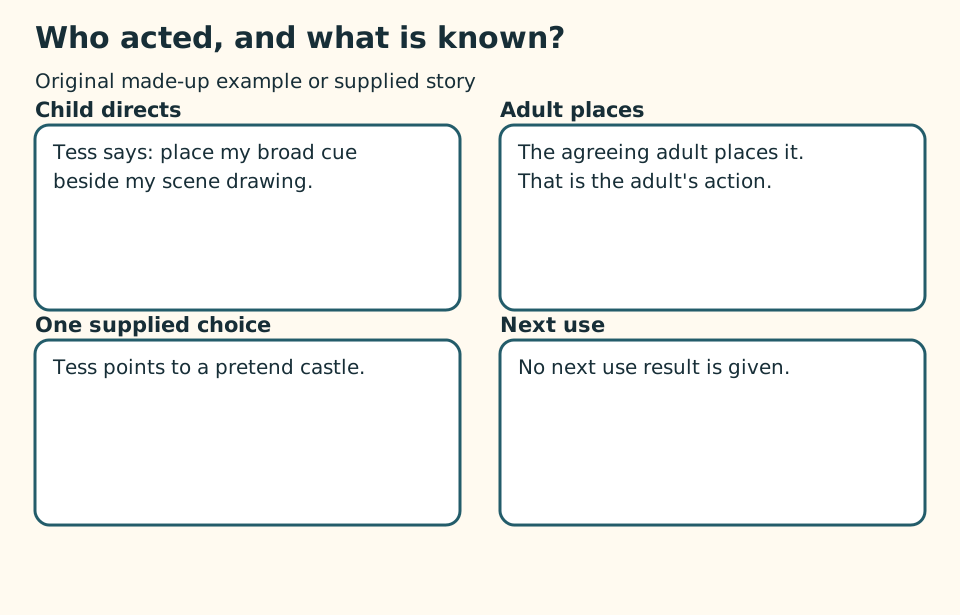
Whole visual and text alternative · Direct original SVG · Complete terms
Grown-up help
Offer speech, sign, AAC, pointing, drawing, faithful dictation, usual home-language support when competent, private work, pause, rest or finish. Ask one part at a time and keep its meaning. No partner, winner, score, time limit or fixed response length is required. Use only locally suitable broad whole paper/card, a checked marking tool and a stable comfortable table. A helper may act exactly as directed; keep the child's idea and the actual operator's action separate. Record an actual event only when it happened. A missing record can mean unknown; it does not establish that no action happened. A supplied story remains fiction.
Save an offered first idea before showing a worked example or a key. Record faithful access help separately from content/design help. Select only components actually taught and review exposure; the public forms are neither secure nor calibrated. Actual child making requires the child's own observed suitable action; adult manufacture is the adult's contribution. Actual familiar exploration is separate from interpreting a new fictional source. Never use response speed, handwriting, touch, compliance, sociability or length as design quality. These are original formative criteria, not official QCAA AP/MC/WW/EX/BA grading.
Modified from Prep alignment, Prep standard elaborations and Prep techniques and conditions, © State of Queensland (QCAA) 2023, CC BY 4.0 with item exceptions. Guidance summaries are adapted; proposed SubjectNest stories, choices, tasks, criteria and teaching moves are original. No endorsement.
About this resource
Reviewed source editionSource review is complete for this two-week edition. Local suitability and classroom use still need review. Earlier candidate or pending-review words are retained in the original files; full-year coverage, translations and audio are not claimed.
Labels and search exclusions are distribution guidance; they do not authenticate or restrict access.
Exact source: 27ee8994bbd86009b885ec2610e799c77cc6e8e3 · 2026-10-09. Source edition, roles and hashes
Complete source and rights notices
Keep these full notices with copies of this resource. Learning text, software, art and outside sources keep their own terms.