One question. One useful source.
You do not need a giant research project to make a lesson feel relevant. Find one sound example, give it a clear job, and keep the bits you can change easy to change.
1. Choose the job first
Write the question before looking for numbers. For example: "Why do these two pages both say Rockhampton but show different populations?" That gives learners a reason to read a heading, check a boundary and explain their answer.
Choose a public locality or an appropriately available source. A town, council area, library, public weather station or named statistical area is enough. Use a prepared extract when finding a source would swamp the intended lesson. Learners need no personal address, family income, account, outing or returned record. A learner may suggest a question; an adult's source selection, reading or scribing remains that adult's contribution.
2. Start with the organisation responsible for the information
- Population and area data: ABS Find Census data. Select the year and area; then read the geography type and code on the actual result. A place name alone is not a boundary.
- Past weather: Bureau Climate Data Online. Select the measurement, station and period. Record the actual station identity and the table's definitions; nearby does not mean identical to conditions at school.
- Recent weather labels and quality: Bureau About latest observations. Read the definition of the chosen field before using a value. Recent observations can be incorrect or missing; a missing value stays missing.
- Queensland library example: State Reference Library. This is a Queensland example, not a directory of every state's libraries. For a local replacement, open your actual council or library's official page and check that exact service and any relevant conditions.
- Local services, events or waste arrangements: use the actual responsible council, venue or service's official page. Confirm its public locality and scope; do not copy another council's arrangements or treat an advertised date as an observed visit. If the relevant page cannot be checked, keep the example draft or use a suitable checked alternative.
- Rockhampton activity information: Council walking and cycling provides a pathway-map starting point. Check the actual intended route and conditions separately; a strategy goal is not a tested participation outcome. Elsewhere, use your own responsible council.
These are starting points, not endorsements or automatic evidence for a task. A national data source can support local inquiry without establishing curriculum alignment in every state.
3. Keep three different dates
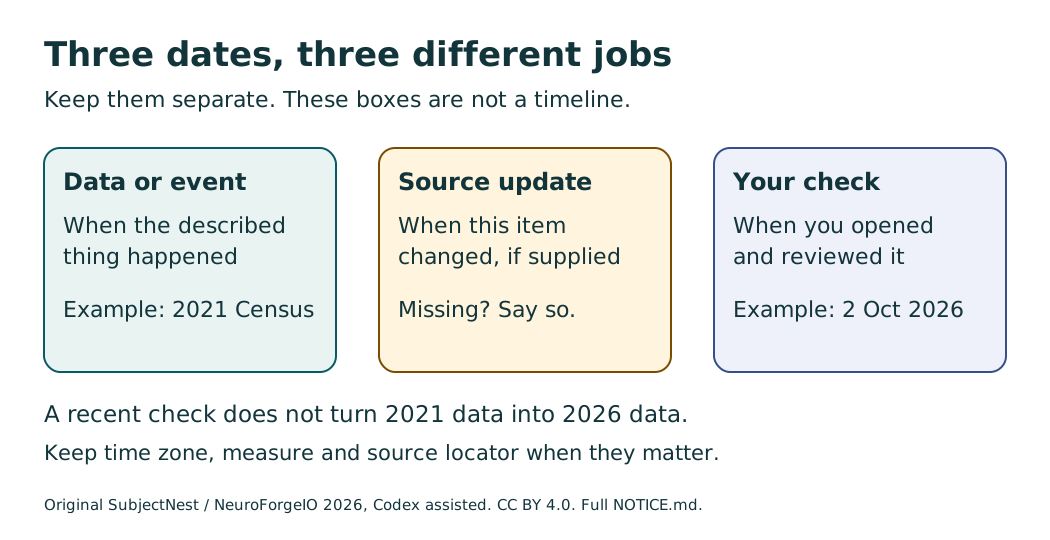
- Data or event period: when the described thing happened. For the worked Census cards, this is the 2021 Census.
- Source publication or update: when that item changed, if actually supplied. A footer year is not this date.
- Your check: when you opened and reviewed the item. Our examples were checked on 2 October 2026; that does not turn 2021 data into 2026 data.
The three-date diagram shows the different jobs. These dates do not have to occur in the order shown on a page. Add observation time and time zone where relevant. If a date is missing, write "not supplied".
4. Write the fact, your thinking and the task separately
Use the blank card. Give the source title, organisation, direct URL and exact table, heading or station. Paraphrase a small supported fact. Put your calculation, interpretation and fictional assumptions in different fields. Keep the units and definitions with the value.
Then write a short task and check its example response. For a calculation, work it again independently. For a source explanation, check that the source supports every part. A real source does not validate an invented scenario or predict that a proposed design works.
Check the actual item's terms before copying a map, photograph, recording, table or dataset. Keep its credit and identify your changes. The notices explain the source terms inspected for this edition; they do not grant rights to other assets. Public access and an attractive website do not establish permission. Public demographic data is not permission to infer a child's identity, language, needs or family circumstances. Community knowledge and First Nations languages need appropriate community involvement and permissions; do not invent a translation or treat a map or public statistic as consent.
5. Review this version, then make it easy to refresh
A named teacher or other suitable adult reads source, fact, working, task, answer and rights together. Record their date, decision, reason and intended use. A completed card records their judgement; it cannot prove accuracy, identity, agency endorsement or always-current status.
Keep an editable dated copy. Add a recheck trigger: before using an event/service time; before reusing a changed source or task; when the relevant data release, boundary, definition or item terms change. Choose timing that fits the example. There is no universal expiry date that makes every fact current. A historical task can deliberately retain 2021 data when the year is clearly stated.
When you edit the fact, task, answer, boundary or rights, mark the revised version draft and review it again. Keep the old version if your usual process needs a record. Do not overwrite an old measurement with a new one while keeping the old date or answer.
Give learners a way in
Offer a short prepared fact in words, a large-print copy, reading aloud by an agreeing helper, a labelled diagram, discussion or a practical paper task. Learners can point, type, draw, speak, dictate or use their usual communication. Keep the same worthwhile question and source limit; change the amount of reading, working space and support. No mode is a fixed learning-style diagnosis. A quiet route, extra time, a pause or a different example can be useful choices for anyone.
Original guide (c) NeuroForgeIO Pty Ltd / SubjectNest 2026, Codex assisted, CC BY 4.0 https://creativecommons.org/licenses/by/4.0/ . Keep credit and identify changes. Full sources and notices.