Public educator selection · preserve first work before criteria or later sources. These pages are public; record prior access.
Day 21 — Spot the changeYear 1 HASS · T1 W5–6 · Teacher · Teacher / Day 21
Resource Weeks 05–06 · flexible 25-minute offer; select a smaller part and fit the actual HASS allocation.
Child start · Home offer · Extra project.
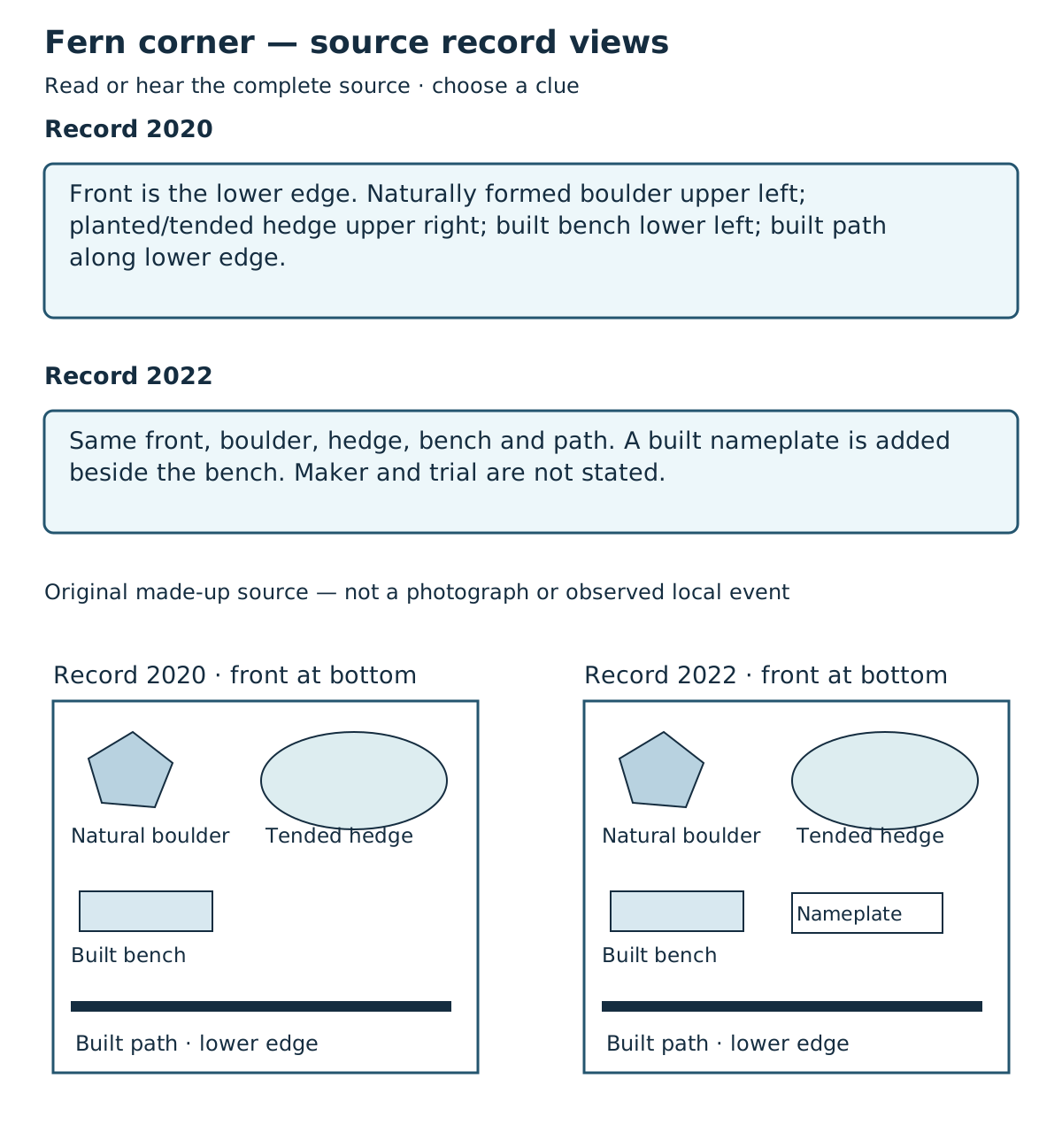
Purpose/product: Name a feature and make a small before/after record that another reader could follow. Selected K03/K04/S01–S03/S06. Prepare O1, two broad scraps or an empty two-panel sheet, a marked front edge and a simple key. Optional real route: a teacher-approved classroom display/storage feature with a known description, no sensitive layout; without an earlier actual record, today's observation cannot establish change.
Invite 3: “What is different in these two cards? Which bit would you like to show?” Read their fiction label. Introduce feature, front and a key with one actual paper symbol.
Model 5: On O1 locate the bench from the lower front edge. Say: “Built bench in both cards; nameplate added in the later card. The source does not say who added it.” Show how a natural material and a deliberately tended arrangement can have different useful aspects; don't classify by green/grey colour or erase possible management.
Guide/own 10: First match one repeated feature to both cards. Then let the child choose two features, show a meaningful location and add source/date labels or their agreed exact account. Ask a wanted helper to follow the child's placement rather than invent the idea. If using a real current feature only, label current observation and keep the earlier box unknown.
Three selectable mechanics:
- Build/direct a two-scene model: Place broad symbol slips on two reachable mats with the same front. Keep one repeated feature in both; add the sourced change only to the later mat. Tell what each symbol means.
- Make a flip picture: Fold paper or use two separate panels; draw/mark the chosen feature and its later clue. Flip between panels and point to the source that supports each.
- Tell a feature-finding story: Use usual communication to direct a helper's two-card placement, or describe the exact relationships without objects. Name source/date and what changed; no physical model-making claim for an unmade description.
Compare 4: Put source and own record side by side. Keep or correct one location/date. Check 3: “Show one thing the cards kept and one thing they changed. Which clue helped?” Look for sourced same/change and an actual own record; not neatness. If colour is the only classification clue, model naturally formed hill/planted garden/built rail using new ordinary words. If location is absent, practise beside with two reachable shapes; if no earlier evidence, retain today without inventing yesterday.
Whole practical aid · Complete terms · Complete alternative · Own blank aids · Care Story Bench/paper.
Preparation · Actual capture · Framework and criteria scope. Sources and reuse. Original activity; selected guidance Modified from linked © State of Queensland (QCAA) 2023 under CC BY 4.0 and document exceptions. No official rating or endorsement.
About this resource
Reviewed source editionSource review is complete for this two-week edition. Local suitability and classroom use still need review. Earlier candidate or pending-review words are retained in the original files; full-year coverage, translations and audio are not claimed.
Labels and search exclusions are distribution guidance; they do not authenticate or restrict access.
Exact source: 1fe5fcdab4e5ff5bfb915d495f5f00210c946335 · 2026-10-09. Source edition, roles and hashes
Complete source and rights notices
Keep these full notices with copies of this resource. Learning text, software, art and outside sources keep their own terms.