Make a collection somebody can follow
Make a tiny collection someone can follow. Two clues, a good question and a source name are plenty.
Paper, telling/signing/AAC, private work, rest or finish are all okay. A helper can read the source or do the moving you choose.
Pick a way
(a) Tabletop pop-up collection: Arrange reachable paper entries and broad heading; child chooses the route through them.
(b) Tiny collection booklet: Fold two pre-folded sheets or dictate a linear two-entry account, including the open question.
(c) Local bench preview: Use nine empty manual fields and linear preview to assemble a transient collection note; keep a wanted paper copy before leaving.
Complete selected sources
O1 — The play-clue tray
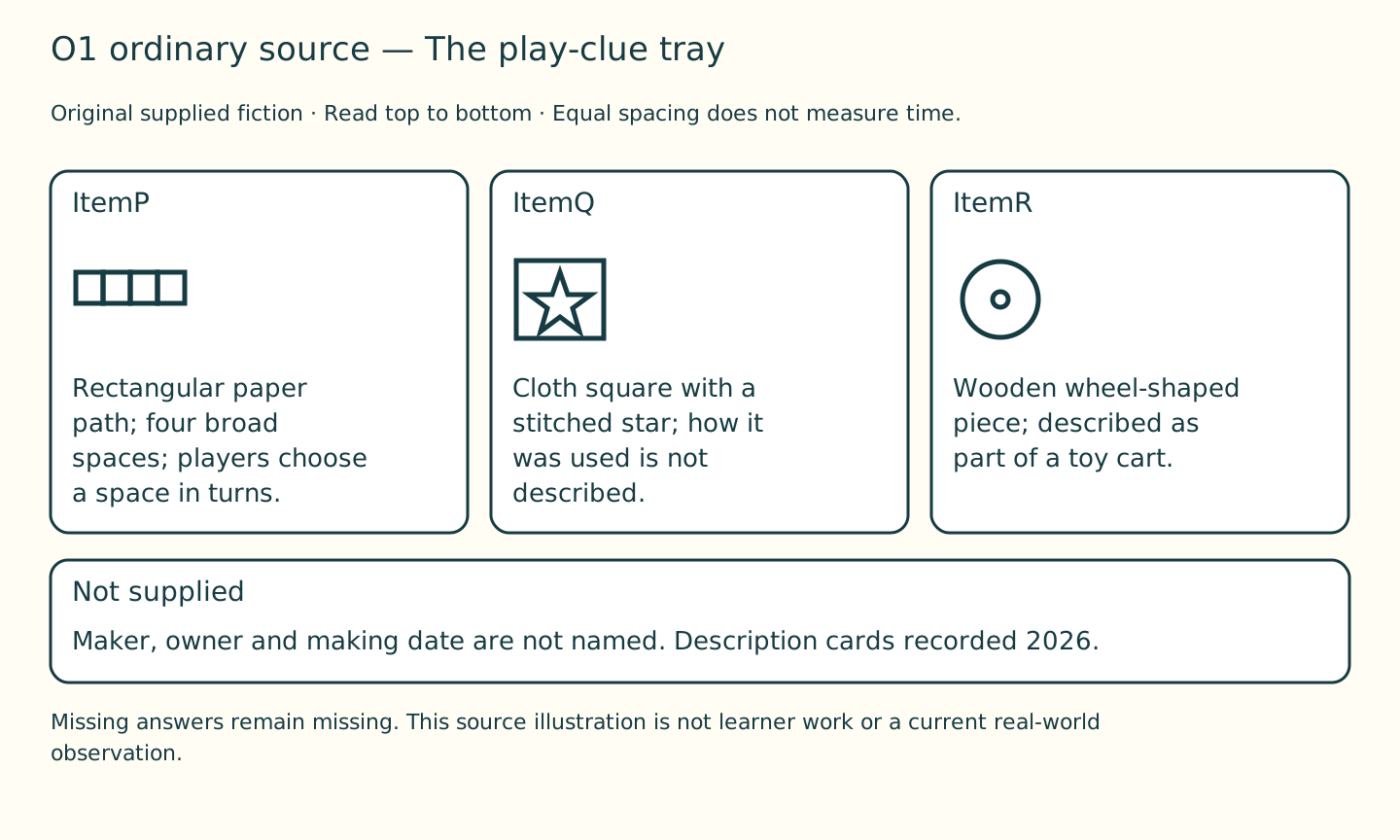
Original fiction, three description cards recorded 2026. ItemP is a rectangular paper path with four broad spaces; its card says players choose a space in turns. ItemQ is a cloth square with a stitched star; its card does not describe how it was used. ItemR is a wooden wheel-shaped piece; its card says it was part of a toy cart. No card names a maker, owner or making date. The descriptions are supplied text, not a child's observation or an image of a real collection. These items can help a material question; the maker is unknown.
O4 — Sort for the job
Original fiction, play-folder descriptions written 2026. Folded Path: paper, a turn-taking path game. Story Patch: cloth, used to tell a pretend story without a recorded turn rule. Picture Pair: paper, a matching game with turns. Mystery Board: material not stated, used for a turn-taking guessing game. No manufacture dates are supplied. Under a paper-material question, Folded Path and Picture Pair fit; Mystery Board belongs in material-unknown, not automatically non-paper. Under a turns question, Folded Path, Picture Pair and Mystery Board fit; Story Patch has no described turn rule, rather than proof no storyteller ever used turns. The two question/rule sorts need different honest group headings.
Whole drawing and complete text alternative.
Grown-up help
Offer one wanted route, not all three. Read the source neutrally, or support sign/AAC, dictation, broad marks and child-directed operation. Keep adult work separate. Rest, private work, pass or finish are valid options. Full teacher plan · Blank making mats.
Sources and reuse · Original educational work © NeuroForgeIO Pty Ltd 2026, CC BY 4.0. Linked authority/provider exceptions and learner ownership stay separate.