Day 41: One amount, two jobs
Useful outcome
Make a use-now/save-later label. Use existing safe pieces, original marks or the empty own organiser. Full description. The child may keep the product private.
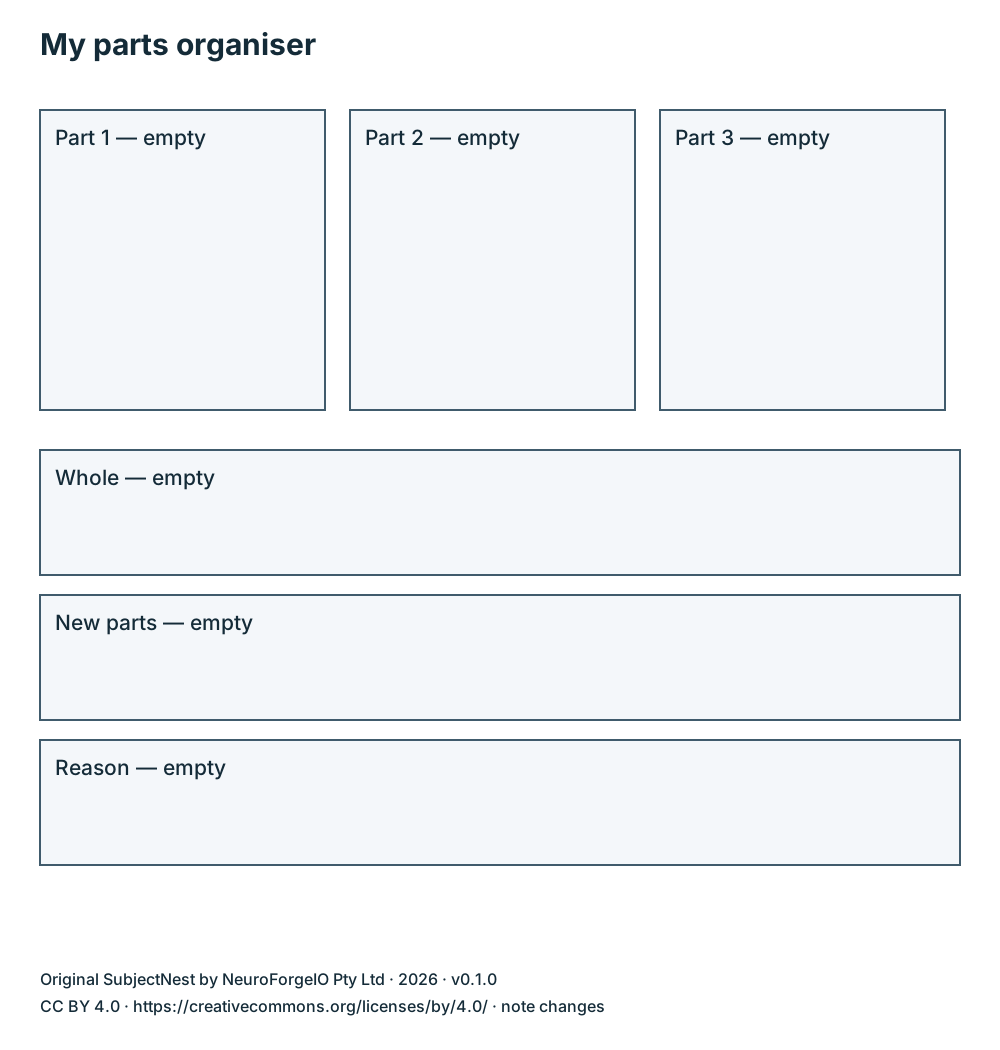
Prepare and check entry
Prepare the ordinary whole 9 and separate counted/waiting space, two or three parts as relevant, large numeral cards and optional verified ten-strips. Audit a ten before using it. Ask for one-to-one coverage and value of a full unit. Teach missing entry knowledge on a new small collection before today's larger example. Smaller actual quantities remain useful and are named.
Run the 25-minute component
- Start, 3 minutes: offer the useful outcome. Ask what amount is being organised and how we can include each object once.
- Model, 5 minutes: 5 + 4 = 9. Another account is 3 + 6 = 9. These describe one original collection. Verify each part and include each object once. Cover each object once with your pointer. Move the same objects to two places. Count both parts. Change the divider. Show that the whole still has nine.
- Try together, 7 minutes: the child selects boundaries/members; an adult may move marks at their direction. Ask “What is in each part? What stayed the same?” Check by the actual members, not only matching printed numerals.
- Choose, 7 minutes: take one of Reading tabs, Drawing tools, Paper game. Different purposes/quantities give new work; they are not fixed sensory learner labels.
- Show and check, 3 minutes: ask for today's relevant part values, whole and one reason. Keep first thinking/support, then a revision if needed. A model already supplied is not independently invented.
- Next invitation: If an object is counted in both parts, move one new small collection once into two outlined places; remove each object from waiting before placing it.
Likely confusion and response
A second drawing is a new account of the same collection, not nine more objects. If an object is counted in both parts, move one new small collection once into two outlined places; remove each object from waiting before placing it.
What to notice
Look for correct whole/part membership, matching quantities, the day's particular exchange/transfer/check and a supported reason. A correct whole alone does not prove every component. A child can choose a valid partition different from the model. Record actual quantity, access support and mathematical prompts; do not grade voice, handwriting, speed or motor independence.
Child start · Home · Extra · Worked contexts · Assessment selector.
Original SubjectNest teaching and drawings © NeuroForgeIO Pty Ltd 2026, CC BY 4.0. Credit SubjectNest by NeuroForgeIO Pty Ltd, version 0.1.0, source and licence; note changes. Curriculum and provider rights remain separate.