Public educator selection · preserve first work before criteria or later sources. These pages are public; record prior access.
D-later · Complete five-card sleeves · staff and four next routesYear 1 Maths · T2 W15–16 · Teacher · Teacher / Held / D later
Eligibility and exposure
Teach each requested sharing/grouping/repeated-whole/model/check component first. Check whether this full source/prompt/model was already exposed. A rehearsed case is supported practice, not an independent first sample. First/later names do not establish official complexity or familiarity. Separate novel equivalent sources need new recorded identities and criteria.
Allowed access support
Read the complete source and exact prompt, supply accessible/tactile/AAC/sign/large presentation, processing time or an exact scribe. Do not deal rounds, choose groups, point to the answer or calculate for the child. Preserve first work and label any later mathematical hint.
Matching complete neutral source and four prompts
D-later
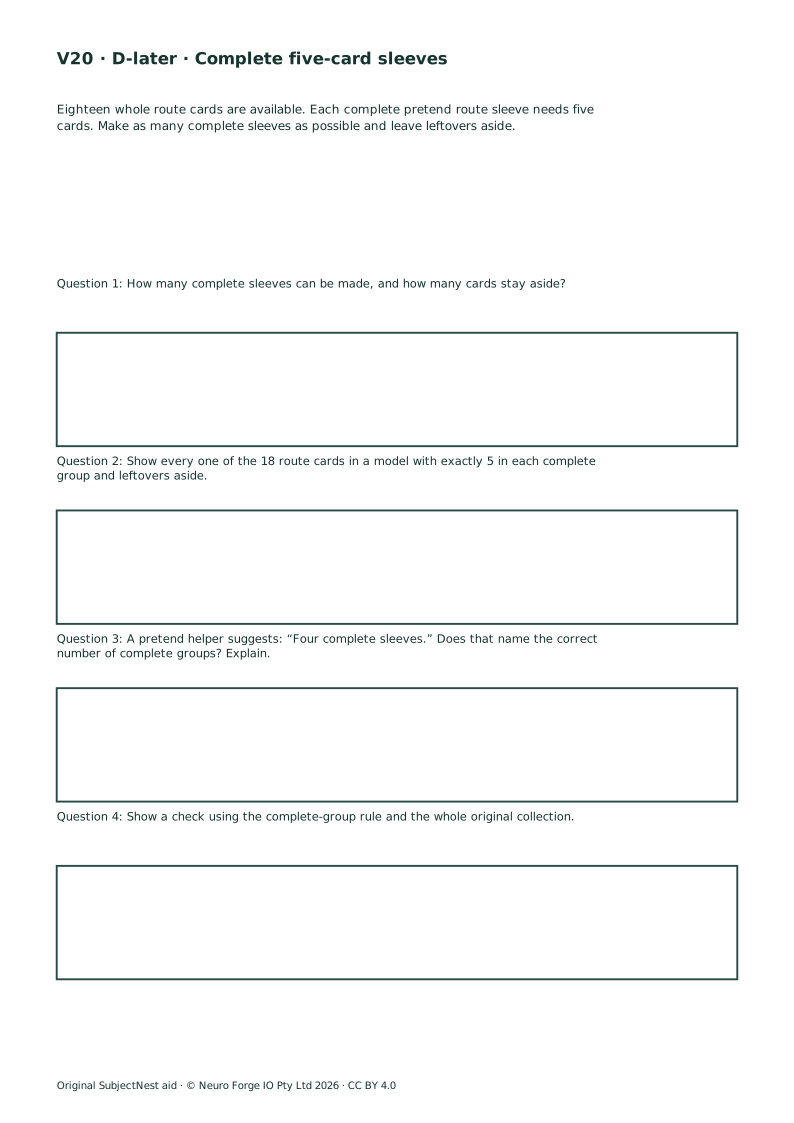
Eighteen whole route cards are available. Each complete pretend route sleeve needs five cards. Make as many complete sleeves as possible and leave leftovers aside.
Question 1
How many complete sleeves can be made, and how many cards stay aside?
Question 2
Show every one of the 18 route cards in a model with exactly 5 in each complete group and leftovers aside.
Question 3
A pretend helper suggests: “Four complete sleeves.” Does that name the correct number of complete groups? Explain.
Question 4
Show a check using the complete-group rule and the whole original collection.
Matching learner four-response page
Exact matching original vector · Complete terms
D-later-Q1
How many complete sleeves can be made, and how many cards stay aside?
Component criterion · staff only
Names 3 complete groups and 3 whole route cards aside.
Worked possibility · staff after first response
Name 18 as the whole available collection and 5 route cards as the required size of each complete pack. Take exactly 5 at a time into a new named pack; check that size before calling it complete. There are 3 complete packs and 3 whole route cards aside. 5+5+5=15; 15+3=18. The requested number 3 names packs; 5 names members in one pack. A leftover group of fewer than 5 is not another complete pack. Count or rebuild all original members to check; repeated addition, known groups or a supported subtraction model are possible taught methods, not a required memorised division fact.
Keep exact source identity, first wording/model, date and actual access/mathematical support. Judge this requested component shown/not yet shown/not observed, not an automatic grade. Full-year AP/MC/WW/EX/BA/achievement judgement needs actual moderated folio evidence.
Whole individual NEXT29 next-teaching lesson
D-later-Q2
Show every one of the 18 route cards in a model with exactly 5 in each complete group and leftovers aside.
Component criterion · staff only
Represents 3 complete groups of 5 members and 3 members separately aside, with all 18 members represented once.
Worked possibility · staff after first response
Name 18 as the whole available collection and 5 route cards as the required size of each complete pack. Take exactly 5 at a time into a new named pack; check that size before calling it complete. There are 3 complete packs and 3 whole route cards aside. 5+5+5=15; 15+3=18. The requested number 3 names packs; 5 names members in one pack. A leftover group of fewer than 5 is not another complete pack. Count or rebuild all original members to check; repeated addition, known groups or a supported subtraction model are possible taught methods, not a required memorised division fact.
Keep exact source identity, first wording/model, date and actual access/mathematical support. Judge this requested component shown/not yet shown/not observed, not an automatic grade. Full-year AP/MC/WW/EX/BA/achievement judgement needs actual moderated folio evidence.
Whole individual NEXT30 next-teaching lesson
D-later-Q3
A pretend helper suggests: “Four complete sleeves.” Does that name the correct number of complete groups? Explain.
Component criterion · staff only
Rejects four complete sleeves as the complete-group result; distinguishes required size 5, completed count 3 and a short leftover collection of 3 which is not another complete group.
Worked possibility · staff after first response
Rejects four complete sleeves as the complete-group result; distinguishes required size 5, completed count 3 and a short leftover collection of 3 which is not another complete group. Name 18 as the whole available collection and 5 route cards as the required size of each complete pack. Take exactly 5 at a time into a new named pack; check that size before calling it complete. There are 3 complete packs and 3 whole route cards aside. 5+5+5=15; 15+3=18. The requested number 3 names packs; 5 names members in one pack. A leftover group of fewer than 5 is not another complete pack. Count or rebuild all original members to check; repeated addition, known groups or a supported subtraction model are possible taught methods, not a required memorised division fact.
Keep exact source identity, first wording/model, date and actual access/mathematical support. Judge this requested component shown/not yet shown/not observed, not an automatic grade. Full-year AP/MC/WW/EX/BA/achievement judgement needs actual moderated folio evidence.
Whole individual NEXT31 next-teaching lesson
D-later-Q4
Show a check using the complete-group rule and the whole original collection.
Component criterion · staff only
Checks every completed group has 5 members and recounts/recombines 15 packed members plus 3 loose to recover 18.
Worked possibility · staff after first response
Name 18 as the whole available collection and 5 route cards as the required size of each complete pack. Take exactly 5 at a time into a new named pack; check that size before calling it complete. There are 3 complete packs and 3 whole route cards aside. 5+5+5=15; 15+3=18. The requested number 3 names packs; 5 names members in one pack. A leftover group of fewer than 5 is not another complete pack. Count or rebuild all original members to check; repeated addition, known groups or a supported subtraction model are possible taught methods, not a required memorised division fact.
Keep exact source identity, first wording/model, date and actual access/mathematical support. Judge this requested component shown/not yet shown/not observed, not an automatic grade. Full-year AP/MC/WW/EX/BA/achievement judgement needs actual moderated folio evidence.
Whole individual NEXT32 next-teaching lesson
Original future-handoff wording remains in the preserved written contract. The matching routes above are actual Source pages; classroom use, independence and annual evidence are not inferred.
Ordinary seven-heading paper · different purpose
About this resource
Reviewed source editionSource review is complete for this two-week edition. Local suitability and classroom use still need review. Earlier candidate or pending-review words are retained in the original files; full-year coverage, translations and audio are not claimed.
Labels and search exclusions are distribution guidance; they do not authenticate or restrict access.
Exact source: 3ee98a6729b35e301b33927a130056b428741f1c · 2026-10-14. Source edition, roles and hashes
Complete source and licence companions
Keep these complete conditions with PDF, SVG, text and ZIP copies. PDFs use the complete separate source and licence companions below; the downloadable packets keep their declared companions.