The toy-stage report · staff
- Complete matching neutral source
- Child · four blank own fields
- Matching four-question case paper
- V17 · source scene and four blank areas
- V17 · complete text alternative
- Ordinary eight-field Reporter Desk paper
- N17 · full follow-on lesson for Q1
- N18 · full follow-on lesson for Q2
- N19 · full follow-on lesson for Q3
- N20 · full follow-on lesson for Q4
The toy-stage report · staff case
Eligibility and exposure
Show the complete matched source only when beginning this case. If the child has already seen its staff worked answers, practised it, or received answer-level help, record that exposure and use it as supported/formative teaching rather than an independent first response. Later is a new source, not an automatic progress test.
Help and actual evidence
Adult reading of the full source, usual communication, larger print, breaks, pointing and exact dictation are allowed; record which. Do not supply a component’s worked answer or criterion before a genuine first response. Reading aloud means this case cannot by itself demonstrate independent decoding; adult pen work cannot demonstrate handwriting.
Complete neutral source
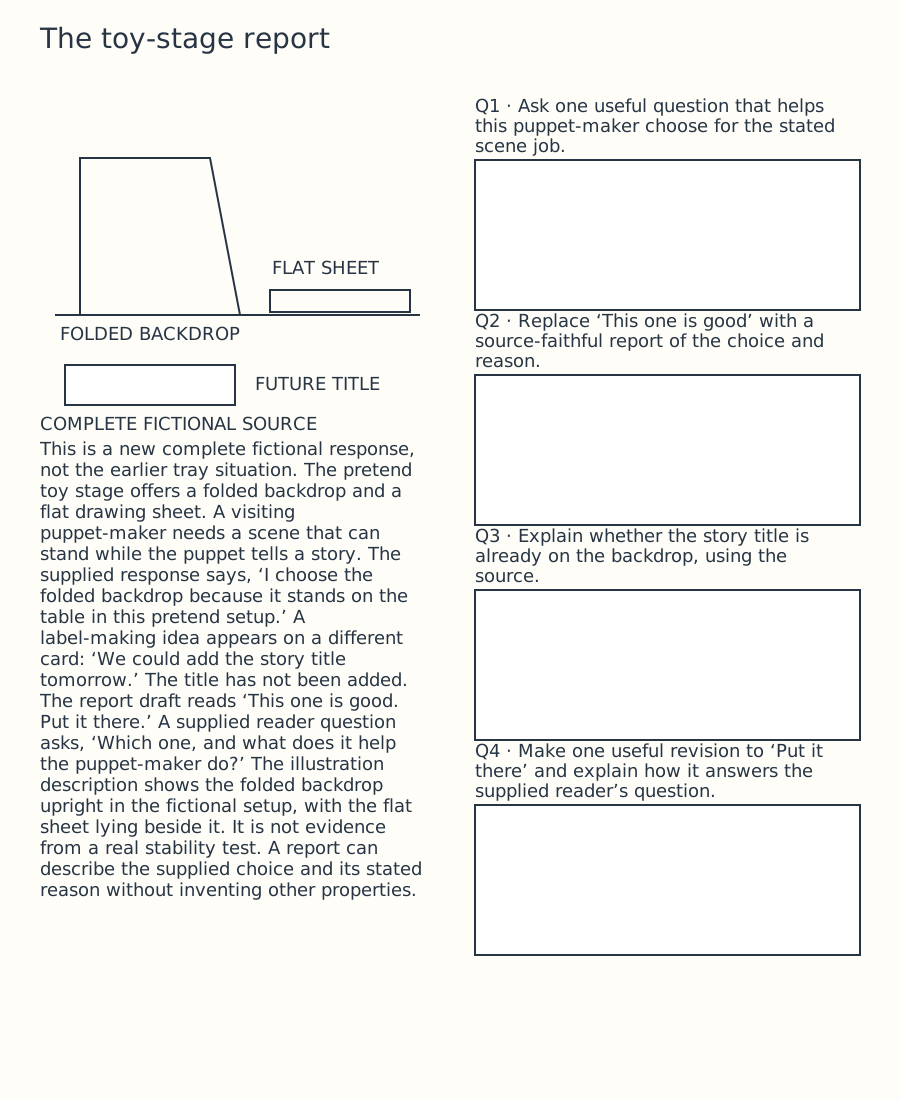
This is a new complete fictional response, not the earlier tray situation. The pretend toy stage offers a folded backdrop and a flat drawing sheet. A visiting puppet-maker needs a scene that can stand while the puppet tells a story. The supplied response says, ‘I choose the folded backdrop because it stands on the table in this pretend setup.’ A label-making idea appears on a different card: ‘We could add the story title tomorrow.’ The title has not been added. The report draft reads ‘This one is good. Put it there.’ A supplied reader question asks, ‘Which one, and what does it help the puppet-maker do?’ The illustration description shows the folded backdrop upright in the fictional setup, with the flat sheet lying beside it. It is not evidence from a real stability test. A report can describe the supplied choice and its stated reason without inventing other properties.
A-later-Q1
Invitation
Ask one useful question that helps this puppet-maker choose for the stated scene job.
Component criterion
Question relates the supplied backdrop/sheet choice to standing for the story job.
Staff example after an attempt
‘Would the folded backdrop or the flat sheet suit your standing story scene?’ focuses on the actual reader and job.
Judgement limit
Use this component-specific description with the actual response and recorded help. No point total, A–E level, diagnosis, causal gain or independent-exposure claim.
Next teaching
N17 · AC9E3LY01, AC9E3LY02
A-later-Q2
Invitation
Replace ‘This one is good’ with a source-faithful report of the choice and reason.
Component criterion
Names folded backdrop and its stated standing purpose, without unverified strength or safety claims.
Staff example after an attempt
‘The puppet-maker chose the folded backdrop because it stands on the table in this pretend setup.’ is more specific than ‘good’.
Judgement limit
Use this component-specific description with the actual response and recorded help. No point total, A–E level, diagnosis, causal gain or independent-exposure claim.
Next teaching
N18 · AC9E3LY05, AC9E3LY06
A-later-Q3
Invitation
Explain whether the story title is already on the backdrop, using the source.
Component criterion
Recognises the uncompleted tomorrow title proposal and supports the conclusion with the source.
Staff example after an attempt
It is not added. ‘Could add tomorrow’ and ‘has not been added’ leave that future job open.
Judgement limit
Use this component-specific description with the actual response and recorded help. No point total, A–E level, diagnosis, causal gain or independent-exposure claim.
Next teaching
N19 · AC9E3LA08, AC9E3LY05
A-later-Q4
Invitation
Make one useful revision to ‘Put it there’ and explain how it answers the supplied reader’s question.
Component criterion
Names the object/job/location as appropriate using supplied details and gives a reader-focused explanation; does not need a new label.
Staff example after an attempt
‘Place the folded backdrop on the table for the puppet’s story’ names the object and place. That helps the reader understand ‘it’ and ‘there’.
Judgement limit
Use this component-specific description with the actual response and recorded help. No point total, A–E level, diagnosis, causal gain or independent-exposure claim.
Next teaching
N20 · AC9E3LY06, AC9E3LA10