Public educator selection · preserve first work before criteria or later sources. These pages are public; record prior access.
The paper bridge arrival · staffYear 3 English · T1 W9–10 · Teacher · Teacher / Cases / B first
- Complete matching neutral source
- Child · four blank own fields
- Matching four-question case paper
- V14 · source scene and four blank areas · Complete terms
- V14 · complete text alternative
- Ordinary eight-field Reporter Desk paper
- N05 · full follow-on lesson for Q1
- N06 · full follow-on lesson for Q2
- N07 · full follow-on lesson for Q3
- N08 · full follow-on lesson for Q4
The paper bridge arrival · staff case
Eligibility and exposure
Show the complete matched source only when beginning this case. If the child has already seen its staff worked answers, practised it, or received answer-level help, record that exposure and use it as supported/formative teaching rather than an independent first response. Later is a new source, not an automatic progress test.
Help and actual evidence
Adult reading of the full source, usual communication, larger print, breaks, pointing and exact dictation are allowed; record which. Do not supply a component’s worked answer or criterion before a genuine first response. Reading aloud means this case cannot by itself demonstrate independent decoding; adult pen work cannot demonstrate handwriting.
Complete neutral source
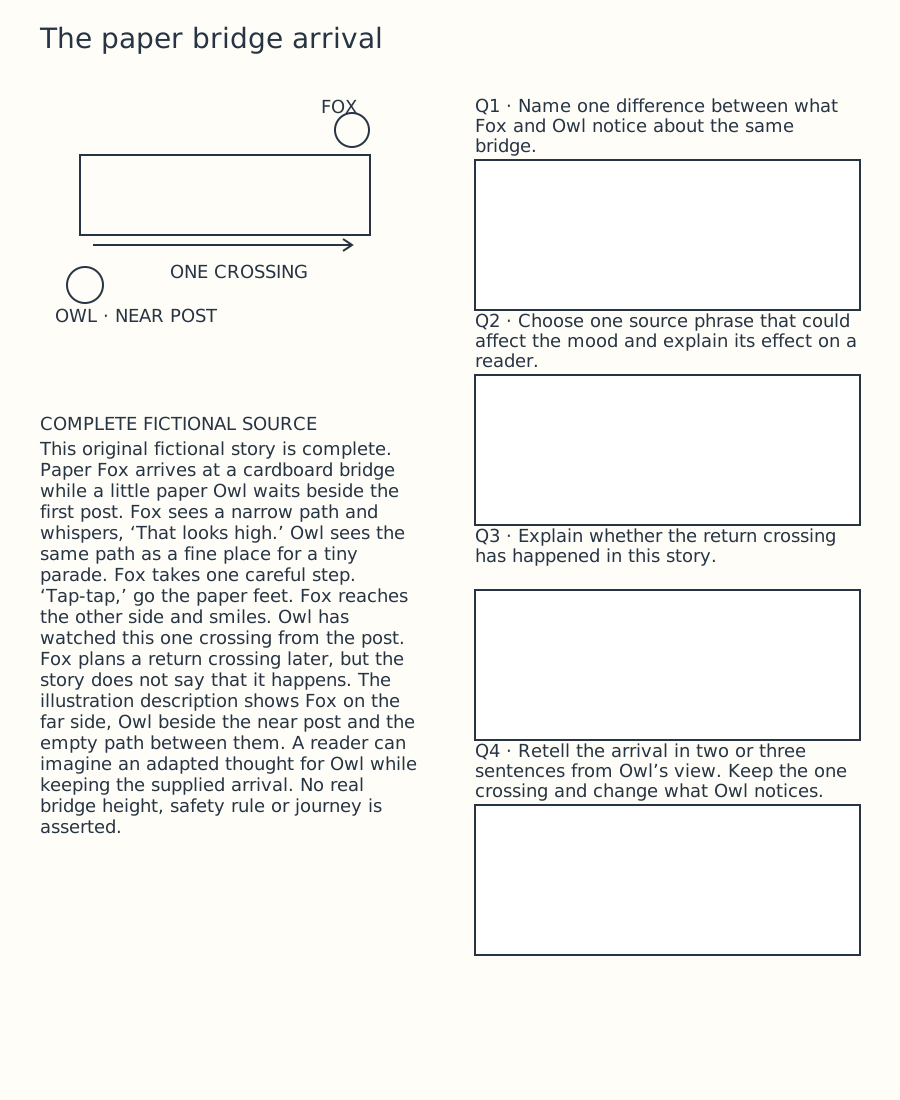
This original fictional story is complete. Paper Fox arrives at a cardboard bridge while a little paper Owl waits beside the first post. Fox sees a narrow path and whispers, ‘That looks high.’ Owl sees the same path as a fine place for a tiny parade. Fox takes one careful step. ‘Tap-tap,’ go the paper feet. Fox reaches the other side and smiles. Owl has watched this one crossing from the post. Fox plans a return crossing later, but the story does not say that it happens. The illustration description shows Fox on the far side, Owl beside the near post and the empty path between them. A reader can imagine an adapted thought for Owl while keeping the supplied arrival. No real bridge height, safety rule or journey is asserted.
B-first-Q1
Invitation
Name one difference between what Fox and Owl notice about the same bridge.
Component criterion
Gives a specific source-supported difference between narrow/high path and parade possibility.
Staff example after an attempt
Fox notices the narrow high-looking path; Owl notices a possible parade place. They do not need to feel the same way.
Judgement limit
Use this component-specific description with the actual response and recorded help. No point total, A–E level, diagnosis, causal gain or independent-exposure claim.
Next teaching
N05 · AC9E3LE02, AC9E3LE03
B-first-Q2
Invitation
Choose one source phrase that could affect the mood and explain its effect on a reader.
Component criterion
Identifies a supplied phrase and gives a plausible supported mood effect; alternatives are accepted.
Staff example after an attempt
‘That looks high’ could make the crossing feel uncertain. ‘Tap-tap’ might make it feel light and playful; the explanation must connect to the chosen words.
Judgement limit
Use this component-specific description with the actual response and recorded help. No point total, A–E level, diagnosis, causal gain or independent-exposure claim.
Next teaching
N06 · AC9E3LE03, AC9E3LE04
B-first-Q3
Invitation
Explain whether the return crossing has happened in this story.
Component criterion
Keeps the supplied completed crossing separate from the open return plan.
Staff example after an attempt
One crossing finishes. The return is only planned; the ending gives no completed return.
Judgement limit
Use this component-specific description with the actual response and recorded help. No point total, A–E level, diagnosis, causal gain or independent-exposure claim.
Next teaching
N07 · AC9E3LY05, AC9E3LA08
B-first-Q4
Invitation
Retell the arrival in two or three sentences from Owl’s view. Keep the one crossing and change what Owl notices.
Component criterion
Preserves the event while making a specific Owl-view noticing; invented thought is understood as adapted fiction.
Staff example after an attempt
‘I watched Fox’s paper feet tap across. The path looked ready for a tiny parade. Fox smiled on the far side.’ keeps the arrival and changes the noticing.
Judgement limit
Use this component-specific description with the actual response and recorded help. No point total, A–E level, diagnosis, causal gain or independent-exposure claim.
Next teaching
N08 · AC9E3LE05, AC9E3LY06
About this resource
Reviewed source editionSource review is complete for this two-week edition. Local suitability and classroom use still need review. Earlier candidate or pending-review words are retained in the original files; full-year coverage, translations and audio are not claimed.
Labels and search exclusions are distribution guidance; they do not authenticate or restrict access.
Exact source: 335608627fe619359a5ab79b7cf66ebfdf290807 · 2026-10-13. Source edition, roles and hashes
Complete source and rights notices
Keep these full notices with copies of this resource. Learning text, software, art and outside sources keep their own terms.