SubjectNest · Year 3 Science · Term 1 · Weeks 09–10 · sequence Days 41–50
V15 · C-first exact source/four-prompt own mat
Whole original plane. For ordinary-size sheets use its matching HTML paper route; do not shrink this tall vector onto one sheet.
Complete text alternative
V15 — C-first exact source/four-prompt own mat. Original proposed aid. Role: Capture owned responses/decline after actual opportunity with exact whole source/prompt identity in every mode.

Complete visible source:
Complete original fictional display-ledge diagram account. Drawn labelled bases M and N use a printed centimetre scale from zero with equal1cm intervals. M spans0–3cm; N spans0–5cm. Those are supplied diagram readings, not dimensions of real rocks or the child’s own ruler measurements. The diagram records no prior prediction. Its display-reader job is to compare these two drawn bases accurately. A separate new plain-paper measuring plan could ask which chosen paper base is longer, use a familiar centimetre ruler with zero aligned and the same base direction, and keep an actual prediction before its own measurement. No new paper result is supplied.

Complete layout and relationships:
Multi-sheet text-first mat: source identity and complete neutral source first; four numbered exact prompts follow in order, each above a generous EMPTY own rectangle. Repeat source identity/honest page order if extra pages required; no unreadably shrunken source. No criterion/model/next lesson or answer-hint connector. Source remains complete and readable as text. Digital native source disclosure initially closed has identical whole neutral source; four own fields genuinely empty. Spoken/signed/AAC/verbatim scribing uses exact prompts one at a time if wanted with read-back confirmation.

Visible labels in reading order:
V15 C-first neutral supplied fiction
Display ledge diagram
Read/hear complete source in place
1. Compare the two supplied drawn base lengths with their unit and a real-object limit.
2. Is a before-measurement prediction supplied here? Explain using the account.
3. Make two matching record rows for M and N with supplied base length and source/unit.
4. With guidance, propose one suitable ruler-reading step for the separate new paper plan and keep its result open.
Own response1 empty
Own response2 empty
Own response3 empty
Own response4 empty
Open/close source keeps words; leaving/reload may lose digital drafts
Paper records stay on paper

Own-work state: All four own areas empty; no staff key/model/criterion in source help or plane; page splitting never truncates source.
No hidden sound, colour-only clue, actual experiment, local observation, reader success or automatic verdict. All visible source relationships are given as text; helper reads verbatim and leaves own areas blank.

Actual generated original plane:
1. Compare the two supplied drawn base lengths with their unit and a real-object limit. — genuinely empty interior
2. Is a before-measurement prediction supplied here? Explain using the account. — genuinely empty interior
3. Make two matching record rows for M and N with supplied base length and source/unit. — genuinely empty interior
4. With guidance, propose one suitable ruler-reading step for the separate new paper plan and keep its result open. — genuinely empty interior

Complete actual visible wording, in reading order:
V15 · C-first exact source/four-prompt own mat
Complete neutral source · four empty own responses
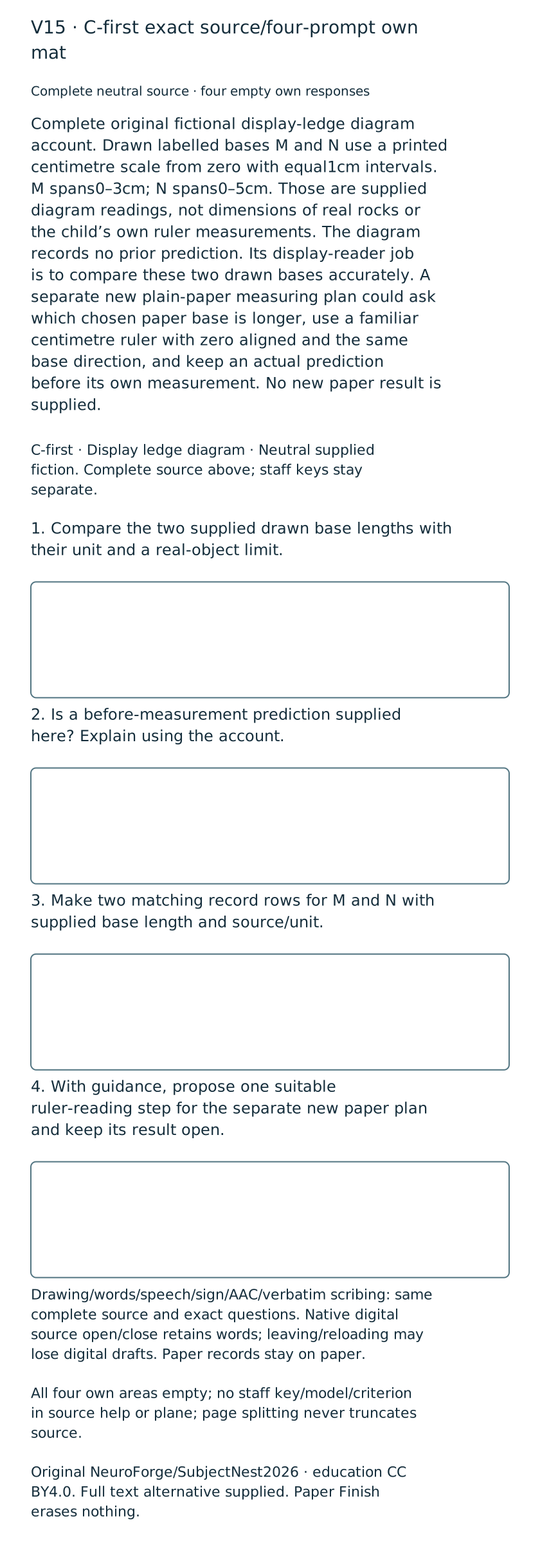
Complete original fictional display-ledge diagram account. Drawn labelled bases M and N use a printed centimetre scale from zero with equal1cm intervals. M spans0–3cm; N spans0–5cm. Those are supplied diagram readings, not dimensions of real rocks or the child’s own ruler measurements. The diagram records no prior prediction. Its display-reader job is to compare these two drawn bases accurately. A separate new plain-paper measuring plan could ask which chosen paper base is longer, use a familiar centimetre ruler with zero aligned and the same base direction, and keep an actual prediction before its own measurement. No new paper result is supplied.
C-first · Display ledge diagram · Neutral supplied fiction. Complete source above; staff keys stay separate.
1. Compare the two supplied drawn base lengths with their unit and a real-object limit.
2. Is a before-measurement prediction supplied here? Explain using the account.
3. Make two matching record rows for M and N with supplied base length and source/unit.
4. With guidance, propose one suitable ruler-reading step for the separate new paper plan and keep its result open.
Drawing/words/speech/sign/AAC/verbatim scribing: same complete source and exact questions. Native digital source open/close retains words; leaving/reloading may lose digital drafts. Paper records stay on paper.
All four own areas empty; no staff key/model/criterion in source help or plane; page splitting never truncates source.
Original NeuroForge/SubjectNest2026 · education CC BY4.0. Full text alternative supplied. Paper Finish erases nothing.
Whole canvas840×2437. This large readable vector can be zoomed. Matching HTML paper pages paginate text and empty responses instead of shrinking the whole vector onto one sheet.