Use this case
Offer the neutral source and four questions after the relevant learning opportunity. Keep staff examples and next teaching on the teacher pages.
Child materials and paper
- B-later · complete neutral source
- B-later · four questions and own response spaces
- B-later · complete source and four empty paper questions
- B-later · matching vector mat (V18)
- B-later · full vector text alternative (V18)
After reviewing the child’s own work
Choose the relevant next lesson. These are supported teaching accounts, separate from the child’s case responses.
Complete neutral source
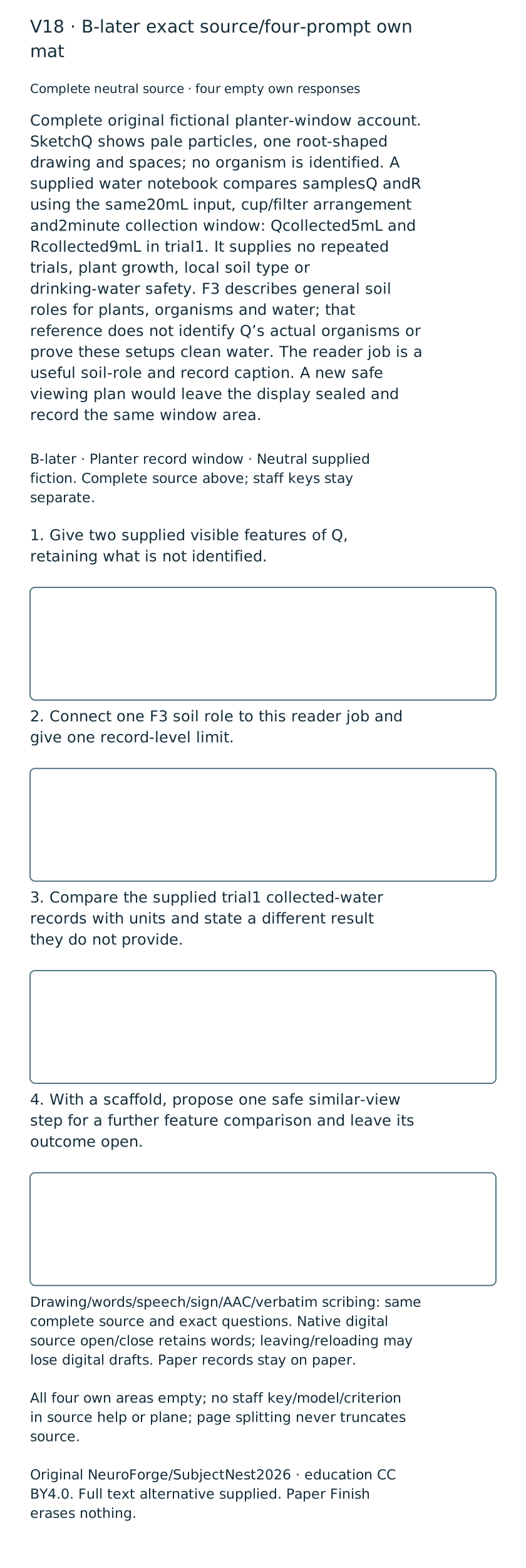
Complete original fictional planter-window account. SketchQ shows pale particles, one root-shaped drawing and spaces; no organism is identified. A supplied water notebook compares samplesQ andR using the same20mL input, cup/filter arrangement and2minute collection window: Qcollected5mL and Rcollected9mL in trial1. It supplies no repeated trials, plant growth, local soil type or drinking-water safety. F3 describes general soil roles for plants, organisms and water; that reference does not identify Q’s actual organisms or prove these setups clean water. The reader job is a useful soil-role and record caption. A new safe viewing plan would leave the display sealed and record the same window area.
Components
Acceptance
Other source-faithful responses in words/drawing/spoken/signed/AAC/exact scribing are legitimate. Apply only this prompt and criterion; no unstated physical action, measured result, word quota or exact model wording. Record actual support and source exposure.
Exact criterion
Two ofpale particles/root-shaped drawing/spaces supplied; no organism identity inferred.
Exact prompt
Give two supplied visible features of Q, retaining what is not identified.
Full unrelated next lesson
Child invitation
Name two bicycle-display view features and leave a concealed detail open.
Four teacher moves
- Read the entire new source with its names, times, conditions and unknowns. Ask one initial meaning question before showing the staff possibility. Let the child ask to hear the whole source again or pass.
- Model selecting visible features with their view/source, rather than filling the closed drawer.
- Read the complete different guided account below. Guide one heading or source location, then pause for the child to make their own distinction. Keep the original worked example separate; no model sentence is inserted into their own work.
- Invite the exact child job below. Record the observable distinction, actual source, mode, support and any unperformed work. Give feedback about one chosen clue, then decide whether another unrelated new opportunity is useful.
Guided different complete source
Different fictional bicycle-display sketch shows a circular wheel outline and an arrow card; its rear panel is concealed. Invite two supplied features without inventing mechanical performance.
Id
N21
Mode limit
These are supported teaching opportunities after component review. Reasoning from a supplied account, a model and actual child conduct are different evidence. A helper operation is attributed; declining, length or format is not an ability diagnosis or grade.
Next decision
If this distinction is still unclear, return to one source-labelled heading pair in this new account and one question. If clear, offer a genuinely fresh ordinary job after further learning. Do not rehearse the held key and call its repetition untouched first/later evidence.
Observable evidence
Child preserves visible-feature versus hidden/identified content distinctions.
Ordinary staff possible model
The box and paper labels are visible supplied features; drawer contents remain unknown.
Teacher preparation
Read the complete new source and different guided account below; prepare large paper headings and a genuinely empty own response area. The accounts are original supplied fiction, not a verified local event. Offer spoken/signed/AAC, pointing with confirmed read-back, drawing or verbatim scribing. No specialised equipment, media recording, purchases or public sharing is needed.
Title
Stationery-window feature note
Whole unrelated source
Fictional stationery-window drawing shows a square box, two paper labels and a closed drawer. No hidden tools or material composition is recorded.
Id
B-later-1
Initial own value
One staff possible response
The sketch supplies pale particles and a root-shaped drawing; it does not identify an organism.
Acceptance
Other source-faithful responses in words/drawing/spoken/signed/AAC/exact scribing are legitimate. Apply only this prompt and criterion; no unstated physical action, measured result, word quota or exact model wording. Record actual support and source exposure.
Exact criterion
AccurateF3role linked tocaption with absent particulargrowth/organism/water-safetyresult; generalrole notsubstitute localtest.
Exact prompt
Connect one F3 soil role to this reader job and give one record-level limit.
Full unrelated next lesson
Child invitation
Give the costume reader a role and a missing actual-fit boundary.
Four teacher moves
- Read the entire new source with its names, times, conditions and unknowns. Ask one initial meaning question before showing the staff possibility. Let the child ask to hear the whole source again or pass.
- Model source role and particular trial limit, avoiding a guaranteed outcome from a general function.
- Read the complete different guided account below. Guide one heading or source location, then pause for the child to make their own distinction. Keep the original worked example separate; no model sentence is inserted into their own work.
- Invite the exact child job below. Record the observable distinction, actual source, mode, support and any unperformed work. Give feedback about one chosen clue, then decide whether another unrelated new opportunity is useful.
Guided different complete source
Different fictional costume guide says pockets can hold tickets. Its paper-pocket drawing has no actual fit record. Ask for a role linked to its reader job and one performance limit.
Id
N22
Mode limit
These are supported teaching opportunities after component review. Reasoning from a supplied account, a model and actual child conduct are different evidence. A helper operation is attributed; declining, length or format is not an ability diagnosis or grade.
Next decision
If this distinction is still unclear, return to one source-labelled heading pair in this new account and one question. If clear, offer a genuinely fresh ordinary job after further learning. Do not rehearse the held key and call its repetition untouched first/later evidence.
Observable evidence
Child connects source-described role to a purpose and retains a particular untested result.
Ordinary staff possible model
The guide supports an information role; the drawing does not prove anyone found the shelf.
Teacher preparation
Read the complete new source and different guided account below; prepare large paper headings and a genuinely empty own response area. The accounts are original supplied fiction, not a verified local event. Offer spoken/signed/AAC, pointing with confirmed read-back, drawing or verbatim scribing. No specialised equipment, media recording, purchases or public sharing is needed.
Title
Information role and missing use
Whole unrelated source
Fictional library guide says labels can carry shelf information. Its particular new label drawing has no reader-use record. The maker wants an accurate display note.
Id
B-later-2
Initial own value
One staff possible response
F3’s water role matters for the caption; this notebook is a particular collected-water record and says nothing about drinking safety.
Acceptance
Other source-faithful responses in words/drawing/spoken/signed/AAC/exact scribing are legitimate. Apply only this prompt and criterion; no unstated physical action, measured result, word quota or exact model wording. Record actual support and source exposure.
Exact criterion
Q5mL/R9mL faithfulcomparison, trial1/setup scope; absentgrowth/safety/generalranking retained.
Exact prompt
Compare the supplied trial1 collected-water records with units and state a different result they do not provide.
Full unrelated next lesson
Child invitation
Compare the rehearsal’s paper-ticket counts without inventing attendance.
Four teacher moves
- Read the entire new source with its names, times, conditions and unknowns. Ask one initial meaning question before showing the staff possibility. Let the child ask to hear the whole source again or pass.
- Model units and record scope, then explicitly separate the different quantity the source did not measure.
- Read the complete different guided account below. Guide one heading or source location, then pause for the child to make their own distinction. Keep the original worked example separate; no model sentence is inserted into their own work.
- Invite the exact child job below. Record the observable distinction, actual source, mode, support and any unperformed work. Give feedback about one chosen clue, then decide whether another unrelated new opportunity is useful.
Guided different complete source
Different fictional rehearsal notebook lists SceneP3paper tickets and SceneQ6paper tickets in plan1. No attendance or enjoyment data exists. Invite the supplied count comparison and a different unsupported outcome.
Id
N23
Mode limit
These are supported teaching opportunities after component review. Reasoning from a supplied account, a model and actual child conduct are different evidence. A helper operation is attributed; declining, length or format is not an ability diagnosis or grade.
Next decision
If this distinction is still unclear, return to one source-labelled heading pair in this new account and one question. If clear, offer a genuinely fresh ordinary job after further learning. Do not rehearse the held key and call its repetition untouched first/later evidence.
Observable evidence
Child compares supplied values with their quantity/unit/scope and keeps a different outcome unsupported.
Ordinary staff possible model
B has3more drawn cups in this record; it does not show food quantity or taste.
Teacher preparation
Read the complete new source and different guided account below; prepare large paper headings and a genuinely empty own response area. The accounts are original supplied fiction, not a verified local event. Offer spoken/signed/AAC, pointing with confirmed read-back, drawing or verbatim scribing. No specialised equipment, media recording, purchases or public sharing is needed.
Title
Cooking-display count comparison
Whole unrelated source
Fictional cooking-display notebook lists TrayA2drawn cups and TrayB5drawn cups in display1. No actual food amount, taste or kitchen performance is recorded.
Id
B-later-3
Initial own value
One staff possible response
Rcollected4mL more than Q in supplied trial1; it does not provide plant growth or safe-drinking-water results.
Acceptance
Other source-faithful responses in words/drawing/spoken/signed/AAC/exact scribing are legitimate. Apply only this prompt and criterion; no unstated physical action, measured result, word quota or exact model wording. Record actual support and source exposure.
Exact criterion
Relevantsealedview/samewindowrecordprocedure or matching condition; planonly/newresultopen.
Exact prompt
With a scaffold, propose one safe similar-view step for a further feature comparison and leave its outcome open.
Full unrelated next lesson
Child invitation
Plan a toy-map comparison without claiming a result.
Four teacher moves
- Read the entire new source with its names, times, conditions and unknowns. Ask one initial meaning question before showing the staff possibility. Let the child ask to hear the whole source again or pass.
- Use a Question/Step/Similar-view/Open-result scaffold. Model one meaningful match and no invented conclusion.
- Read the complete different guided account below. Guide one heading or source location, then pause for the child to make their own distinction. Keep the original worked example separate; no model sentence is inserted into their own work.
- Invite the exact child job below. Record the observable distinction, actual source, mode, support and any unperformed work. Give feedback about one chosen clue, then decide whether another unrelated new opportunity is useful.
Guided different complete source
Different fictional toy-map plan asks about arrow placement while keeping the same map/view area. No reader trial is supplied. Invite one safe paper-view step and matching factor with its new outcome open.
Id
N24
Mode limit
These are supported teaching opportunities after component review. Reasoning from a supplied account, a model and actual child conduct are different evidence. A helper operation is attributed; declining, length or format is not an ability diagnosis or grade.
Next decision
If this distinction is still unclear, return to one source-labelled heading pair in this new account and one question. If clear, offer a genuinely fresh ordinary job after further learning. Do not rehearse the held key and call its repetition untouched first/later evidence.
Observable evidence
Child gives a relevant safe similarity/view plan and retains actual conduct/result gaps.
Ordinary staff possible model
Review the same page area after the planned border change; no reader result yet.
Teacher preparation
Read the complete new source and different guided account below; prepare large paper headings and a genuinely empty own response area. The accounts are original supplied fiction, not a verified local event. Offer spoken/signed/AAC, pointing with confirmed read-back, drawing or verbatim scribing. No specialised equipment, media recording, purchases or public sharing is needed.
Title
Art-plan same-view comparison
Whole unrelated source
Fictional art-display plan asks how a border change affects a reader’s picture view. Paper layouts are available but no reader observation exists. The safe plan keeps the page/view spot similar.
Id
B-later-4
Initial own value
One staff possible response
Keep Qsealed, record the same view window again and leave new feature results empty until observed.
Eligibility
Offer only after relevant actual teaching opportunity; first capture/decline precedes its corresponding later source and all staff keys. Record source familiarity, earlier answer exposure, child/adult operations, wording help, mode, actual versus supplied/model evidence and time/order. Coached reuse is teaching, not untouched evidence.
Exact four prompts
- Give two supplied visible features of Q, retaining what is not identified.
- Connect one F3 soil role to this reader job and give one record-level limit.
- Compare the supplied trial1 collected-water records with units and state a different result they do not provide.
- With a scaffold, propose one safe similar-view step for a further feature comparison and leave its outcome open.
Id
B-later
Learner door
Native initially closed same-page complete neutral source disclosure, four exact matching prompts and genuinely empty own spaces. Open/close retains drafts without JS. External full-source reference remains optional; leave/reload may discard memory-only words. Exact paper mat repeats the source identity, whole source and four empty prompts; no criteria/models/next teaching in help.
Own values
Source kind
Original supplied fiction; provider knowledge is separately attributed. No actual child/local trial or reader success supplied.
Title
Planter record window