Make a paper water trail
Choose a water place. Give the next arrow a job. Make a trail that helps someone understand your question. This is a model. It does not forecast the weather.
An ordinary sheet and a pencil are enough. Write, draw, point, sign, dictate or ask a helper to move cards at your direction. You can pause, switch route or return later. No screen, printer, cutting, purchase or water handling is required.
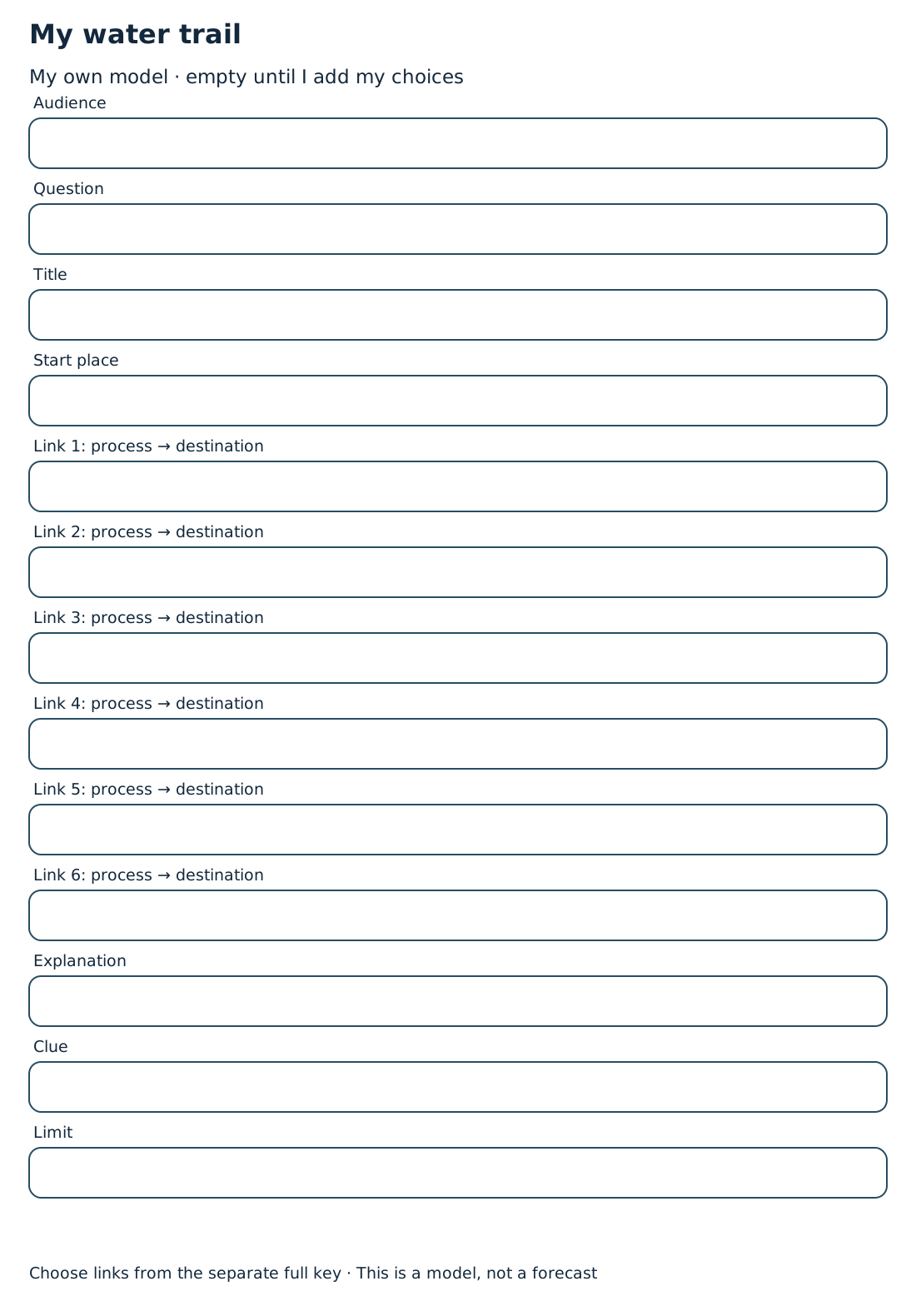
My nine choices — start empty
Audience: ______
Question: ______
Start water place: ______
Process: ______
Destination: ______
Explanation for this link: ______
Clue: ______
Limit: ______
Title: ______
Full selected link key
- ocean liquid → evaporation → vapour in air
- lake liquid → evaporation → vapour in air
- river liquid → evaporation → vapour in air
- surface liquid on land → evaporation → vapour in air
- vapour in air → condensation → cloud droplets
- vapour in air → condensation → liquid drops on a cool surface
- cloud droplets → precipitation → ocean liquid
- cloud droplets → precipitation → surface liquid on land
- surface liquid on land → runoff → river liquid
- river liquid → flow to sea → ocean liquid
- surface liquid on land → infiltration → water in soil
These are selected possible links, not every hydrological path. “Water in soil” and “liquid drops on a cool surface” are stopping places here: our small model stops; water can take other paths. Flow/runoff/infiltration move liquid; evaporation changes liquid to invisible vapour; condensation forms droplets; precipitation falls from clouds. Clouds can also include ice.
Make and inspect
- Choose one start place. Choose a process and destination from the full key; no choice is prefilled.
- Write, draw or direct that exact link. If wanted, add your own explanation. Leave optional words empty if you have not entered them.
- The next link begins at the last destination. Add up to six links. A three-process path needs three links; one relevant link can answer a smaller question.
- Keep the first trail with its title. Make a comparison from any chosen existing node or another named water place. Put both complete trails beside each other. Say which change matters to your question.
- Finish by reading the exact audience/question/title, both full paths and your actual explanations/clue/limit. Mark missing optional words “not entered”; do not insert a model answer. This is a guide, not a grade or an observation.
Back means revisit your choices, keeping work. Undo crosses out only the last current link; the earlier end becomes the next start. Keep your other trail. Swap exchanges the two whole trails and their nine field words; if there is only a kept trail, restore it without inventing a second. To clear, first ask whether to keep the work: Keep or Escape-equivalent stop preserves it, while Clear starts an agreed fresh sheet and discards/crosses out the old work.
A supplied opt-in example is ocean liquid → evaporation → vapour in air → condensation → cloud droplets → precipitation → surface liquid on land. Label it example model, not your observation. It contains no pupil explanation. Do not replace existing work silently.
Copy or print the digital work you want before leaving. Leaving, returning or reloading the digital tool starts empty; paper does not automatically erase when set aside. The paper/digital routes share the same selected links and reasoning, not an identical physical storage behaviour.
My blank trail sheet · Complete sheet words · Digital Water Trail
Grown-up help
A helper reads neutrally and records the child's actual selections/words. Source interpretation, directed paper work and observed practical conduct remain different; this model cannot establish formal instrument use, a real drop's journey, weather or attainment. Usual communication and no-object routes preserve the explanation purpose, not an unperformed physical observation.
Full preparation · Sources and reuse. Modified from Year 4 Science alignment, standard elaborations and Years 3–4 conditions, © State of Queensland (QCAA) 2023, covered CC BY 4.0 with exceptions; original model/task words remain ours.