Day 31 · Find a water place
Start: “Pick a water place. What tells you water is there?”
Purpose: Name a store/source of water and distinguish a place from a process.
Prepare
Read today's complete model and two contexts before the session. Paper, a pencil and the full written picture words are sufficient. Optional actual water work follows ordinary preparation; the teacher chooses suitable familiar materials/instruments. Use today's three routes without assigning a fixed learning-style label.
Run the session
- Reconnect: offer a drawn pond, cloud, ocean and tap. Ask for one choice; accept pointing or the usual communication aid.
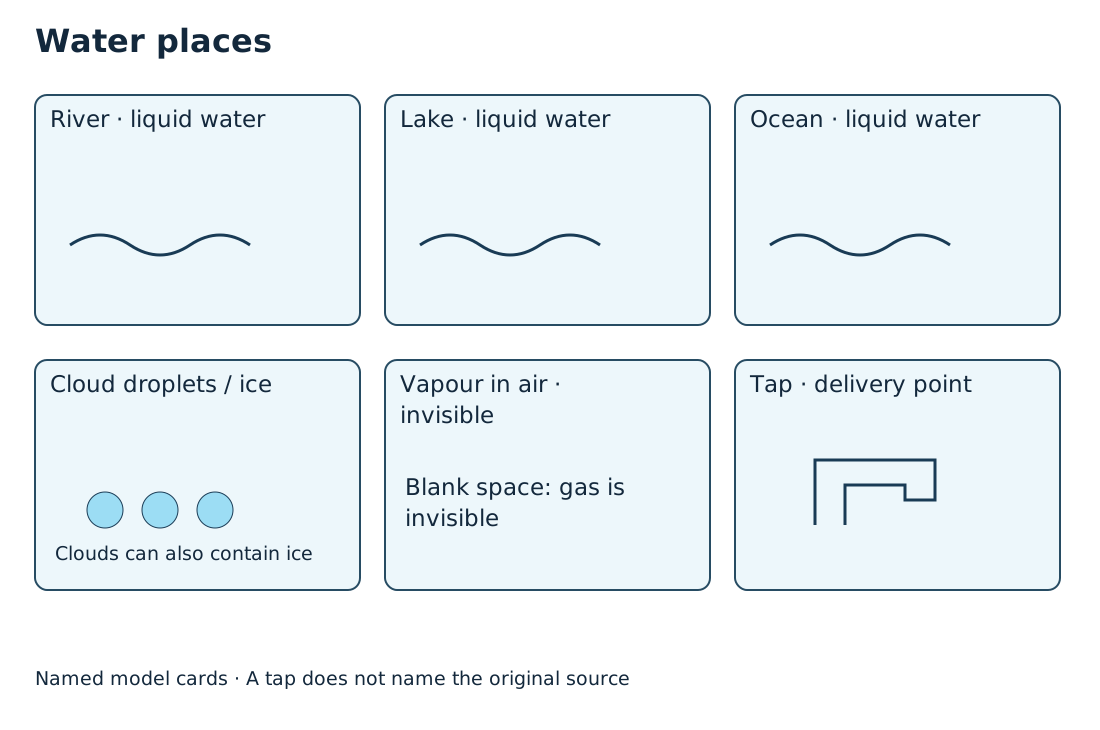
- Model: name liquid water in a pond, ocean water and tiny water droplets in a cloud. A tap is a delivery point; it does not name the original source. Introduce “water place” before the adult term store.
- Try: children sort six cards: river, ocean, lake, cloud droplets, water vapour in air, water flowing from a tap. Choose two places and add a supplied or actually seen clue. Do not infer that every cloud contains only liquid.
- Compare: show “ocean” beside “evaporation”. One names a place, the other a change. Ask what is missing from “the tap is where all water begins”. Model “I would need the supply source”.
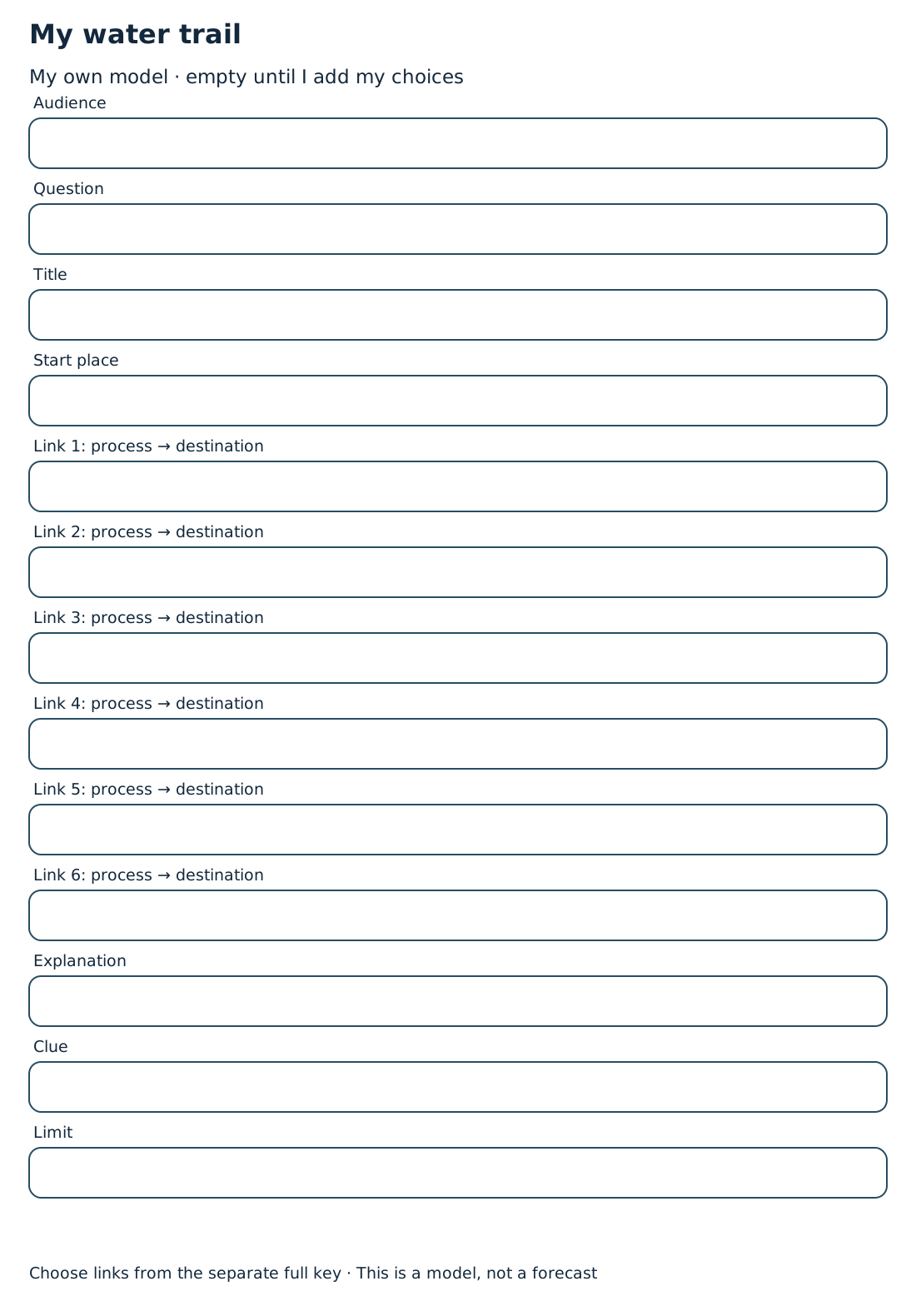
- Make: draw/point to two places connected by an unlabelled arrow. Say the arrow still needs a job; save this draft for Day 34.
- Exit: “One water place is __. My clue is __.” Record source-card use versus an actual observation separately.
Three ways in
Water-place detective
Use six written/pictured place cards on a desk; select two and match each to a supplied clue. A helper can read every card.
Worked ordinary reasoning: River: flowing liquid water is shown. Cloud: tiny droplets are shown; it is not invisible vapour.
Map-maker
Draw a made-up landscape with sea, pond and cloud; label two water places. No real location, drawing skill or map symbols are presumed.
Worked ordinary reasoning: The pond and ocean are liquid-water places in this model.
Small spoken trail
Choose from spoken river/ocean/air options; dictate or point to two labels and one clue while a helper records the intended explanation.
Worked ordinary reasoning: Water can be in the ocean and as invisible vapour in air; this is supplied information.
Look and choose the next teaching
A named place plus a relevant clue, with tap delivery separated from an original natural source.
If the child calls a change a place, rehearse ocean / evaporation with different named cards before Day 32.
Today's complete resources
A01 · whole labelled picture · A01 · complete picture words
A05 · whole labelled picture · A05 · complete picture words
Short child start · Written read-aloud · Water Trail and paper
Partial opportunities: AC9S4U02, AC9S4I01 · Full mapping and limits
Grown-up help
Allow source access and neutral reading/support. Keep supplied story, child response, helper actions and actual observation distinct. Use component-specific criteria after the response, not a model answer before it. Suggested six-move timing 4/7/12/8/6/3 minutes may be split; there is no performance timer.
Modified from Year 4 Science alignment, standard elaborations and Years 3–4 techniques and conditions, © State of Queensland (QCAA) 2023, covered CC BY 4.0 with exceptions. Our task criteria are original; these are not official A–E bands. Actual folio and on-balance professional judgment remain necessary.