Day 38 · Follow a public water-supply clue
Start: “Where does this town's supply story begin?”
Purpose: Use a dated public source for a bounded local example and separate natural cycle from human water supply.
Prepare
Read today's complete model and two contexts before the session. Paper, a pencil and the full written picture words are sufficient. Optional actual water work follows ordinary preparation; the teacher chooses suitable familiar materials/instruments. Use today's three routes without assigning a fixed learning-style label.
Run the session
- Reconnect: a tap delivers water; it does not identify the original source by itself.
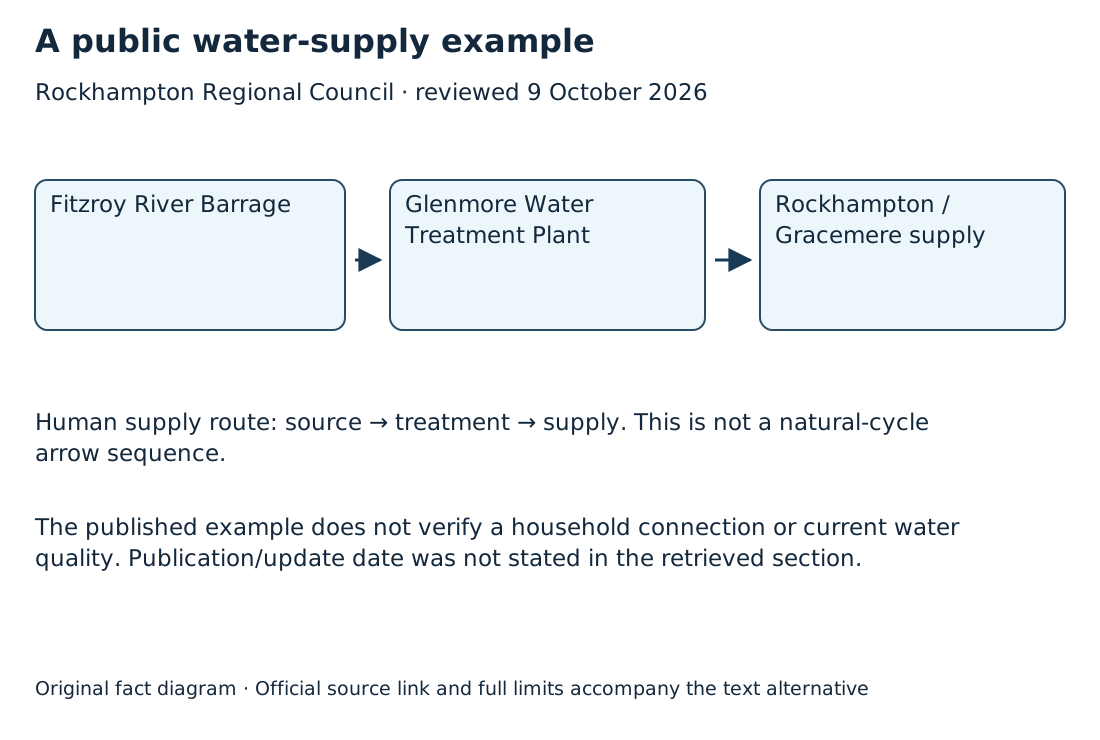
- Model: read F5 with its Council URL and 9 October 2026 review date. Build Barrage → Glenmore Water Treatment Plant → Rockhampton/Gracemere supply. This is the stated public system example, not a verified household connection.
- Try: children label a human supply route beside a natural-cycle model. Treatment is a human process; the source here does not teach detailed treatment chemistry or verify current water quality.
- Compare: replace the named places with a made-up town. Ask which facts would need a new publisher/source before calling the result real. A review date is not a page publication date.
- Make: a visitor card states one useful named fact, the responsible publisher/date reviewed and one limit. Adult source help carries the full links/rights and local replacement procedure.
- Exit: “This source tells us __. It does not tell us __.” No addresses, household survey or outdoor trip is requested.
Three ways in
Public-route mapper
Arrange the three named source cards with supply-route arrows; compare to the process-labelled natural model.
Worked ordinary reasoning: The Council names the Barrage, Glenmore plant and Rockhampton/Gracemere service; these supply arrows are not evaporation or precipitation.
Visitor caption
Write, dictate, sign or type a two-line public information caption and a limit; a helper can read the Council fact aloud.
Worked ordinary reasoning: A Council example names Glenmore's Barrage source. It does not prove my home's current connection or water quality.
Source checker
Use a complete adult-approved broad public source card from another locality, or the supplied F5 card; separate stated/reviewed/unknown dates.
Worked ordinary reasoning: I name the publisher and reviewed date; if no publication date is stated I keep “not stated”.
Look and choose the next teaching
Named bounded fact, sensible source/date distinction and no unsupported household/Queensland-wide claim.
If supply and natural arrows are mixed, rebuild one of each with their exact named jobs.
Today's complete resources
A13 · whole labelled picture · A13 · complete picture words
Short child start · Written read-aloud · Water Trail and paper
Partial opportunities: AC9S4U02, AC9S4H02, AC9S4I06 · Full mapping and limits
Grown-up help
Allow source access and neutral reading/support. Keep supplied story, child response, helper actions and actual observation distinct. Use component-specific criteria after the response, not a model answer before it. Suggested six-move timing 4/7/12/8/6/3 minutes may be split; there is no performance timer.
Modified from Year 4 Science alignment, standard elaborations and Years 3–4 techniques and conditions, © State of Queensland (QCAA) 2023, covered CC BY 4.0 with exceptions. Our task criteria are original; these are not official A–E bands. Actual folio and on-balance professional judgment remain necessary.