Original SubjectNest draft · educator and accessibility review pending. Copy or enlarge these tools. They also work in plain text or with actual objects. Cut only with adult help. A tactile version needs raised borders and removable objects; printing this page does not make it tactile. Original content: © NeuroForgeIO Pty Ltd 2026, CC BY 4.0; credit and separate ACARA terms are in README.md.
For a ready-to-print number path and two comparison mats, use the original A4 vector page or its PNG preview. The plain-text version below provides the same labels and frame structure without depending on an image.
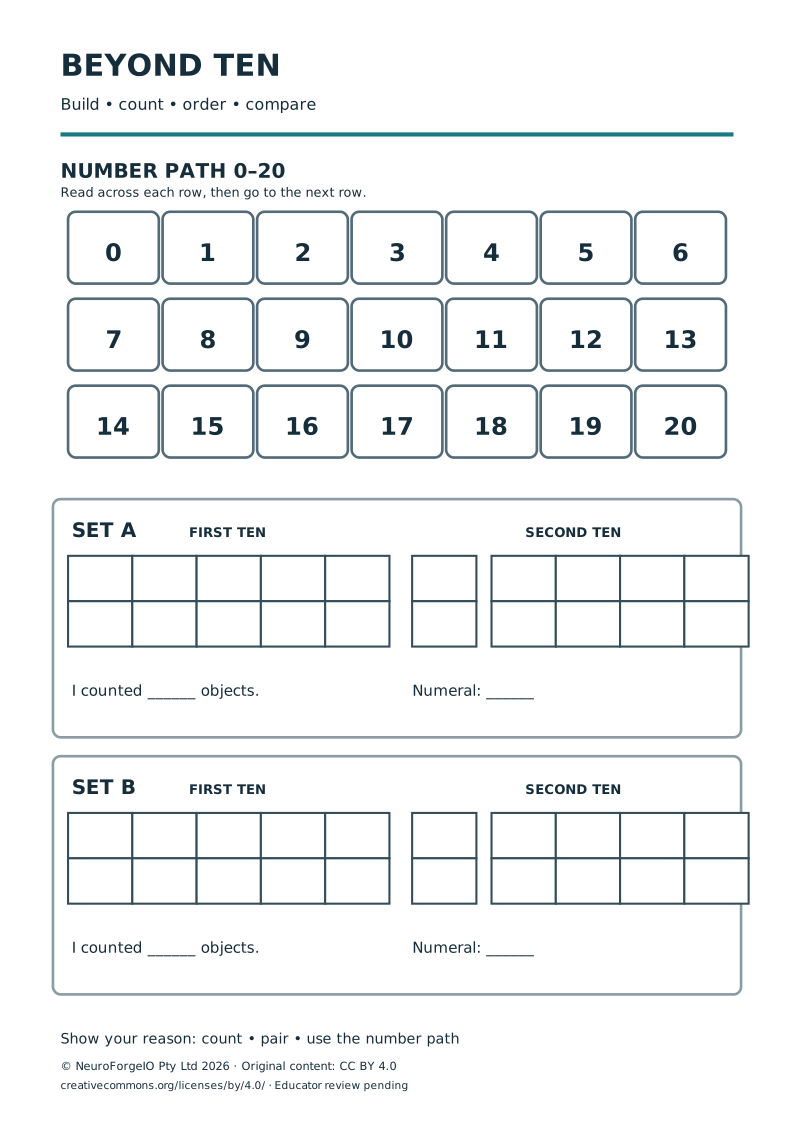
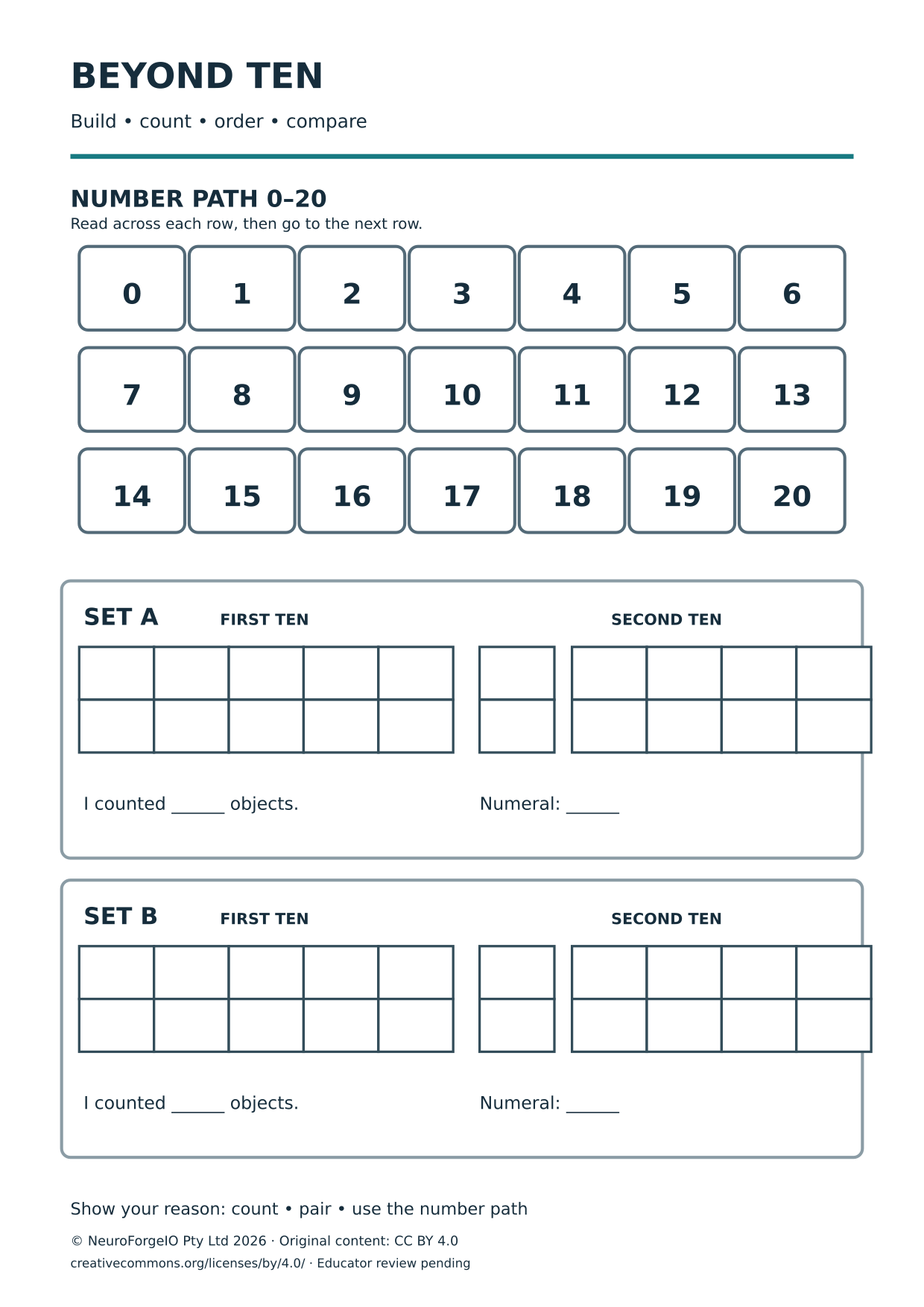
Two ten-frames per collection
Mark two separate sets A and B when comparing. Each set gets the two frames below. Fill each frame left to right, top row then bottom row. Place one object in each box. Ten in the first frame and four in the second shows fourteen. Count all fourteen once to check.
SET: ________       FIRST TEN                    SECOND TEN
                +---+---+---+---+---+        +---+---+---+---+---+
                |   |   |   |   |   |        |   |   |   |   |   |
                +---+---+---+---+---+        +---+---+---+---+---+
                |   |   |   |   |   |        |   |   |   |   |   |
                +---+---+---+---+---+        +---+---+---+---+---+
COUNTED TOTAL: ________             NUMERAL CARD: ________
Number path and cut-apart numerals
Print a second copy if cards need cutting. Keep 10–20 together as whole numeral labels; never cut their digits apart. For touch access, add an agreed raised mark or use the learner’s existing tactile numeral system.
 0  |  1  |  2  |  3  |  4  |  5  |  6  |  7  |  8  |  9  | 10
11  | 12  | 13  | 14  | 15  | 16  | 17  | 18  | 19  | 20
For a continuous path, copy the labels onto one strip in this order:
0 — 1 — 2 — 3 — 4 — 5 — 6 — 7 — 8 — 9 — 10 — 11 — 12 — 13 — 14 — 15 — 16 — 17 — 18 — 19 — 20
Two-set comparison strip
SCENE: ___________________________________  DATE: __________
A: I counted ______ objects.   B: I counted ______ objects.
I can show A and B with objects / frames / marks / a partner moving objects.
Circle or indicate: A has MORE / FEWER / THE SAME number as B.
I know because: ____________________________________________________
Did spreading or changing the objects change the number? _____________
Original scene switches
Use these as pretend counts with reusable counters, drawings or accessible objects. They deliberately span familiar and less familiar domains; invite a child’s own safe context without assuming their family owns or visits anything listed. The number is the target count, not a factual claim about the world. For each comparison, model two separate sets before giving the child a fresh pair.
| Card | Scene and teacher prompt | Correct total or relation |
|---|---|---|
| 1 | Library: “Show 11 books ready for a pretend return trolley.” | 11 |
| 2 | Garden: “Show 12 seed markers in two planting trays.” | 12 |
| 3 | Bus stop: “Show 13 paper passengers waiting.” | 13 |
| 4 | Makerspace: “Show 14 reusable parts for a model.” | 14 |
| 5 | Sports shed: “Show 15 cones to pack away.” | 15 |
| 6 | Art gallery: “Show 16 picture labels on two boards.” | 16 |
| 7 | Theatre: “Show 17 pretend tickets on two rows.” | 17 |
| 8 | Museum: “Show 18 object labels for two display cases.” | 18 |
| 9 | Bike repair: “Show 19 small paper job cards.” | 19 |
| 10 | Playground: “Show 20 chalk spots in two groups of ten.” | 20 |
| 11 | Animal shelter: “Make 12 blanket cards and 14 bowl cards. Which set has more?” | bowls, 14 > 12 |
| 12 | Parcel desk: “Make 15 large parcel cards and 13 small parcel cards. Which set has fewer?” | small, 13 < 15 |
| 13 | Music room: “Make 16 drum cards and 16 shaker cards. Are the counts the same?” | same, 16 = 16 |
| 14 | Weather station: “Make 18 cloud marks and 17 sun marks. Which has more?” | clouds, 18 > 17 |
| 15 | Community garden: “Make 19 plant labels and 20 pot labels. Which has fewer?” | plant labels, 19 < 20 |
| 16 | Swimming centre: “Make 11 kickboard cards and 15 float cards. Which has more?” | floats, 15 > 11 |
| 17 | Repair café: “Make 14 screw cards and 14 washer cards. Are the counts the same?” | same, 14 = 14 |
| 18 | Cinema: “Make 17 seat cards and 19 ticket cards. Which has fewer?” | seats, 17 < 19 |
| 19 | Beach care: “Make 13 safe picture cards and 12 sorting cards. Which has more?” | pictures, 13 > 12 |
| 20 | Observatory: “Make 20 star cards and 18 telescope cards. Which has more?” | stars, 20 > 18 |
| 21 | Train depot: “Make 12 carriage cards and 12 platform cards. Are the counts the same?” | same, 12 = 12 |
| 22 | Health clinic supplies: “Make 15 bandage cards and 16 box cards. Which has fewer?” | bandages, 15 < 16 |
| 23 | Recycling centre: “Make 18 paper cards and 20 container cards. Which has more?” | containers, 20 > 18 |
| 24 | Space mission: “Make 19 equipment cards and 17 map cards. Which has more?” | equipment, 19 > 17 |
Answer check: For a comparison, the child can prove the relation by counting both sets, pointing to their order on the number path, or pairing objects and identifying leftovers. Do not teach that a longer row or a physically bigger object means more. The same-count cards are 13, 17 and 21. Card numbers label prompts; they are not part of the child’s number task.