Original SubjectNest draft · educator and accessibility review pending. © NeuroForgeIO Pty Ltd 2026, CC BY 4.0. Print, cut or read these cards aloud. The A4 visual mat and PNG preview contain the same labelled spaces. Give children the prompt side only; the answer key stays with the teacher. Every scene uses pretend indivisible counters, even if its real object could behave differently. Swap a scene that is unfamiliar or uncomfortable without changing its numbers and rule.
Copyable tools
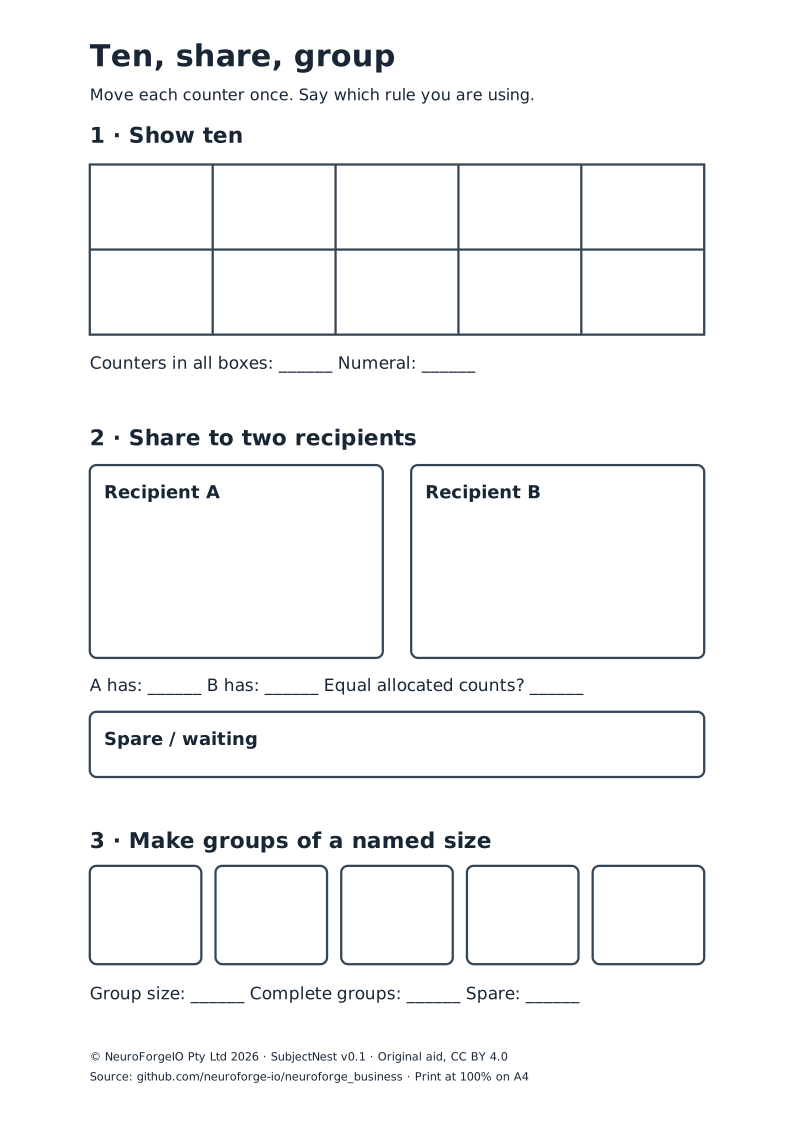
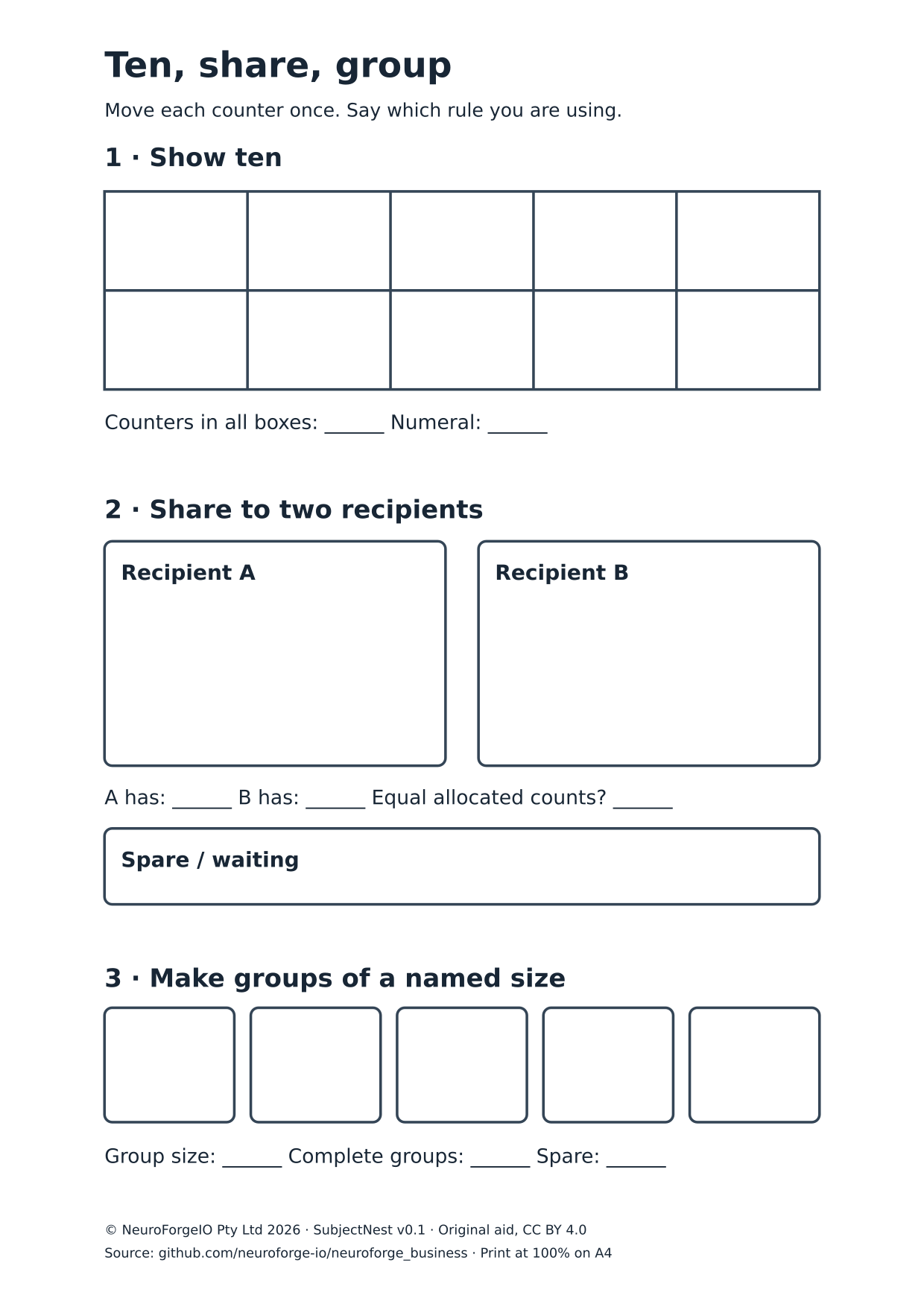
TEN-FRAME: fill from left to right, top row first. Each box holds one counter.
  [ ][ ][ ][ ][ ]
  [ ][ ][ ][ ][ ]
Numeral: ____   I counted ____ objects.

PARTS OF THE SAME TEN: move each of the ten counters to ONE part only.
  Whole: [ ten counters ]
  Part A: [          ]     Part B: [          ]
  A has ____; B has ____; together ____.

SHARE: name the recipients first. Move each counter once.
  Recipient A [          ]     Recipient B [          ]
  Spare       [          ]
  A has ____; B has ____; spare ____.

GROUP: name the group size first. Make equal groups until none or a spare remains.
  Group size: ____    Groups made: ____    Spare: ____
  [          ] [          ] [          ] [          ] [          ]
For a tactile version, draw or tape raised borders and use large grippable counters. For a verbal route, read the exact rule, let the child direct one move at a time, and repeat the final count for checking. For a screen reader, the text above gives the reading order; the SVG is a visual aid, not the sole instruction. Allow the child to dictate or point to a numeral. Pre-cut mats for learners who do not use scissors.
Ten in familiar and unfamiliar places: T cards
For each card, set out ten counters, then choose a second representation. The named domains are story prompts, not facts about a child's family, culture or access to services.
| ID | Child-facing prompt | Teacher key / useful follow-up |
|---|---|---|
| T01 | A library trolley has ten return slips. Show ten on a frame. | Full frame; five on each row. |
| T02 | An art table sorts ten paper shapes into six circles and four squares. Show the same ten in two parts. | 6 + 4 = 10; no duplicated piece. |
| T03 | A garden team has ten plant labels. Draw one mark for each label. | Ten marks and ten objects correspond one-to-one. |
| T04 | A music stand has ten beat counters. Make two equal groups. | 5 and 5; together ten. |
| T05 | A bike-repair picture needs ten wheel stickers. Show seven first and then the rest. | 7 and 3. |
| T06 | A theatre desk has ten seat markers. Make eight in one row and the rest in another. | 8 and 2. |
| T07 | A recycling station has ten lid tokens. Show nine and the rest. | 9 and 1. |
| T08 | An animal-care game has ten shelter tags. Put all in one part and none in the other. | 10 and 0; still ten. |
| T09 | A map game needs ten route dots. Make four dots first, then complete ten. | Four plus six more. |
| T10 | A parcel desk has ten label cards. Move them from a loose pile into a frame. | Final count ten despite new arrangement. |
| T11 | A science table has ten safe plastic tiles. Show five on one frame row and five on the next. | Two fives; numeral 10. |
| T12 | A sports kit has ten cone pictures. Make three in one part and the rest in another. | 3 and 7. |
Share or group: S cards
Tell the child which rule is in force. Share to a named number of mats: place one object on each mat in turns until a full fair round is impossible. Make groups of a named size: fill one group to the named size, then start another. A spare counter may stay aside. When the child proposes a different fair real-life arrangement, acknowledge it and return to the stated counter rule for this check.
| ID | Child-facing prompt | Rule and teacher key |
|---|---|---|
| S01 | Six paintbrush counters for two art tables. Share equally. | Share to 2: 3 each, 0 spare. |
| S02 | Eight map counters for two walking teams. Share equally. | Share to 2: 4 each, 0 spare. |
| S03 | Seven museum-label counters for two display boards. Share equally. | Share to 2: 3 each, 1 spare. |
| S04 | Nine beanbag counters packed in bags of three. Make groups. | Group size 3: 3 groups, 0 spare. |
| S05 | Ten clip counters packed in pairs. Make groups. | Group size 2: 5 groups, 0 spare. |
| S06 | Ten ticket counters for two class game stations. Share equally. | Share to 2: 5 each, 0 spare. |
| S07 | Eight flag counters packed in sets of four. Make groups. | Group size 4: 2 groups, 0 spare. |
| S08 | Five tool counters for two work benches. Share equally. | Share to 2: 2 each, 1 spare. |
| S09 | Six wheel tokens packed in pairs at a repair game. Make groups. | Group size 2: 3 groups, 0 spare. |
| S10 | Nine sign counters for three information desks. Share equally. | Share to 3: 3 each, 0 spare. |
| S11 | Ten washer counters packed in sets of five. Make groups. | Group size 5: 2 groups, 0 spare. |
| S12 | Ten star counters for two night-sky boards. Share equally. | Share to 2: 5 each, 0 spare. |
Teacher card strips for fresh checks
Cut each line, fold away the key, and use the prompt with a new arrangement of counters. A child may instead hear the same words and use tactile pieces.
T-check: Ten marker counters. Fill a five-by-two frame; show a second way. | 10; any equivalent second way with exactly ten.
P-check: Ten tile counters. Show 6 in A; how many in B?       | 4 in B; same ten used once.
S-check: Seven tag counters. Share to two labelled mats.       | 3, 3, 1 spare.
G-check: Nine bead counters. Make groups of three.             | 3 groups of 3; 0 spare.
Keep the teacher's exact prompt and count with the observation; do not compare a modified card with the fixed key. No photographic evidence or home materials are required.