Original SubjectNest draft · educator and accessibility review pending. © NeuroForgeIO Pty Ltd 2026, CC BY 4.0. Use the child prompt table alone and keep teacher keys private during a fresh check. Print the part-whole page or PNG and the capacity decision page or PNG as needed. No item here is a record of a real child, container test or nature observation.
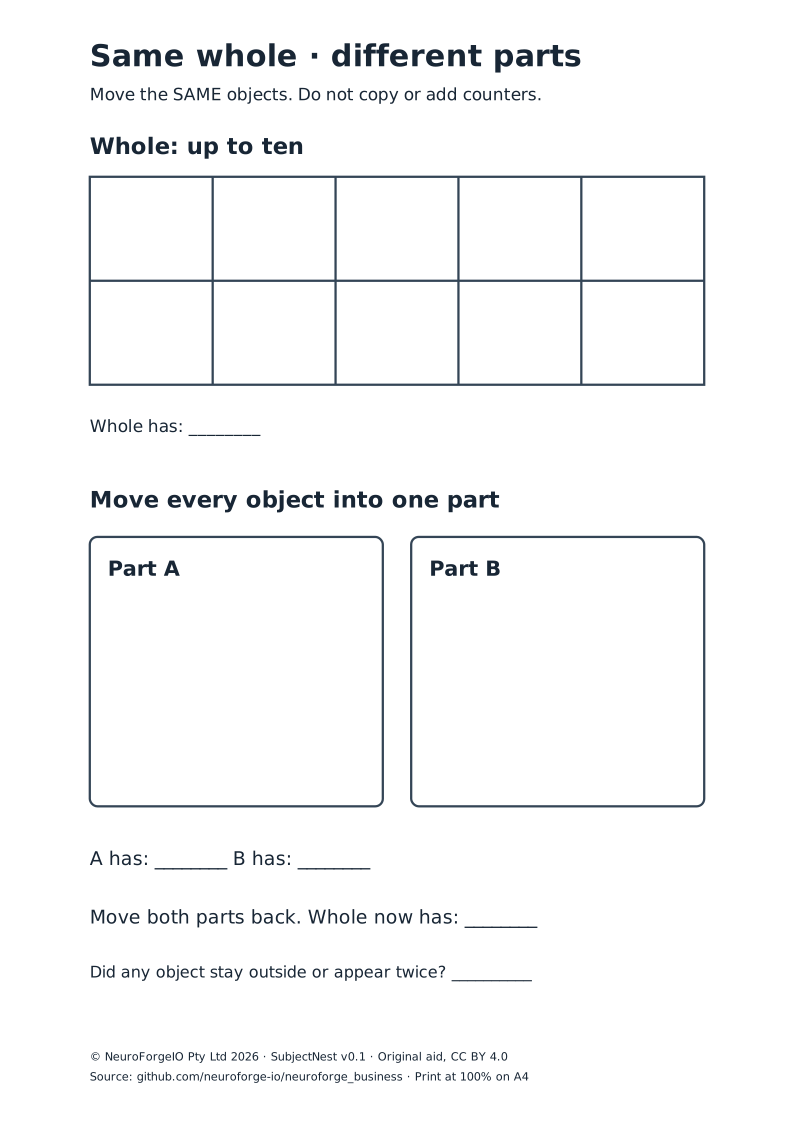
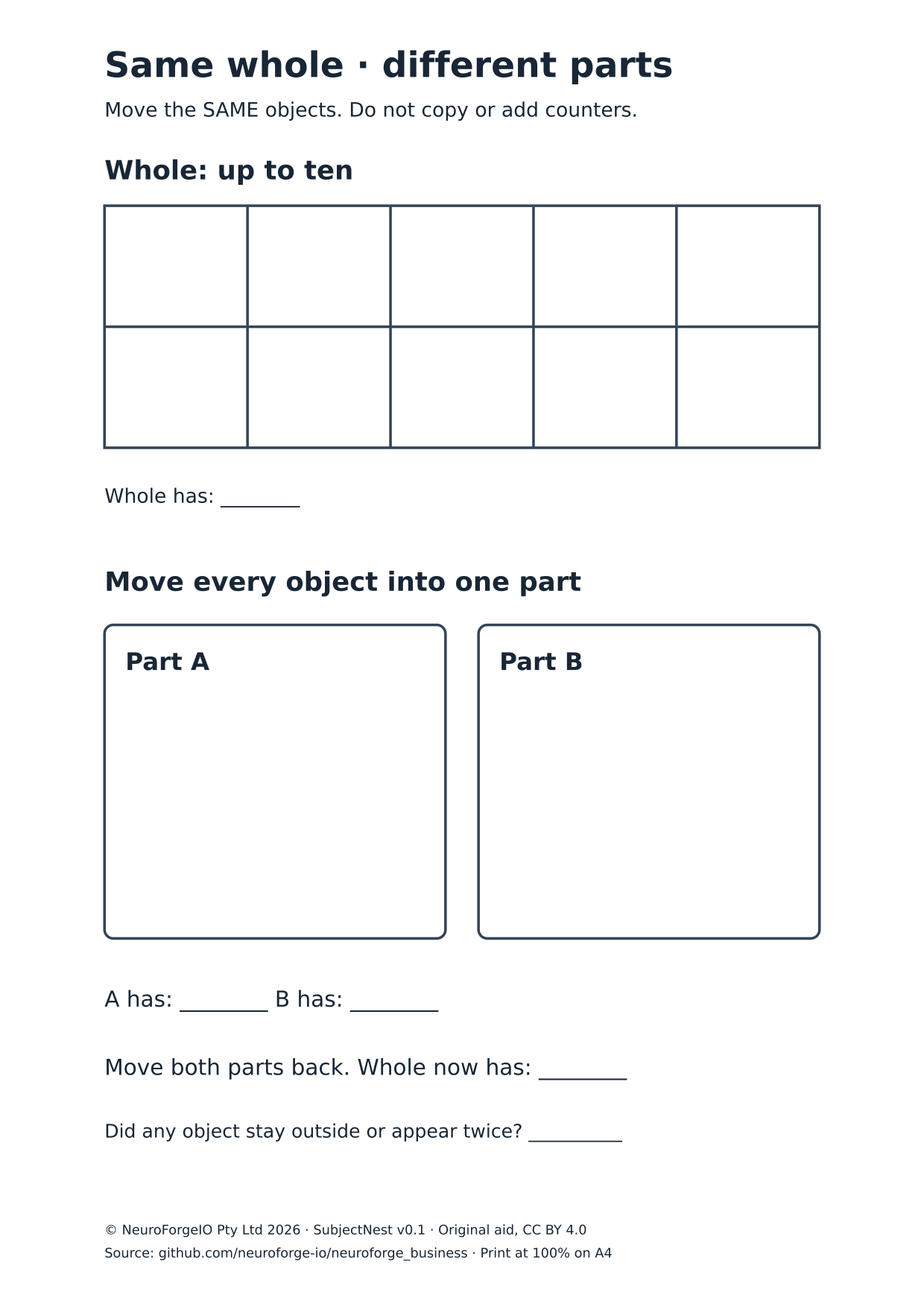
Plain-text part mat
Move the SAME objects. Do not add new ones.
WHOLE [                                   ]
PART A [                 ]   PART B [                 ]
A has ____ . B has ____ . Whole has ____ .
Move both parts back to WHOLE to check.
For a tactile version, put raised borders around three spaces; use large grippable counters. For an AAC/partner route, the child directs each move and selects a numeral or word. A teacher may show a small group of up to five at once for accessible visual subitising; if the learner uses touch/counting instead, record that actual route without labelling it a deficit.
P cards: child-facing part-whole prompts
Every story is fictional; all materials are reusable classroom counters. The whole is never more than ten.
| ID | Prompt to read or cut out |
|---|---|
| P01 | Eight music beat counters are one whole. Put three in A; how many go in B? |
| P02 | Nine tool-label counters are one whole. Put four in A; how many go in B? |
| P03 | Ten library return counters are one whole. Put six in A; how many go in B? |
| P04 | Seven garden-marker counters are one whole. Put two in A; how many go in B? |
| P05 | Ten bike-repair clip counters are one whole. Put seven in A; how many go in B? |
| P06 | Six museum-dot counters are one whole. Put one in A; how many go in B? |
| P07 | Nine sports-cone counters are one whole. Put five in A; how many go in B? |
| P08 | Ten parcel-label counters are one whole. Put none in A; where are all ten? |
| P09 | Eight route-token counters are one whole. Can you make two equal parts? |
| P10 | Ten theatre-seat counters are one whole. Put eight in A; how many go in B? |
| P11 | Six recycling-symbol counters are in A and three in B. What whole do they make? |
| P12 | Nine art-shape counters are in A and one in B. What whole do they make? |
Private teacher key
| Card | A | B | Whole | Check |
|---|---|---|---|---|
| P01 | 3 | 5 | 8 | Recombine 3 and 5 same objects. |
| P02 | 4 | 5 | 9 | Recombine 4 and 5. |
| P03 | 6 | 4 | 10 | Recombine 6 and 4. |
| P04 | 2 | 5 | 7 | Recombine 2 and 5. |
| P05 | 7 | 3 | 10 | Recombine 7 and 3. |
| P06 | 1 | 5 | 6 | Recombine 1 and 5. |
| P07 | 5 | 4 | 9 | Recombine 5 and 4. |
| P08 | 0 | 10 | 10 | Empty A is a valid part. |
| P09 | 4 | 4 | 8 | Same size parts. |
| P10 | 8 | 2 | 10 | Recombine 8 and 2. |
| P11 | 6 | 3 | 9 | Start with parts; build the whole. |
| P12 | 9 | 1 | 10 | Start with parts; build the whole. |
Fresh numerical checks (do not practise the exact pair immediately before checking): F-P1 whole ten, A=2 → B=8; F-P2 A=4, B=3 → whole seven; F-P3 whole nine, A=0 → B=9. Check by moving the same counters. These are worked keys, not written-algorithm requirements.
Capacity: teacher preparation and safe direct test
Use unbreakable clear containers and clean water in a shallow tray under school safety rules. The adult controls pouring; the learner can direct every step. Mark each container's usable fill limit near its own rim. These marks set the practical capacity being compared; they are not measuring units. Dry/reset between tests. Never ask children to infer capacity from height, current water level, shape or a picture alone.
PAIR REGISTER — complete privately by teacher pretest before class
Pair E: identical containers, IDs ______ / ______. Test A→B: __________
        Use only if transfer confirms the same usable amount to the lines.
Pair A: IDs ______ / ______. Test A→B: _________________________________
        Use only if B reaches its line and water remains in A: A holds more.
Pair B: IDs ______ / ______. Test A→B: _________________________________
        Use only if A empties and B still has room: B holds more.
Pair F (Day 80 reserve, unfamiliar to learners): IDs ______ / ______.
        Actual A→B test observation: __________  Result: __________
        Do not assign a printed answer; keep this verified result as the key.
If a result differs, relabel the pair by the observed test or choose another pair.
If the test spills or is unclear, record INCONCLUSIVE and redo with teacher.
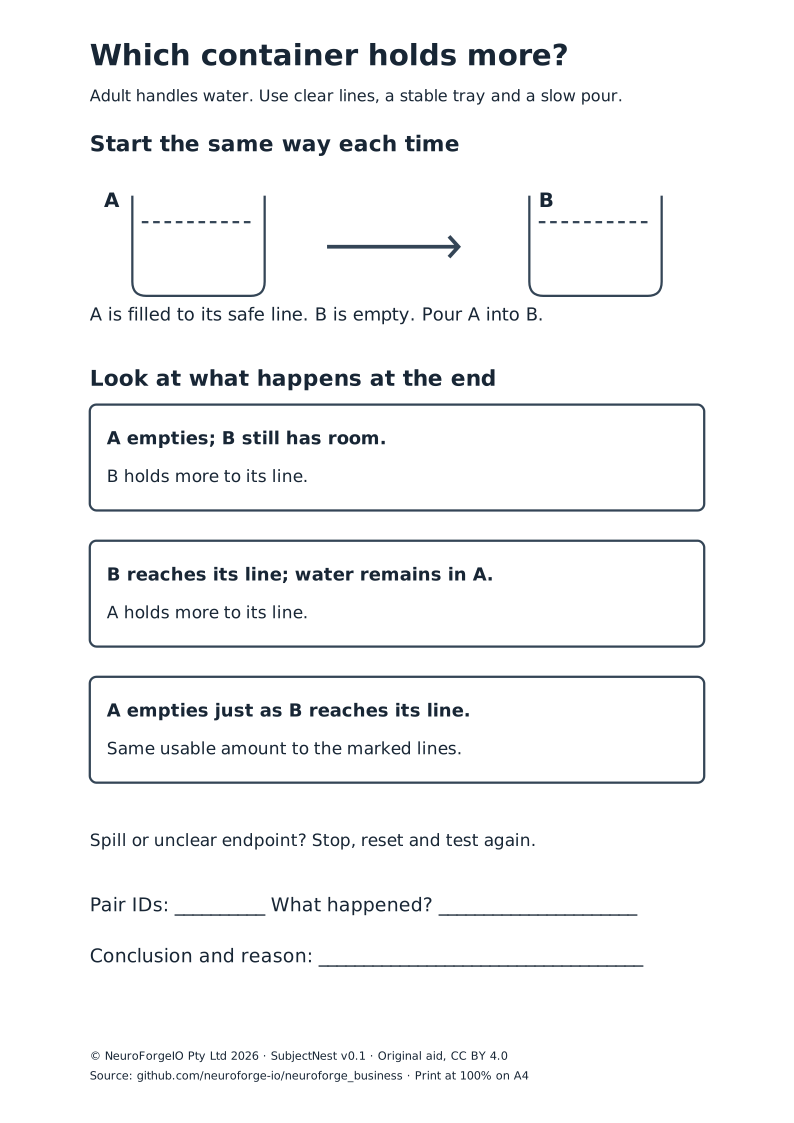
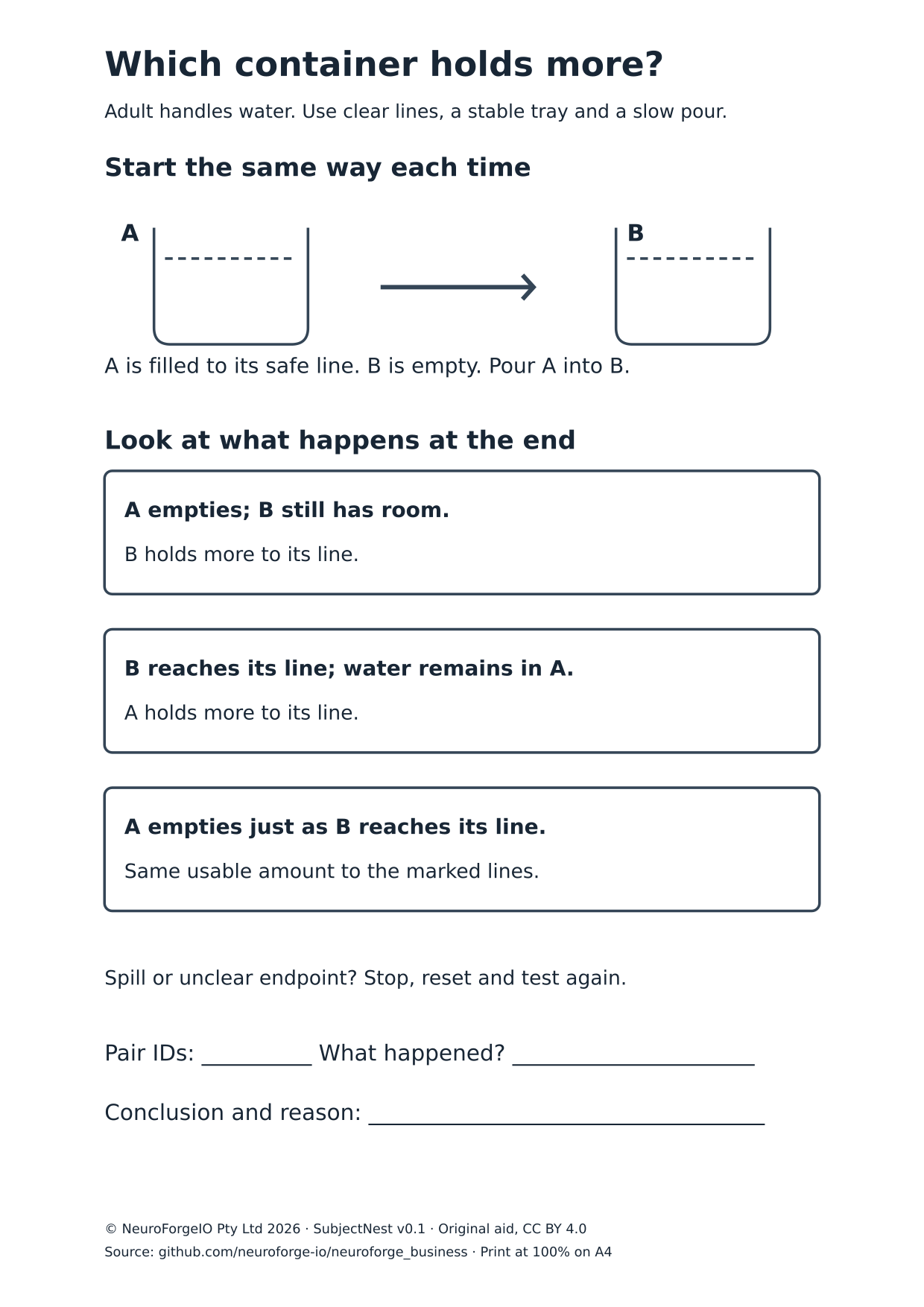
Transfer decision: Start with A filled to its safe line and B empty. Pour slowly from A to B over the tray. If A empties and B is below its line, B holds more to its line. If B reaches its line while A still contains water, A holds more. If A empties as B reaches its line, same usable amount to the lines. Avoid overflow; stop at B's line. The physical result comes from the actual pretest, never from this resource alone.
C cards: child-facing pretend uses for the same pretested pairs
The context does not alter the pair's test result. Do not use these vessels for drinking. Repeat the test to see the result; a correct answer from memory is weaker evidence than a demonstrated direct comparison.
| ID | Child-facing prompt |
|---|---|
| C01 | Two clean art-rinse cups: which holds more to its line? |
| C02 | Two pretend garden-watering containers: which holds more? |
| C03 | Two toy-boat water-tray containers: which holds more? |
| C04 | Two paintbrush-cleanup containers: which holds more? |
| C05 | Two model-fountain refill containers: which holds more? |
| C06 | Two classroom science-display containers: are they the same? |
| C07 | Two reusable wash-station containers: which holds more? |
| C08 | Two pretend outdoor-mural cleanup containers: which holds more? |
| C09 | Two puppet-show rain-catcher containers: which holds more? |
| C10 | Two craft water-brush containers: are they the same? |
| C11 | Two model-irrigation containers: which holds more? |
| C12 | Two supervised water-play containers: which holds more? |
Private teacher pairing/key plan
| Cards | Use pretested pair | Expected result only if pretest confirmed profile |
|---|---|---|
| C01, C06, C10 | E | Same usable amount to lines. |
| C02, C04, C07, C09, C12 | B | A empties, B still has room; B holds more. |
| C03, C05, C08, C11 | A | B reaches line, A has water left; A holds more. |
Fixed worked result cards, for rehearsal without pretending they are real tests
These describe observed transfer states. They are logically keyed, unlike the unknown result of an untested physical pair.
| ID | Observation to read | Teacher key |
|---|---|---|
| R01 | A began at its line; after A→B, A is empty and B has room below its line. | B holds more to its line. |
| R02 | A began at its line; B reaches its line while water remains in A. | A holds more to its line. |
| R03 | A began at its line; A empties just as B reaches its line. | Same usable amount to lines. |
| R04 | Reverse: B began at its line; B empties into A and A still has room. | A holds more to its line. |
| R05 | Reverse: B began at its line; A reaches its line while water remains in B. | B holds more to its line. |
| R06 | Some water spilled outside the tray or a fill line could not be seen clearly. | Inconclusive; reset and test safely. |
The live result form on capacity-transfer.svg has blanks for pair IDs, start condition, observed endpoint, conclusion and reason. Do not invent a capacity total or count scoops to complete it.