25 minutes · AC9MFSP02 partial practice · educator review pending
Success: The child matches named map symbols to locations, describes at least two relative positions with the gate at the bottom, and moves a marker only on a drawn paper path.
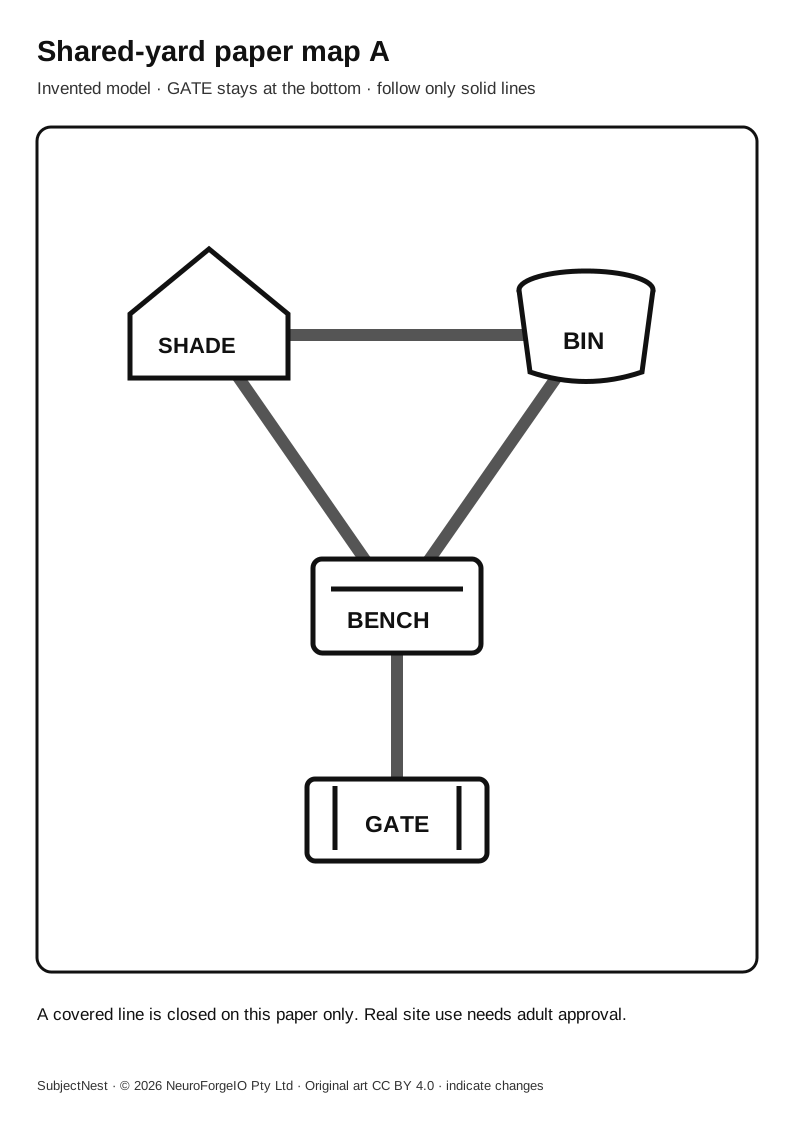
Prepare: fictional shared-yard map A or exact text/tactile alternative, large gate/bench/shade/bin shape cards, one movable marker, a spare sheet for a turned-map contrast. The map is not an approved school site.
- Retrieve, 3 min. Put a marker beside a real mat. Ask for a reference-complete description such as “beside the mat.” Recall that a map's places also need named references.
- Model orientation, 5 min. Set map A with GATE at the bottom. Point to gate, bench, shade and bin shapes, saying the adult can read their word labels. Say, “On this page, bench is above gate; bin is above and right of bench.” Turn the spare copy and show why “right” would change without a fixed page orientation; reset gate to bottom.
- Guided map moves, 9 min. Learners place the marker on GATE, then BENCH by following the solid GATE—BENCH line. Ask which named place is above gate and which is upper-left of bench. Trace BENCH—SHADE and BENCH—BIN separately; do not jump across unlined paper. A child may direct the adult's marker precisely.
- Fresh independent try, 5 min. Ask “Start at BENCH. Show the drawn path to SHADE. Where is SHADE compared with BENCH on this page?” Key: one solid link, above-left. Then ask whether this drawing tells the actual distance outside; no.
- Close, 3 min. Ask one learner to explain why we keep GATE at the bottom for left/right on this page. Record symbol location, relative word, path use and orientation cue separately. Tomorrow joins two connected links.
If a learner draws a straight shortcut to BIN: Point to the solid-line rule and ask them to trace a printed link. Access and record: raised large symbol shapes and connecting strips, exact spoken text alternative, digital drag or child-directed adult trace, AAC/sign/pointing. Do not assess sight or printed label fluency as spatial knowledge.