O5 ordinary source — A catalogue and an account — complete text alternativeYear 1 HASS · T1 W7–8 · Aids / V05 alternative
Source review complete · local suitability still needs review.
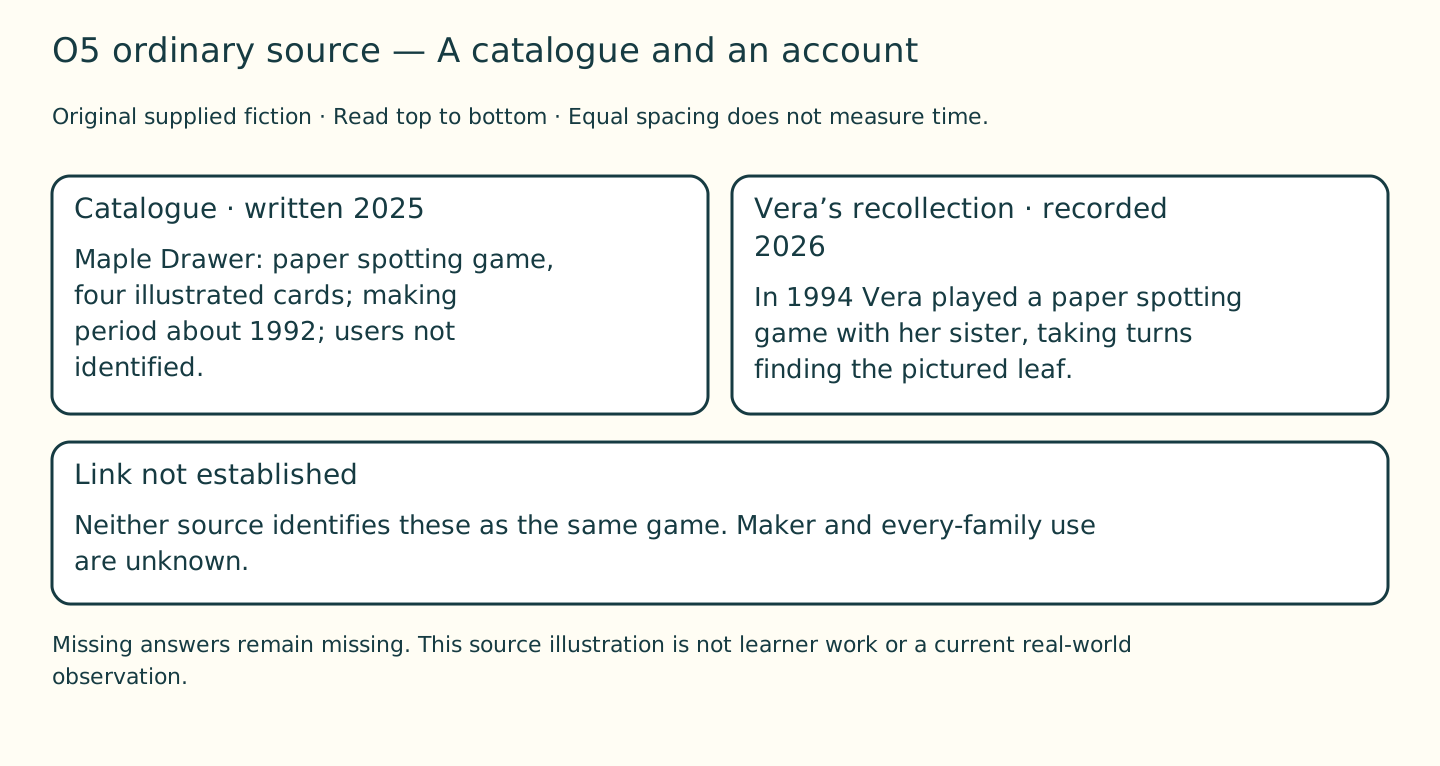
Original fictional source layout, not a real photograph, map or learner work. Original fiction. A catalogue note written 2025 says the invented Maple Drawer holds one paper spotting game with four illustrated cards; it labels its making period “about 1992”. An attributed fictional recollection from Vera, recorded 2026, says: “In 1994 I played a paper spotting game with my sister. We took turns finding the pictured leaf.” The catalogue does not identify who used its particular game. Vera's recollection does not say her game is the catalogue's game. Neither names the paper maker or proves every family had it. Asking about Vera's playing companion can use the recollection; asking how the catalogue describes its cards can use the catalogue. Exact identification linking the two objects stays unknown. The equal panels and any arrow organise these supplied clues; they do not measure time, provide absent answers or prove actual current use.
Reading order and exact labels
Catalogue · written 2025
Maple Drawer: paper spotting game, four illustrated cards; making period about 1992; users not identified.
Vera’s recollection · recorded 2026
In 1994 Vera played a paper spotting game with her sister, taking turns finding the pictured leaf.
Link not established
Neither source identifies these as the same game. Maker and every-family use are unknown.
Complete source text
Original fiction. A catalogue note written 2025 says the invented Maple Drawer holds one paper spotting game with four illustrated cards; it labels its making period “about 1992”. An attributed fictional recollection from Vera, recorded 2026, says: “In 1994 I played a paper spotting game with my sister. We took turns finding the pictured leaf.” The catalogue does not identify who used its particular game. Vera's recollection does not say her game is the catalogue's game. Neither names the paper maker or proves every family had it. Asking about Vera's playing companion can use the recollection; asking how the catalogue describes its cards can use the catalogue. Exact identification linking the two objects stays unknown.
Editable whole SVG · Complete terms · All drawing alternatives.

Sources and reuse · Original educational work © NeuroForgeIO Pty Ltd 2026, CC BY 4.0. Linked authority/provider exceptions and learner ownership stay separate.
About this resource
Reviewed source editionSource review is complete for this two-week edition. Local suitability and classroom use still need review. Earlier candidate or pending-review words are retained in the original files; full-year coverage, translations and audio are not claimed.
Exact source: c1fb25010ca4a3706be203bffe491b1dcf3da406 · 2026-10-12. Source edition, roles and hashes
Complete source and rights notices
Keep these full notices with copies of this resource. Learning text, software, art and outside sources keep their own terms.