Useful outcome
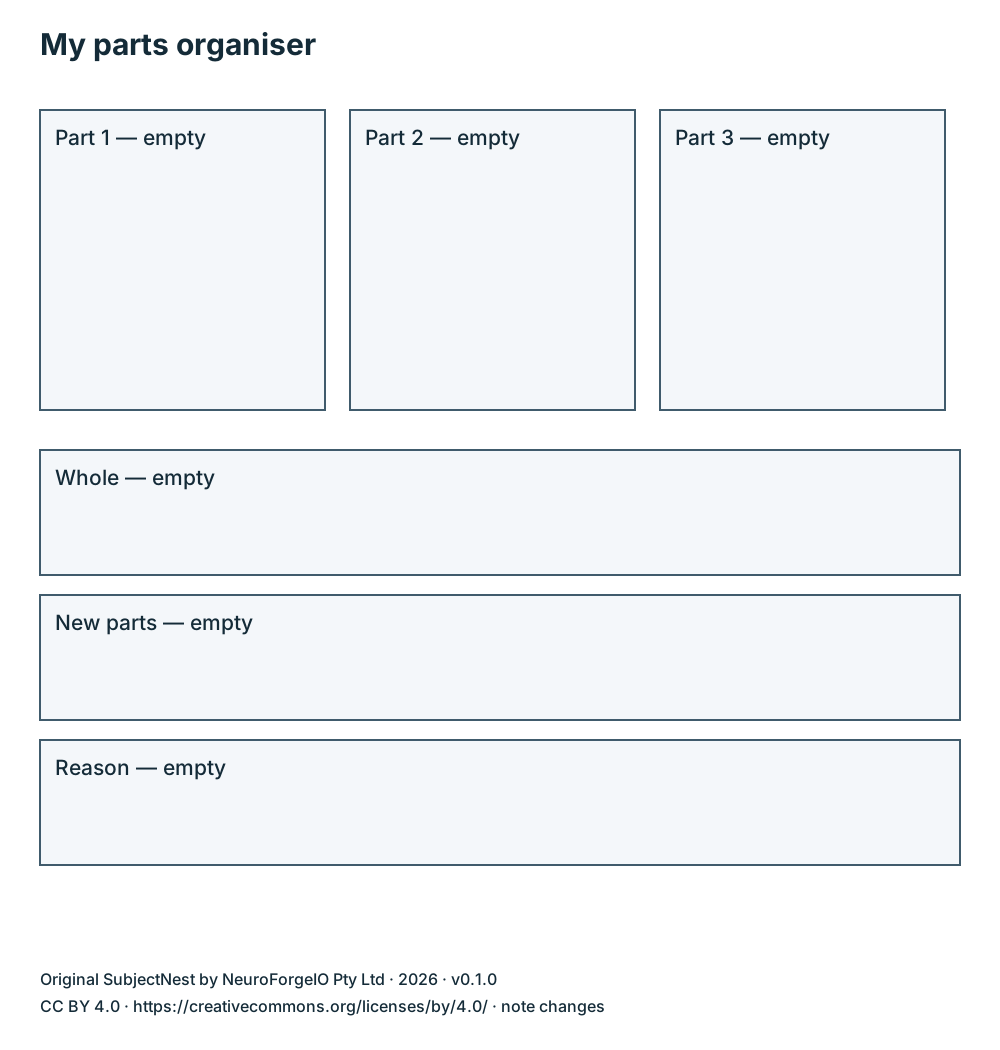
Make a corrected, checkable quantity note. Use existing safe pieces, original marks or the empty own organiser · Complete terms. Full description. The child may keep the product private.
Prepare and check entry
Prepare the ordinary whole 36 and separate counted/waiting space, two or three parts as relevant, large numeral cards and optional verified ten-strips. Audit a ten before using it. Ask for one-to-one coverage and value of a full unit. Teach missing entry knowledge on a new small collection before today's larger example. Smaller actual quantities remain useful and are named.
Run the 25-minute component
- Start, 3 minutes: offer the useful outcome. Ask what amount is being organised and how we can include each object once.
- Model, 5 minutes: 30 + 6 = 36. Another account is 20 + 16 = 36. These describe one original collection. Verify each part and include each object once. Compare thirty and six with twenty and sixteen. Both account for thirty-six. Test the faulty claim thirty and five for that stated whole. Find the missing one. Keep a valid account or repair the label/model. Say what your change fixed.
- Try together, 7 minutes: the child selects boundaries/members; an adult may move marks at their direction. Ask “What is in each part? What stayed the same?” Check by the actual members, not only matching printed numerals.
- Choose, 7 minutes: take one of Card pieces, Drawing tags, Board-game marks. Different purposes/quantities give new work; they are not fixed sensory learner labels.
- Show and check, 3 minutes: ask for today's relevant part values, whole and one reason. Keep first thinking/support, then a revision if needed. A model already supplied is not independently invented.
- Next invitation: If every claim is changed, show a new valid and invalid small pair without error cues. If the reason is only looks wrong, match each claimed object to actual members before changing a label.
Likely confusion and response
A check may say keep: not every claim is faulty. The actual part members and stated whole decide. If every claim is changed, show a new valid and invalid small pair without error cues. If the reason is only looks wrong, match each claimed object to actual members before changing a label.
What to notice
Look for correct whole/part membership, matching quantities, the day's particular exchange/transfer/check and a supported reason. A correct whole alone does not prove every component. A child can choose a valid partition different from the model. Record actual quantity, access support and mathematical prompts; do not grade voice, handwriting, speed or motor independence.
Child start · Home · Extra · Worked contexts · Assessment selector.
Original SubjectNest teaching and drawings © NeuroForgeIO Pty Ltd 2026, CC BY 4.0. Credit SubjectNest by NeuroForgeIO Pty Ltd, version 0.1.0, source and licence; note changes. Curriculum and provider rights remain separate.