B-first · Complete sign packs
Complete alternative
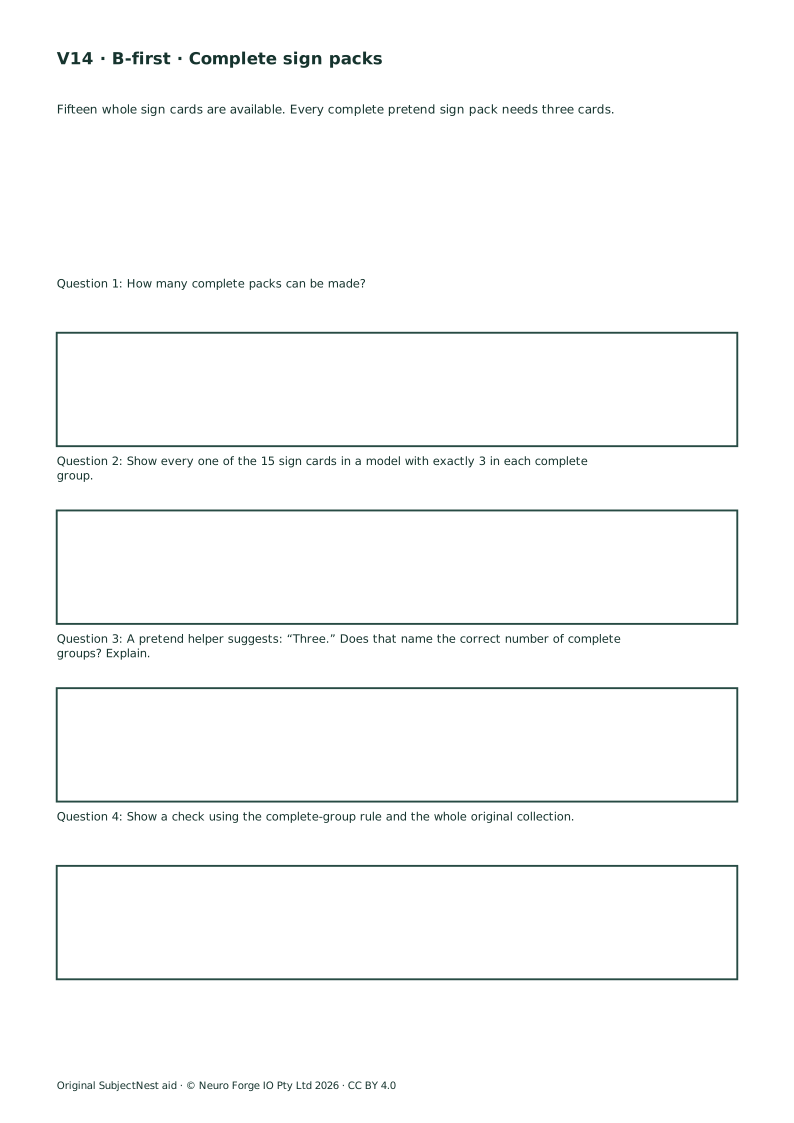
Complete fictional held source: Fifteen whole sign cards are available. Every complete pretend sign pack needs three cards. Question 1: How many complete packs can be made? Question 2: Show every one of the 15 sign cards in a model with exactly 3 in each complete group. Question 3: A pretend helper suggests: “Three.” Does that name the correct number of complete groups? Explain. Question 4: Show a check using the complete-group rule and the whole original collection. Four separate genuinely empty response areas follow the exact four prompts. No staff criteria, worked response or next lesson appears on this child mat. Reading order: identity, full neutral source, then each exact question and its own empty area. Speech, signing, AAC, tactile marks, dictated words and an exact child-directed helper preserve the requested mathematics. Original vector and matched paper are supplied in this Source edition. The transcript remains written; no administered assessment or recording is claimed.
Exact written optional transcript
Fifteen whole sign cards are available. Every complete pretend sign pack needs three cards. Question 1: How many complete packs can be made? Question 2: Show every one of the 15 sign cards in a model with exactly 3 in each complete group. Question 3: A pretend helper suggests: “Three.” Does that name the correct number of complete groups? Explain. Question 4: Show a check using the complete-group rule and the whole original collection. Choose how to show your own thinking. Your four response spaces are empty.
No audio recording is supplied. The original brief and production-status changes remain in the dated written data and art record.
Original prompts/specification/alternative/transcript© Neuro Forge IO Pty Ltd 2026 CC BY 4.0; QCAA/ACARA attribution and provider rights separate.