Public educator selection · preserve first work before criteria or later sources. These pages are public; record prior access.
Day 11 · Two views, two useful questionsYear 2 HASS · T1 W3–4 · Teacher · Teacher / Day 11
Purpose: Develop a purposeful question and select a related source window. A room plan and a wider-area model serve different questions; neither is a universal map.
Actually taught prerequisite: Recall the opening source question/publisher practice. If that has not been taught, read O01 together and model one unrelated question before inviting the child's own.
Prepare: O01 lending-room plan, O02 imaginary care-supplies plan, F01/F02 original checked wider-area cards, question-own aid; existing paper or screen. No trip or household plan.
Complete ordinary sources · Worked contexts · Selected original aid · Complete terms · Complete alternative
Genuinely empty own aid · Complete terms · Complete empty-aid words
Full teacher script
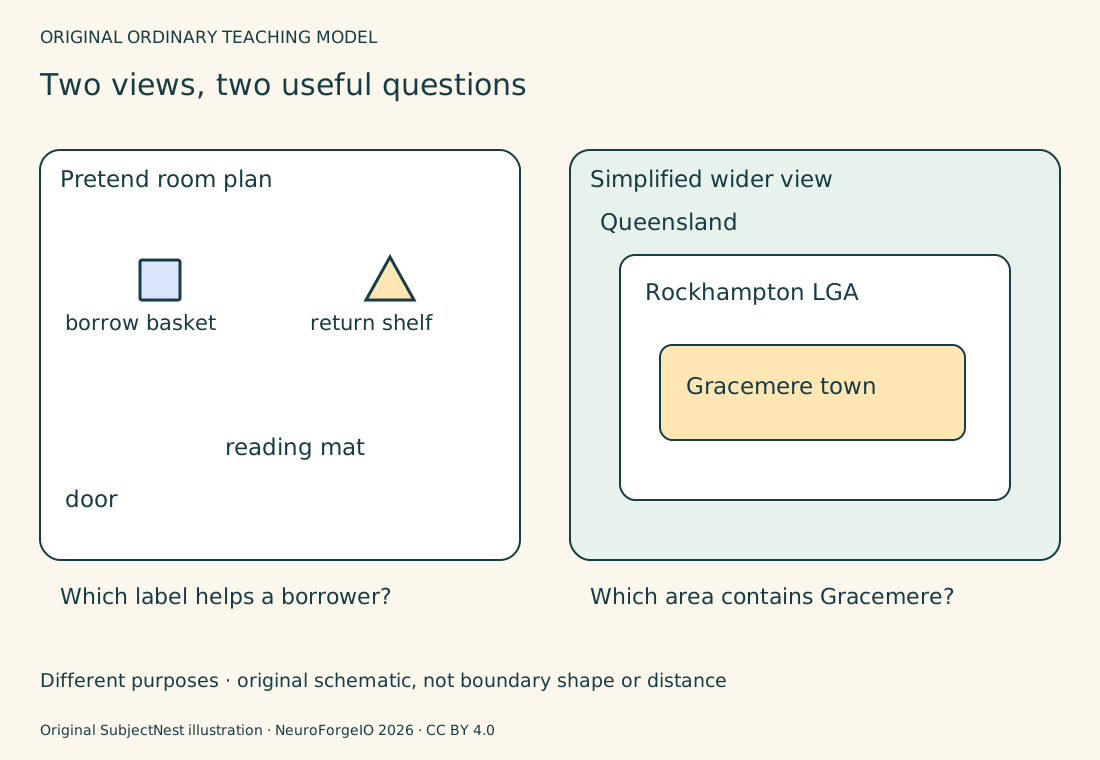
- Start with a job · about 3 minutes. Show O01. Say, ‘Our pretend visitor wants to find the return shelf. What could they ask?’ Accept a child's question or gesture without replacing it with yours. Keep the supplied visitor's question separate from a child's own one. Point out FICTIONAL PLAN before naming any place.
- Read two different views · about 6 minutes. Compare O01 with the wider-area illustration and its F01/F02 source notes. The room plan labels door, reading mat and return shelf. The wider-area model represents checked enclosing areas but has no room door. Model only: ‘Which larger named area contains Gracemere?’ The nesting is a schematic, not a distance or direction map.
- Choose a worthwhile route · about 10 minutes. Let the child choose one of the three routes below. They formulate or select and refine a question, point to the related view/detail, and say what cannot be answered from it. A child directing a helper chooses the question/detail; the helper operates or records faithfully. Do not give a room location from the wider model.
- Try a different question · about 5 minutes. Read C01 and C02, then offer an unrelated new question about the chosen picture. Ask, ‘What would you need to see to answer that?’ If the source is silent, keep a useful question rather than inventing an answer. A selected source type alone does not supply its missing fact.
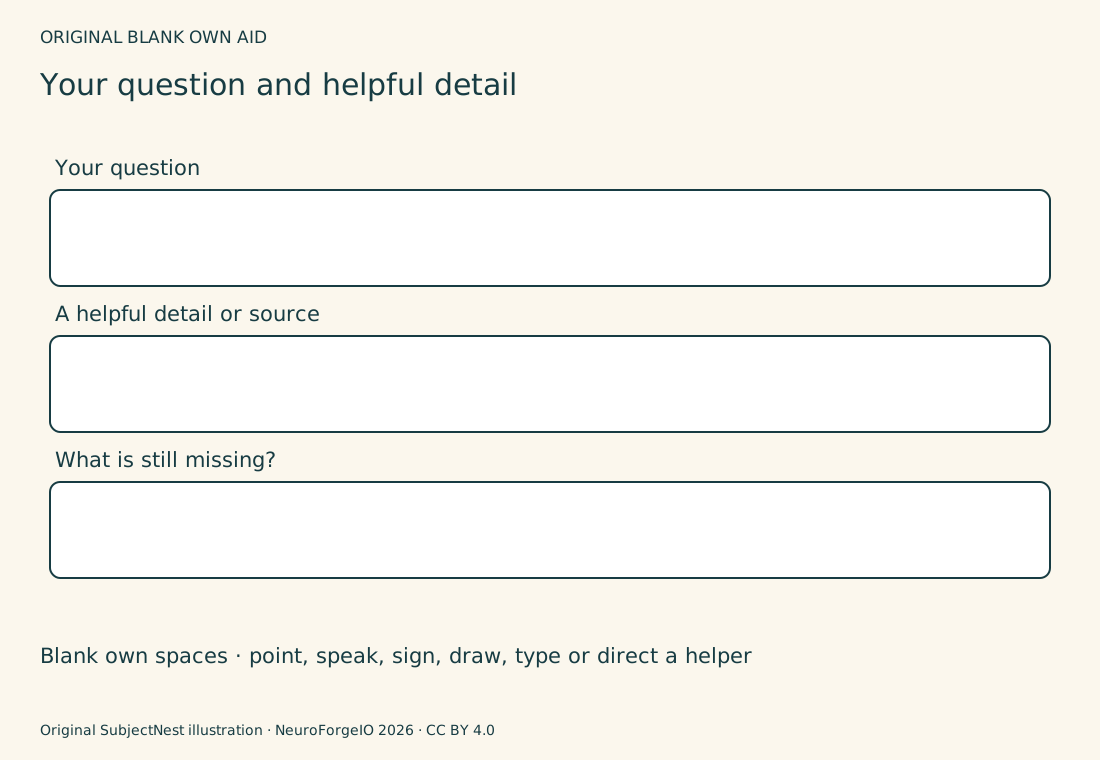
- Keep a small contribution · about 3 minutes. Invite a spoken, signed, drawn, typed or pointed question and one source detail. A child can explain privately. Record the exact contribution and support, not that all learners completed the page. Use the genuinely empty question-own aid only if useful.
- Choose next teaching. If the question is unrelated, use another simple supplied plan to connect its words with a visible detail. If a wider-area model is treated as a room map, place both titles beside their distinct purposes. If the child finds a missing detail, extend to choosing a source that might supply it; do not pretend it already does.
Three selectable routes
Lending room
Use O01's door, reading mat and return shelf. Make a question that could help a new borrower, choose a relevant labelled detail, then name one unknown such as current opening time. It is a fictional room, not a particular library.
Care supplies
Use O02's bowls shelf, towels cupboard and labelled collection desk. Ask a find-or-return question for pretend equipment; no animal handling or household information. Compare its purpose with O01 without asserting which design is best.
Wider-area explorer
Hear/read F01/F02 and choose Rockhampton or Gracemere. Form a question about a supplied enclosing area and identify the source/model that could answer it. Keep the infrastructure-plan region's exact name/purpose; local facts alone do not show room navigation.
What to notice and teach next
S01 own purposeful question and S02 related selection. Choosing a supplied question is a supported selection, not automatically an independently developed question. A fictional view cannot establish K03 real geographical divisions.
Components may be offered across suitable sittings with usual communication/neutral reading and faithful scribing identified. Keep the child’s contribution distinct from an adult’s supplied answer. Response length is not quality; these are original formative components, not a complete folio or Year 2 reporting grade.
Modified from Years 1–2 HASS assessment techniques and conditions, October 2023, © State of Queensland (QCAA) 2023, CC BY 4.0. Original SubjectNest task/criterion/next teaching is separate; source exceptions remain.
About this resource
Reviewed source editionSource review is complete for this two-week edition. Local suitability and classroom use still need review. Earlier candidate or pending-review words are retained in the original files; full-year coverage, translations and audio are not claimed.
Labels and search exclusions are distribution guidance; they do not authenticate or restrict access.
Exact source: 0926c2cd7246a69889dee2ffb58a72ad5f57134c · 2026-10-09. Source edition, roles and hashes
Complete source and rights notices
Keep these full notices with copies of this resource. Learning text, software, art and outside sources keep their own terms.