Day 12 · A key that someone can use
Purpose: Interpret a supplied map key and make a clear labelled representation for a chosen purpose. Test meaning with another person's actual interpretation only if they agree; imagined interpretation remains a plan.
Actually taught prerequisite: Day 11 source/view purpose, or give its short O01 model first. A symbol has a chosen meaning in this particular key; it is not a universally understood instruction.
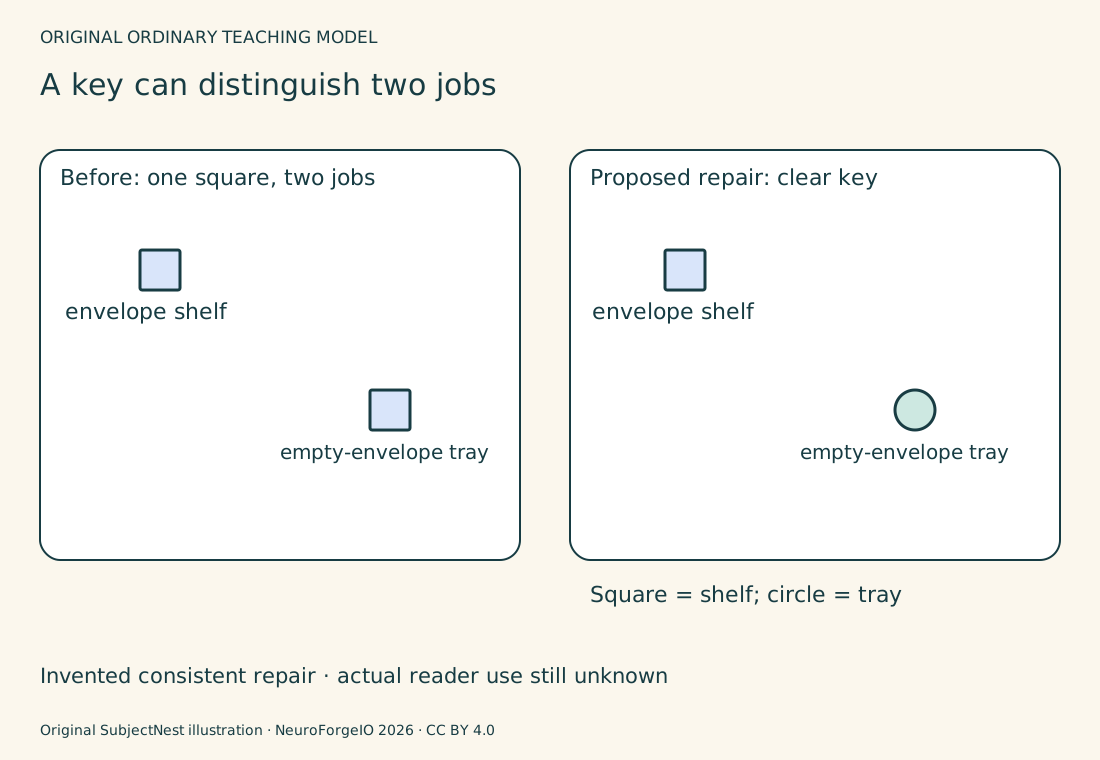
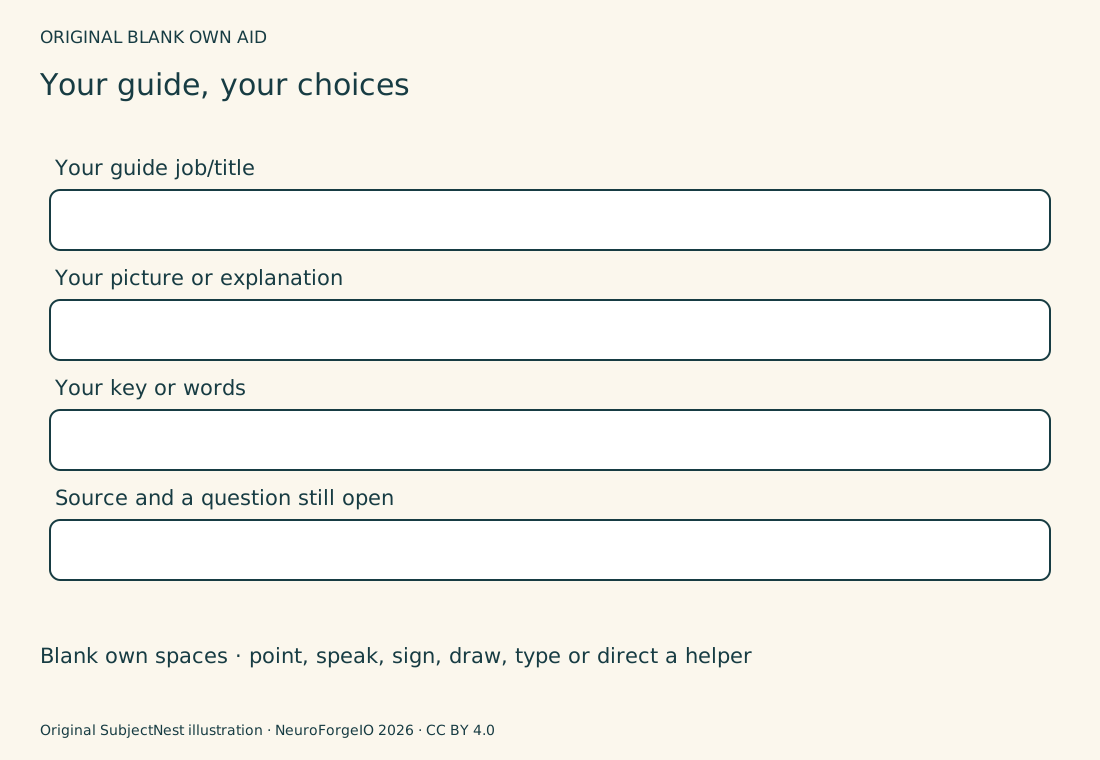
Prepare: O03 seed-library plan and O04 repair-kit bench plan, legend-repair illustration, guide-own aid (Your guide, your choices) or existing paper. Large word labels can replace drawing/cutting. No seed ingestion, tool use or site navigation.
Complete ordinary sources · Worked contexts · Selected original aid · Complete alternative
Genuinely empty own aid · Complete empty-aid words
Full teacher script
- Find the job · about 3 minutes. Read O03's source title and FICTIONAL label. A pretend borrower wants an envelope shelf, not the empty-envelope tray. Ask, ‘Which mark could help?’ Let the child inspect before naming a solution.
- Show an ambiguous key · about 6 minutes. In O03 a square has been used for both shelf and tray. The ambiguity is an original example, not a real seed library's fault. Model one fix on O04 instead: a triangle plus ‘repair-kit return’. Words and shapes carry meaning together; colour may decorate but does not carry the only distinction.
- Make or direct a repair · about 10 minutes. Choose a route. The child chooses one useful label/shape relation and changes the relevant key or picture consistently. A scribe repeats the child's wording before writing. If a child changes a key but leaves an old marker, ask what that marker would mean now; do not silently finish the repair for them.
- Optional meaning check · about 5 minutes. A willing reader explains one new mark without being supplied its meaning. Record their actual words if the child wants to use them. If no reader is available, the child explains their intention to a toy or adult; label this explanation rather than a successful usability test. The local workspace offers editable labels and a visible check list, not an automated grade.
- Keep the chosen explanation · about 3 minutes. Invite the child to point between mark and word, describe their repair, or leave an explanation in an empty own space. One relevant relation can be enough to observe this component; there is no minimum symbol count. The teacher notes what the child chose and any prompt.
- Choose next teaching. If a child treats a symbol as self-explanatory, show a new imaginary symbol and ask what its key says. If labels/key disagree, compare those two exact locations. If meaning is clear, extend to a different stated user preference rather than making the drawing more elaborate.
Three selectable routes
Seed borrower
Repair the ambiguity in O03's two square marks. Use shape/words or just large word labels to distinguish envelope shelf and empty-envelope tray. The child selects the meaning; no real seeds or container purchase.
Repair-kit helper
O04 uses a triangle for returns and a circle for borrow. Change or explain a chosen label so a pretend helper can place an unopened imaginary kit. No tool handling and no claim that a pictured bench is safe for real repairs.
Class materials, if suitable
An adult can supply an approved simple classroom materials plan. The child chooses a clear label/key relation. Actual shelf positions are separately checked there; a proposed new label does not prove a real reader can use it. Otherwise use the complete fictional O04 route.
What to notice and teach next
S02 labelled recording, S03 key interpretation and S06 communication. Record actual user feedback separately from the child's intended meaning; visual neatness and universal accessibility are not established.
Components may be offered across suitable sittings with usual communication/neutral reading and faithful scribing identified. Keep the child’s contribution distinct from an adult’s supplied answer. Response length is not quality; these are original formative components, not a complete folio or Year 2 reporting grade.
Modified from Years 1–2 HASS assessment techniques and conditions, October 2023, © State of Queensland (QCAA) 2023, CC BY 4.0. Original SubjectNest task/criterion/next teaching is separate; source exceptions remain.