Purpose: Identify and discuss provided perspectives, then make a reasoned proposal without inventing a real person's preferences or universal access benefit.
Actually taught prerequisite: Key/purpose interpretation from Day 12 or a short O04 model. All speaker statements are supplied fiction; no need to tell a personal preference, diagnosis or family experience.
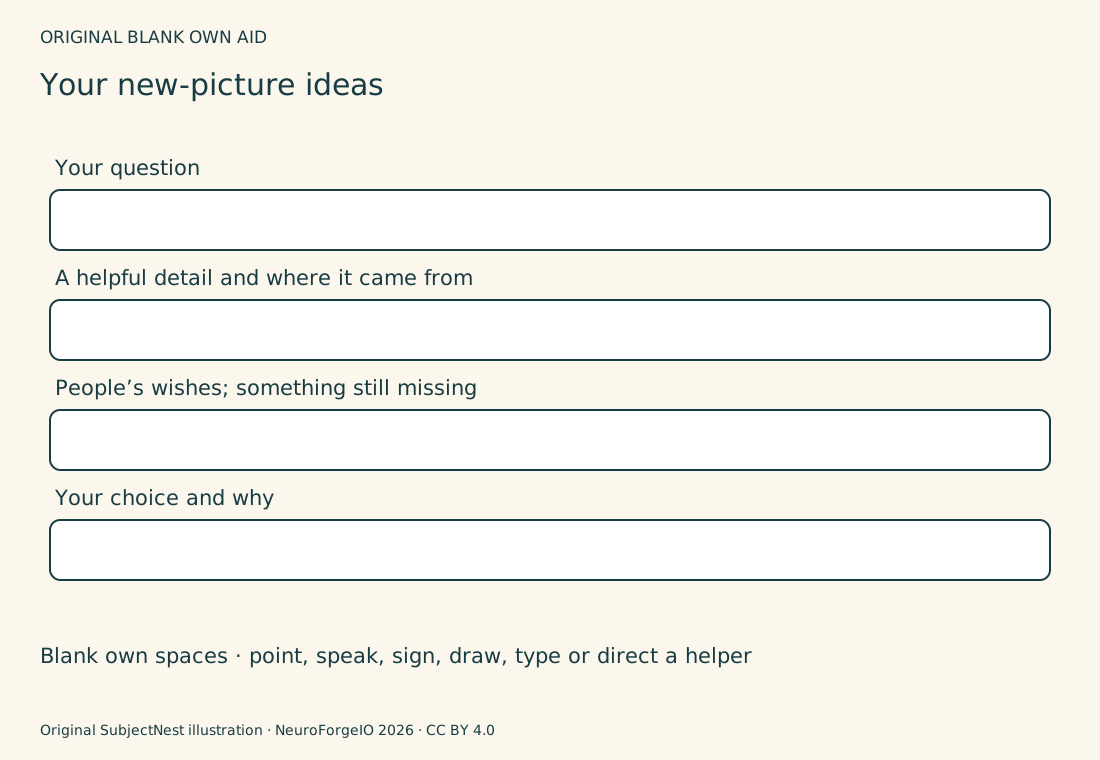
Prepare: O09 games-store voices, O10 tool-library voices, O11 mobile-book display voices; two-voices illustration and source-own aid (Your new-picture ideas). No real public sharing or site testing required.
Complete ordinary sources · Worked contexts · Selected original aid · Complete terms · Complete alternative
Genuinely empty own aid · Complete terms · Complete empty-aid words
Full teacher script
-
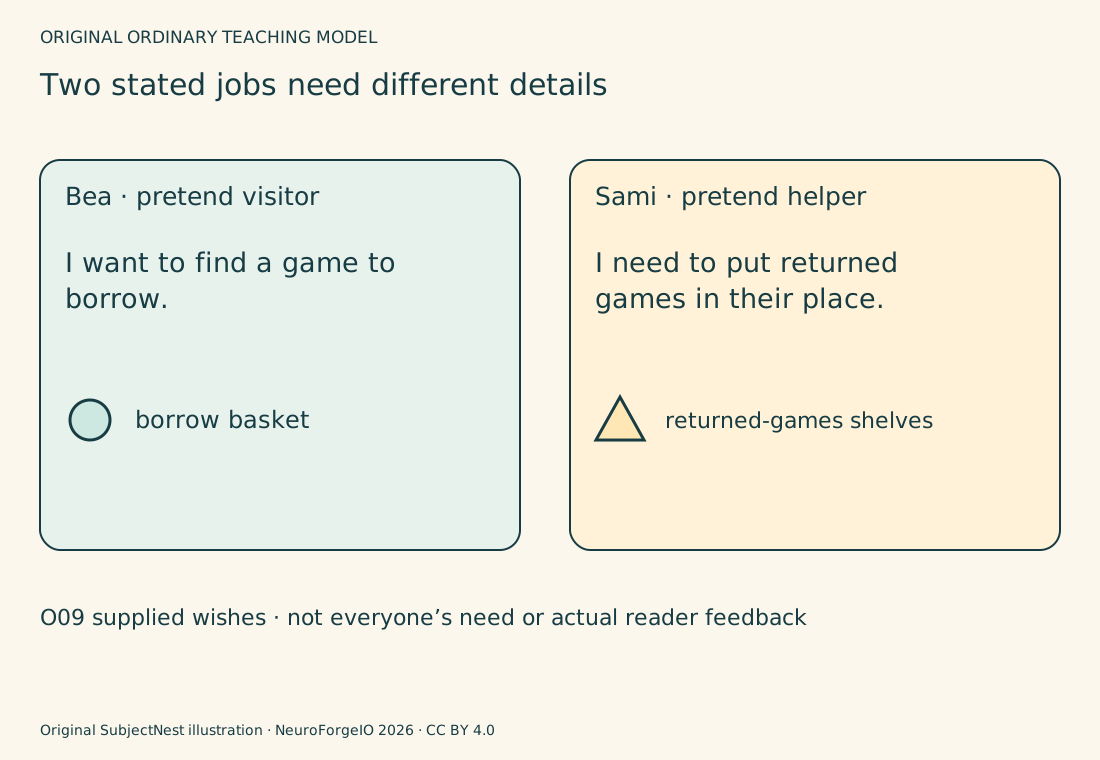
Hear two stated jobs · about 3 minutes. Read O09 verbatim as fiction. Visitor says ‘I want to find a game to borrow’; helper says ‘I need to put returned games in their place’. Ask what each wants, preserving their different jobs. Do not add an emotional/cultural account they have not stated.
-
Separate a need from a guess · about 6 minutes. Use O11's supplied large-word preference. The fictional speaker asks for large words; this is sufficient for that stated preference. Do not assign a diagnosis, say all older/younger people want it, or promise this feature makes a guide accessible to everyone. An actual user's needs would need their own permissioned contribution/review.
-
Choose a useful route · about 10 minutes. Child links a detail/label to each chosen speaker's stated purpose and proposes keep/change with a reason. A card can be moved at the child's direction instead of written. The quiet route still interprets the provided perspectives; no compulsory partner discussion or self-disclosure.
-
Consider a trade-off · about 5 minutes. Read C13/C14. Ask, ‘Could one small guide help both jobs? What would still need checking?’ A return label may help a helper without giving the visitor a borrow route. Avoid declaring a winner or that a broad path drawn on paper is suitable for every actual user.
-
Keep a source-linked explanation · about 3 minutes. Invite a short statement/sign/point sequence naming the speaker, their supplied wish, a detail and the child's proposed choice. Adults keep their own suggestions separate. If child chooses to keep the guide, a relevant reason counts as a proposal decision; a redesign is not compulsory.
-
Choose next teaching. If the voices collapse, read one exact statement beside its corresponding job/detail on an unrelated plan. If an inferred wish replaces the supplied one, sort ‘speaker said’ and ‘we imagined’. If both perspectives are clear, extend to a third fictional purpose and ask what information would need another page.
Three selectable routes
Games visitor/helper
Use O09. Distinguish a borrow basket for a visitor from return shelves for the helper. Choose a word/shape label or short narrated guide that serves a stated job; do not invent prices/hours.
Tool-library helper
Use O10's pretend caller asking which collection desk and helper asking which unopened-box return point. Add or keep a detail for each stated purpose. No tools are handled and no live lending membership is needed.
Mobile-book display
Use O11, whose pretend visitor asks for large word labels and helper wants a return mark. Propose a labelled guide with these particular preferences. Point/direct/type privately if useful; do not diagnose the speaker or assume universal access.
What to notice and teach next
S04 provided perspectives, S05 source-grounded proposal, S06 subject-specific communication. Actual reader feedback, personal identity, accessibility or approval is not inferred from fictional voices.
Components may be offered across suitable sittings with usual communication/neutral reading and faithful scribing identified. Keep the child’s contribution distinct from an adult’s supplied answer. Response length is not quality; these are original formative components, not a complete folio or Year 2 reporting grade.
Modified from Years 1–2 HASS assessment techniques and conditions, October 2023, © State of Queensland (QCAA) 2023, CC BY 4.0. Original SubjectNest task/criterion/next teaching is separate; source exceptions remain.