Public educator selection · preserve first work before criteria or later sources. These pages are public; record prior access.
Day 19 · A small guide with a useful jobYear 2 HASS · T1 W3–4 · Teacher · Teacher / Day 19
Purpose: Bring question, source detail, representation/key, perspective and careful proposal together in a practical guide. Optional actual use/refinement remains distinct from intended meaning or invented example feedback.
Actually taught prerequisite: Selected source/key/perspective/unknown components actually taught in prior sessions, or use short ordinary models first. The product can be one purposeful part; it is not evidence of every Year 2 outcome.
Prepare: Existing paper/markers or local legend/label workspace, chosen complete ordinary source window, own guide aid and full alternative. No purchase, required page/symbol count, recording, account or public gallery.
Complete ordinary sources · Worked contexts · Selected original aid · Complete terms · Complete alternative
Genuinely empty own aid · Complete terms · Complete empty-aid words
Full teacher script
- Choose the guide's job · about 3 minutes. Invite one purpose: finding an imaginary borrow shelf, explaining an exhibition picture, or showing a checked wider-area/connection relation. Ask who the supplied intended reader is and what they are stated to want. Personal/user disclosure is optional; provided fictional reader statements are complete.
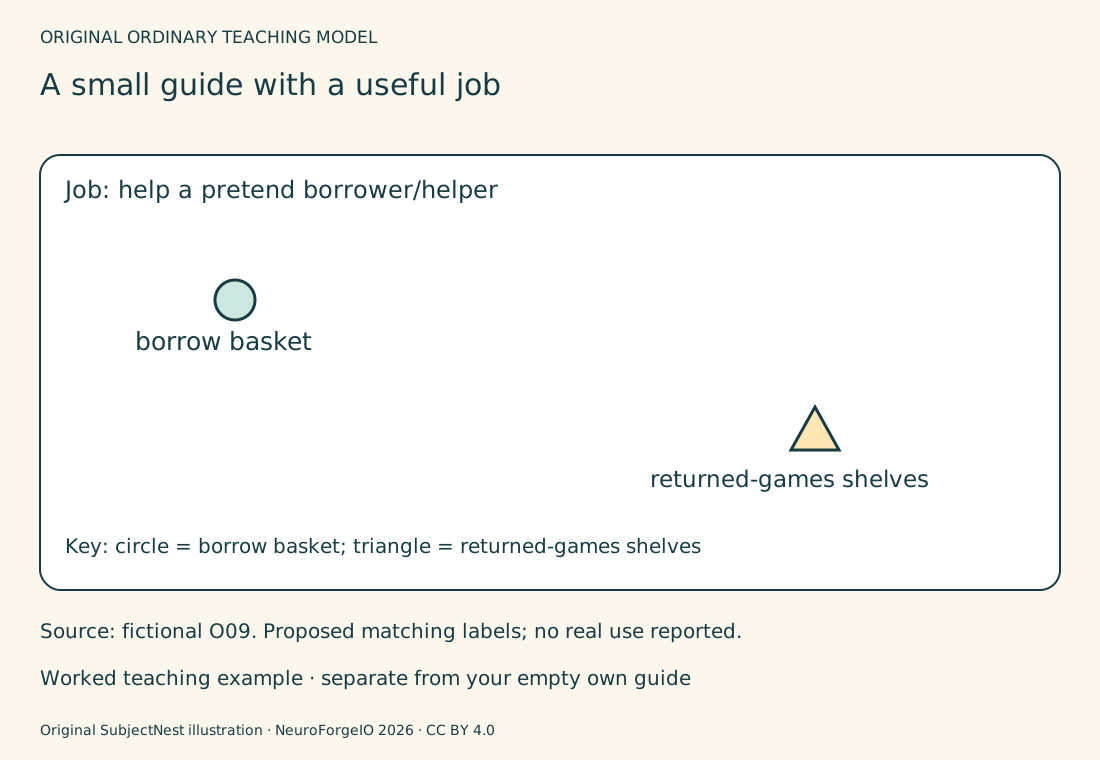
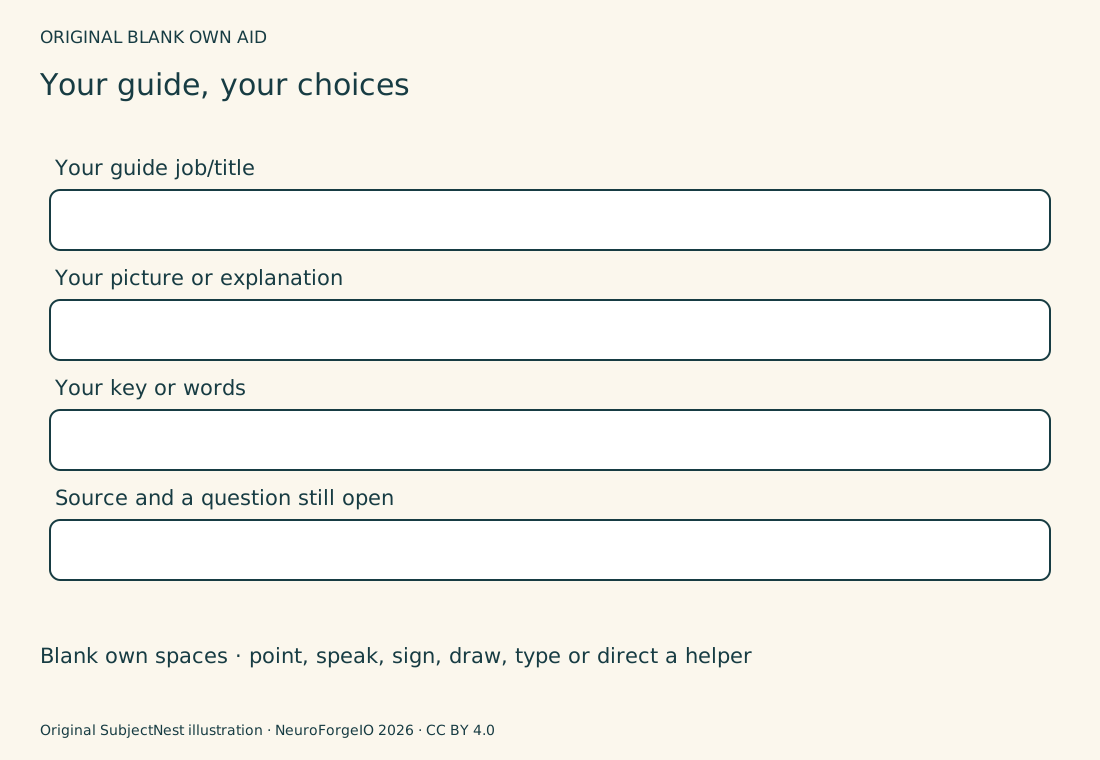
- Model a small useful guide · about 6 minutes. Show the worked ordinary guide illustration and C17's explicitly invented feedback. It has a title/purpose, matched key/labels and source note, not a compulsory format. The fictional feedback is a teaching example, not an actual teacher/child trial. Show the genuinely empty own guide separately; it is not a pre-filled response.
- Make or direct the chosen guide · about 10 minutes. Child chooses a source/detail and decides how to communicate it. Use words/shape labels/narrated pointing/signs/typed fields. In the local workspace, edit own labels, move them with keyboard buttons, and use the visible meaning-check prompts; there is no automatic HASS scoring. Paper has the same label/key/edit/meaning-check route. Keep fictional/real tags and the exact defined region/source if selected.
- Optional use and revision · about 5 minutes. If a willing suitable reader is available, invite a neutral task about the finished guide and capture their actual reply with permission. Child may keep/change a detail using that reply. With no reader, explain intended meaning or propose a future test; call it intended/planned, not ‘it worked’. A toy listener gives a private explanation route, not actual human usability evidence.
- Retain an honest guide claim · about 3 minutes. Ask what the guide can say, what source helped, and what remains unknown. If using checked geographical facts, record only a child's actual source-backed division/connection contribution in K03-CONTRIBUTION; don't fill it from the guide's neat appearance. Separate adult operation and child's choices. Sharing remains optional/private.
- Choose next teaching. If the job/detail mismatches, return to an unrelated ordinary plan with one clear user purpose. If source labels disappear, add the actual source title/tag and retain the unknown. If meaning is clear, propose a second purpose/version; no mandatory redesign, number of trials or polished display.
Three selectable routes
Lending-shelf guide
Use O01 or O09 and a stated pretend borrower/helper job. Make a purposeful find/return guide with a matched label/key and source note. Optional reader use concerns the guide only, not actual borrowing or a real library's safety/access.
Exhibition guide
Use O11 as an imaginary display plan. Distinguish items for display from any invented borrowing offer only if the supplied source states it. Choose a narrated, large-word or picture-plus-word guide; don't create unsupported prices or opening hours.
Checked areas/connection guide
Use F01/F02/F03 to explain a named town's wider areas and the limited named route relation. Preserve exact grouping purpose and source/unknown tags. This is a source-backed geographical explanation, not actual track directions or a travel invitation. Teacher separately records actual child K03 components if offered.
What to notice and teach next
S01–S06 selected components can contribute at actual observed scope. Real K03 only via checked facts/model/connection and child contribution; actual guide-use evidence requires a willing actual reader and recorded reply, not a planned scenario.
Components may be offered across suitable sittings with usual communication/neutral reading and faithful scribing identified. Keep the child’s contribution distinct from an adult’s supplied answer. Response length is not quality; these are original formative components, not a complete folio or Year 2 reporting grade.
Modified from Years 1–2 HASS assessment techniques and conditions, October 2023, © State of Queensland (QCAA) 2023, CC BY 4.0. Original SubjectNest task/criterion/next teaching is separate; source exceptions remain.
Record an actual checked real-geography contribution only if offered.
About this resource
Reviewed source editionSource review is complete for this two-week edition. Local suitability and classroom use still need review. Earlier candidate or pending-review words are retained in the original files; full-year coverage, translations and audio are not claimed.
Labels and search exclusions are distribution guidance; they do not authenticate or restrict access.
Exact source: 0926c2cd7246a69889dee2ffb58a72ad5f57134c · 2026-10-09. Source edition, roles and hashes
Complete source and rights notices
Keep these full notices with copies of this resource. Learning text, software, art and outside sources keep their own terms.