Public educator selection · preserve first work before criteria or later sources. These pages are public; record prior access.
Use this case
Offer the neutral source and four questions after the relevant learning opportunity. Keep staff examples and next teaching on the teacher pages.
Child materials and paper
- A-later · complete neutral source
- A-later · four questions and own response spaces
- A-later · matching four-question paper mat (V17) · Complete terms
- A-later · full paper-mat text alternative (V17)
After reviewing the child’s own work
Choose the relevant next lesson. These are supported teaching accounts, separate from the child’s case responses.
Complete neutral source
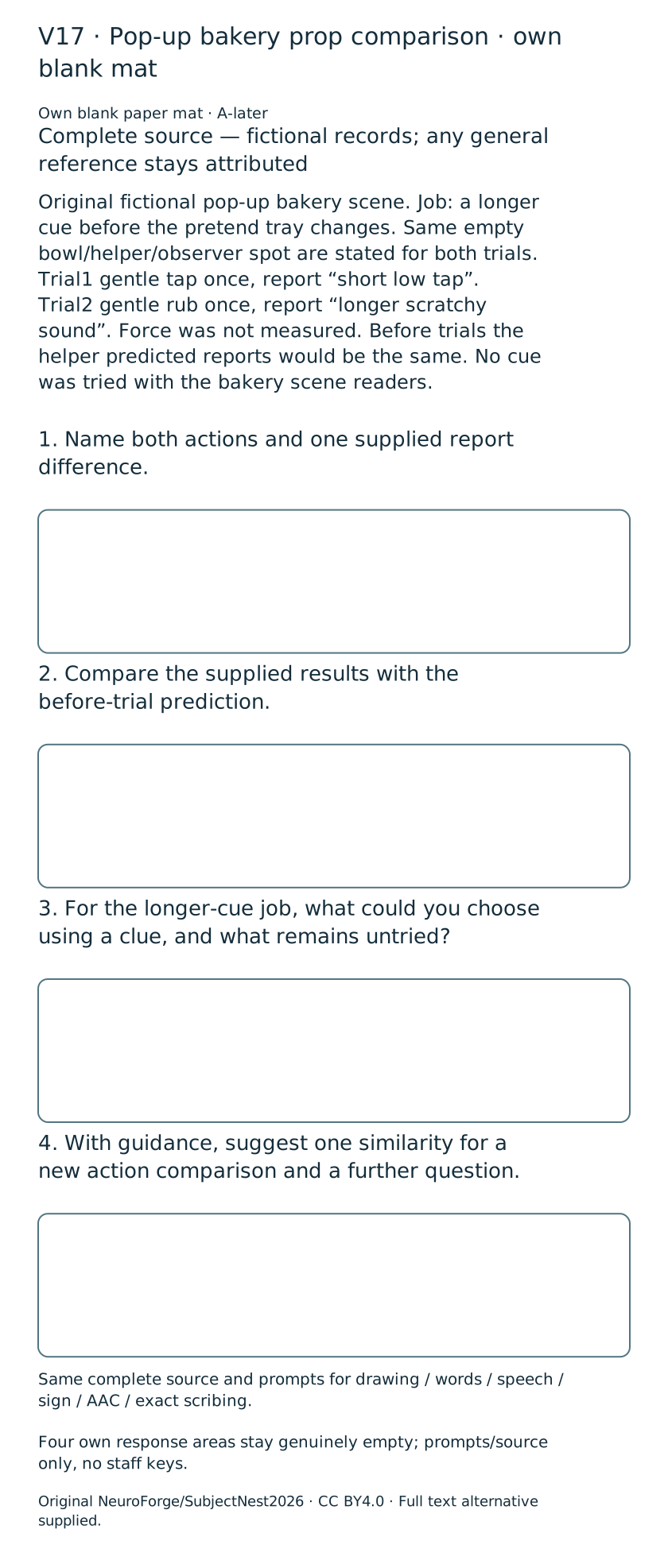
Original fictional pop-up bakery scene. Job: a longer cue before the pretend tray changes. Same empty bowl/helper/observer spot are stated for both trials. Trial1 gentle tap once, report “short low tap”. Trial2 gentle rub once, report “longer scratchy sound”. Force was not measured. Before trials the helper predicted reports would be the same. No cue was tried with the bakery scene readers.
Components
Accept other responses
Accept a different source-faithful response in text/drawing/speech/sign/AAC/exact scribing. No required wording, hearing performance or neatness score. Apply only the exact prompt/criterion; no unstated physical action or result required.
Exact component criterion
Tap/rub plus one exact supplied description difference; no measured energy/level demanded.
Exact prompt
Name both actions and one supplied report difference.
Full individual next learning
Child invitation
Make an action catalogue that preserves which note belongs to which action.
Guided different context
Child directs a new safe paper crease and paper slide, or works with supplied exact notes, keeping modes named.
Id
N17
Mode opportunity
This is supported teaching after review. Actual performing, reasoning about supplied stories and model construction are recorded separately. New-context transfer is a small observed step, not annual mastery or a new official grade.
Next decision
If the named distinction is still unclear, return to two source-labelled cards in this unrelated context and one prompt at a time. If clear, offer a different job/source after further learning; do not retry this held case with the staff model rehearsed.
Observable next evidence
Child compares variety with exact action-result provenance rather than assuming sound behaviour.
Ordinary possible model
Different actions have different supplied notes; object/action/result must stay paired.
Teacher preparation
Full account/model and a separate blank child page; cards or paper drawings as named in the guided context. Offer pointing/AAC/exact scribing and quiet helper operation. No source collection or public publication is required.
Teacher sequence
- Read the complete new account and ask which event/reference is actually supplied before showing its ordinary model.
- Model first workshop row, guide one new row with a helper, then child assembles the other and checks full source/actual event.
- Guide the different new context above using an open question. After child chooses, pause so they can author/select/draw their own evidence distinction; the model answer stays a teaching example, never inserted into their own work.
- Invite the child to explain one exact clue and one limit in the new task. Keep actual events, supplied stories and unperformed plans labelled. Use the observable check below to choose whether to revisit this meaning or offer a genuinely fresh task later.
Title
Workshop action catalogue
Whole unrelated teaching account
A fictional craft workshop has paper fold—two corners meet; card slide—stops by edge. These are supplied material/motion descriptions.
Id
A-later-1
Initial own value
One possible staff response
Tap and rub; short low tap versus longer scratchy sound were reported.
Staff focus
U02 action variety
Accept other responses
Accept a different source-faithful response in text/drawing/speech/sign/AAC/exact scribing. No required wording, hearing performance or neatness score. Apply only the exact prompt/criterion; no unstated physical action or result required.
Exact component criterion
Recognises reports differ from same-report prediction; limits conclusion to supplied trials.
Exact prompt
Compare the supplied results with the before-trial prediction.
Full individual next learning
Child invitation
Make a three-lane kit record: requested, predicted before, reported afterwards. Explain one comparison without turning a request into evidence.
Guided different context
Complete different fictional craft-kit account. A maker asks for three drawn buttons. Before a packet is filled, the helper predicts three buttons because an earlier packet card showed three. The later fill record shows two buttons. No later record exists for a second packet. Ask the child to compare the explicit before expectation and after record while keeping the request separate. Use paper pictures only.
Id
N18
Mode opportunity
This is supported teaching after review. Actual performing, reasoning about supplied stories and model construction are recorded separately. New-context transfer is a small observed step, not annual mastery or a new official grade.
Next decision
If wishes and predictions blur, return to the time-labelled expectation and separate request in this new account, then ask one outcome question. If comparison is clear, choose a fresh ordinary event with another prediction/record pair; no annual or independent transfer judgement follows automatically.
Observable next evidence
Child compares an explicit prospective prediction with the supplied after record, states the difference within that story, and keeps desire/request distinct from both prediction and observation.
Ordinary possible model
The helper predicted two before packing, using earlier two-roll records. The after record shows one, so this supplied result differs from that expectation. The request for two is a wish, not itself a prediction or proof of packing. The second tray remains unknown.
Teacher preparation
Prepare the complete bakery/kit accounts and three large time/purpose lanes, not food or loose buttons. Keep staff model separate until initial response. Offer drawings, signing, AAC or helper read-back; label supplied fiction and actual support.
Teacher sequence
- Read the bakery request, explicit timed expectation and after entry. Ask when each was stated and which one gives the reported outcome.
- Model the two-predicted versus one-reported comparison, then show why the customer’s wish is not the prediction’s evidence or an observed result.
- Read the whole different kit account. Guide one lane heading, then allow the child to place or direct three statements, compare three predicted with two reported and leave the second packet unknown.
- Ask for the child’s reason and missing result; record exact words, source and support. Offer a new unrelated prediction comparison later if needed, not coached repetition of the held same-report sound task.
Title
Bakery expectation versus packing record
Whole unrelated teaching account
Complete original fictional bakery account. A customer requests two drawn rolls. Before packing at11:00, the helper predicts the tray will contain two rolls because the last two pictured orders each had two. After packing at11:05, the supplied record shows only one roll on this tray. A second tray has no packing record. The customer’s request, helper’s prediction and after record are different statements; no real food order or customer event occurred.
Id
A-later-2
Initial own value
One possible staff response
The supplied reports differ, unlike the helper’s prediction that they would be the same. This describes those notes only.
Staff focus
I05 prediction/results reasoning
Accept other responses
Accept a different source-faithful response in text/drawing/speech/sign/AAC/exact scribing. No required wording, hearing performance or neatness score. Apply only the exact prompt/criterion; no unstated physical action or result required.
Exact component criterion
Purpose-linked rub or other source-faithful choice uses longer clue and preserves real scene/reader trial unknown.
Exact prompt
For the longer-cue job, what could you choose using a clue, and what remains untried?
Full individual next learning
Child invitation
Choose what could help the costume reader find the return table. Give one supplied clue and keep the real reader trial open.
Guided different context
Complete different fictional rehearsal notice. The job is to help a costume-display reader find the return table. SignA has a labelled arrow toward the table on a plan; supplied helper note says it points to that drawn table. SignB has a swirl and no location note. No real display reader has used either sign. Invite a choice for that job, its exact clue and an untried-reader statement.
Id
N19
Mode opportunity
This is supported teaching after review. Actual performing, reasoning about supplied stories and model construction are recorded separately. New-context transfer is a small observed step, not annual mastery or a new official grade.
Next decision
If the response is only decorative preference, return to the complete named job and ask which supplied clue relates to it. If the job/clue/limit chain is clear, offer another ordinary reader product with a different purpose; avoid rehearsing the held longer-cue answer.
Observable next evidence
Child links a choice to a named useful reader job and a relevant supplied clue, and identifies actual reader use as untried rather than guaranteed.
Ordinary possible model
I could offerP for finding the next stop because the supplied note links its arrow to locating the drawn stop. Our actual game reader has not tried it; a different source-faithful option or an open choice is legitimate with its own relevant clue and limit.
Teacher preparation
Read/print the complete map and rehearsal accounts with two large option cards for each. The arrow is a plan drawing, not a visited place or universal access guarantee. Offer seated card placement, voice/sign/AAC or exact scribing; sharing with a real reader is optional and separately consented.
Teacher sequence
- Read the entire treasure job, both alternatives and the supplied note. Ask what the reader needs before discussing your own preferred choice.
- Model a purpose-linkedP choice with its exact locating clue and the untried reader boundary. Explain that a decorative preference can be expressed but does not establish the locating job.
- Read the different rehearsal account. Guide naming its return-table purpose, then let the child choose a sign or a faithful open choice, cite a relevant source clue and leave actual use unresolved.
- Ask what a willing real reader could later help check, without pretending they already used it. Record the child’s choice/reason/limit and any help; choose a fresh job if the source link still needs teaching.
Title
Treasure-path choice for a reader job
Whole unrelated teaching account
Complete original fictional treasure-map account. The job is to help a reader find the next stop on a paper trail. OptionP is a large arrow drawing; supplied note says a helper located the drawn next stop using that arrow on the plan. OptionQ is a decorative star with no pointing direction and no locating report. No actual treasure-game reader has tried either option. The clue is about the supplied arrow/plan event, not proof of success for a new reader.
Id
A-later-3
Initial own value
One possible staff response
I could try rub for longer because its supplied note says longer. Bakery scene readers have not tried it.
Staff focus
H01/I06 bounded purpose choice
Accept other responses
Accept a different source-faithful response in text/drawing/speech/sign/AAC/exact scribing. No required wording, hearing performance or neatness score. Apply only the exact prompt/criterion; no unstated physical action or result required.
Exact component criterion
Relevant planned similarity and new question with guidance; no performance/force certainty requirement.
Exact prompt
With guidance, suggest one similarity for a new action comparison and a further question.
Full individual next learning
Child invitation
Name one planned change, one similarity and a useful further question.
Guided different context
Design a new pretend museum-label comparison changing font size while keeping text/position same; no real user result yet.
Id
N20
Mode opportunity
This is supported teaching after review. Actual performing, reasoning about supplied stories and model construction are recorded separately. New-context transfer is a small observed step, not annual mastery or a new official grade.
Next decision
If the named distinction is still unclear, return to two source-labelled cards in this unrelated context and one prompt at a time. If clear, offer a different job/source after further learning; do not retry this held case with the staff model rehearsed.
Observable next evidence
Child recognises multi-change limits and asks a purpose-linked next question.
Ordinary possible model
The plan cannot isolate colour preference.
Teacher preparation
Full account/model and a separate blank child page; cards or paper drawings as named in the guided context. Offer pointing/AAC/exact scribing and quiet helper operation. No source collection or public publication is required.
Teacher sequence
- Read the complete new account and ask which event/reference is actually supplied before showing its ordinary model.
- List cover changes, model a question-matched revision, then guide child to design the label plan and leave actual feedback blank.
- Guide the different new context above using an open question. After child chooses, pause so they can author/select/draw their own evidence distinction; the model answer stays a teaching example, never inserted into their own work.
- Invite the child to explain one exact clue and one limit in the new task. Keep actual events, supplied stories and unperformed plans labelled. Use the observable check below to choose whether to revisit this meaning or offer a genuinely fresh task later.
Title
Book-cover trial fairness
Whole unrelated teaching account
A fictional reader trial compares red cover at large size with blue cover at tiny size. Colour and size both change; preferences are not supplied.
Id
A-later-4
Initial own value
One possible staff response
Keep bowl/helper/observer spot similar and ask whether a new gentle rub report will still be longer. Force remains unmeasured.
Staff focus
I02/I05 guided future comparison
Delivery
Read/display the exact whole neutral source and prompts, with one question at a time if wanted. Do not read criteria/worked/next accounts. Each own page has initial-closed same-page full neutral source disclosure and an external whole-source link; paper mat repeats this source identity and four exact prompts.
Eligibility
Staff records learning opportunity, familiarity with source, prior answer exposure, adult help/operation/scribing, mode, self-directed versus guided reasoning and whether actual practical evidence was offered. After coaching on this source, use it as teaching and arrange genuinely fresh later evidence.
Exact four prompts
- Name both actions and one supplied report difference.
- Compare the supplied results with the before-trial prediction.
- For the longer-cue job, what could you choose using a clue, and what remains untried?
- With guidance, suggest one similarity for a new action comparison and a further question.
First later
First and later are eligible local evidence opportunities, not required timing or a numerical progress scale. Describing supplied outcomes does not demonstrate practical conducting; keep actual observations in a separate folio.
Id
A-later
Own response values
Role
neutral held assessment source; teacher offered only after relevant learning opportunity; independent staff criterion/models separate
Source kind
original supplied fiction; any reference fact/model explicitly labelled
Title
Pop-up bakery prop comparison
About this resource
Reviewed source editionSource review is complete for this two-week edition. Local suitability and classroom use still need review. Earlier candidate or pending-review words are retained in the original files; full-year coverage, translations and audio are not claimed.
Labels and search exclusions are distribution guidance; they do not authenticate or restrict access.
Exact source: 5f1257e02932ae49dd88716c3b0d208ba5e4696c · 2026-10-13. Source edition, roles and hashes
Complete source and rights notices
Keep these full notices with copies of this resource. Learning text, software, art and outside sources keep their own terms.