Public educator selection · preserve first work before criteria or later sources. These pages are public; record prior access.
Use this case
Offer the neutral source and four questions after the relevant learning opportunity. Keep staff examples and next teaching on the teacher pages.
Child materials and paper
- D-first · complete neutral source
- D-first · four questions and own response spaces
- D-first · matching four-question paper mat (V16) · Complete terms
- D-first · full paper-mat text alternative (V16)
After reviewing the child’s own work
Choose the relevant next lesson. These are supported teaching accounts, separate from the child’s case responses.
Complete neutral source
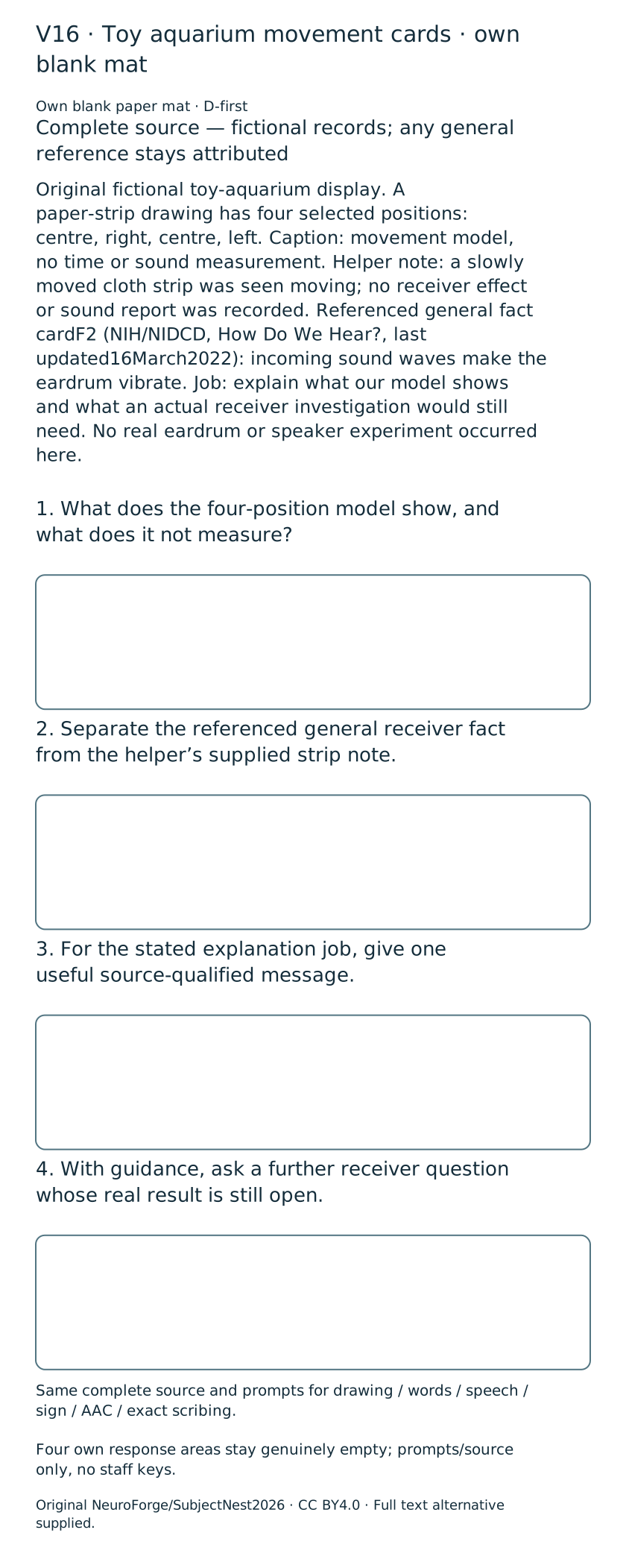
Original fictional toy-aquarium display. A paper-strip drawing has four selected positions: centre, right, centre, left. Caption: movement model, no time or sound measurement. Helper note: a slowly moved cloth strip was seen moving; no receiver effect or sound report was recorded. Referenced general fact cardF2 (NIH/NIDCD, How Do We Hear?, last updated16March2022): incoming sound waves make the eardrum vibrate. Job: explain what our model shows and what an actual receiver investigation would still need. No real eardrum or speaker experiment occurred here.
Components
Accept other responses
Accept a different source-faithful response in text/drawing/speech/sign/AAC/exact scribing. No required wording, hearing performance or neatness score. Apply only the exact prompt/criterion; no unstated physical action or result required.
Exact component criterion
Identifies selected model positions/movement representation and absent time/sound measurement; no waveform or measured vibration-frequency claim.
Exact prompt
What does the four-position model show, and what does it not measure?
Full individual next learning
Child invitation
Tell a reader what the storyboard shows and what it cannot measure.
Guided different context
Make a new four-frame paper pet-toy movement loop; choose each position deliberately.
Id
N13
Mode opportunity
This is supported teaching after review. Actual performing, reasoning about supplied stories and model construction are recorded separately. New-context transfer is a small observed step, not annual mastery or a new official grade.
Next decision
If the named distinction is still unclear, return to two source-labelled cards in this unrelated context and one prompt at a time. If clear, offer a different job/source after further learning; do not retry this held case with the staff model rehearsed.
Observable next evidence
Child describes represented movement without inventing time/distance data.
Ordinary possible model
Frames show selected positions; they do not give delivery speed.
Teacher preparation
Full account/model and a separate blank child page; cards or paper drawings as named in the guided context. Offer pointing/AAC/exact scribing and quiet helper operation. No source collection or public publication is required.
Teacher sequence
- Read the complete new account and ask which event/reference is actually supplied before showing its ordinary model.
- Read courier caption before moving cards; guide two pet frames, then child finishes and explains the model limit.
- Guide the different new context above using an open question. After child chooses, pause so they can author/select/draw their own evidence distinction; the model answer stays a teaching example, never inserted into their own work.
- Invite the child to explain one exact clue and one limit in the new task. Keep actual events, supplied stories and unperformed plans labelled. Use the observable check below to choose whether to revisit this meaning or offer a genuinely fresh task later.
Title
Courier-envelope movement model
Whole unrelated teaching account
A fictional drawing sequence places an envelope at desk, door, cart and desk; no clock readings or delivery distances exist.
Id
D-first-1
Initial own value
One possible staff response
It shows selected strip positions; it does not measure time, pitch, loudness or real sound.
Staff focus
I04 model/literal evidence limits
Accept other responses
Accept a different source-faithful response in text/drawing/speech/sign/AAC/exact scribing. No required wording, hearing performance or neatness score. Apply only the exact prompt/criterion; no unstated physical action or result required.
Exact component criterion
General incoming-sound/eardrum account is reference knowledge; helper supplied source movement without receiver observation remains distinct.
Exact prompt
Separate the referenced general receiver fact from the helper’s supplied strip note.
Full individual next learning
Child invitation
Separate general idea from an unobserved particular event.
Guided different context
Provide a new pretend light card stating “lamps can light a room” alongside an empty room observation space. No mains equipment is handled.
Id
N14
Mode opportunity
This is supported teaching after review. Actual performing, reasoning about supplied stories and model construction are recorded separately. New-context transfer is a small observed step, not annual mastery or a new official grade.
Next decision
If the named distinction is still unclear, return to two source-labelled cards in this unrelated context and one prompt at a time. If clear, offer a different job/source after further learning; do not retry this held case with the staff model rehearsed.
Observable next evidence
Child distinguishes a general statement from a specific result and keeps missing local observation open.
Ordinary possible model
A general reference does not prove it rained here today.
Teacher preparation
Full account/model and a separate blank child page; cards or paper drawings as named in the guided context. Offer pointing/AAC/exact scribing and quiet helper operation. No source collection or public publication is required.
Teacher sequence
- Read the complete new account and ask which event/reference is actually supplied before showing its ordinary model.
- Use reference/actual columns; model the weather gap, guide lamp-note classification, then invite a child-authored check question for a toy room drawing.
- Guide the different new context above using an open question. After child chooses, pause so they can author/select/draw their own evidence distinction; the model answer stays a teaching example, never inserted into their own work.
- Invite the child to explain one exact clue and one limit in the new task. Keep actual events, supplied stories and unperformed plans labelled. Use the observable check below to choose whether to revisit this meaning or offer a genuinely fresh task later.
Title
Weather-reference boundary
Whole unrelated teaching account
A fictional poster carries the supplied sentence that rain falls from clouds, but has no report for today at this school. Its fact wording is an ordinary teaching illustration, not a local forecast.
Id
D-first-2
Initial own value
One possible staff response
F2 is a general fact about incoming sound and eardrum vibration. The helper note only records seeing a strip move, not a receiver effect.
Staff focus
U02 receiver concept partial knowledge/reference vs actual
Accept other responses
Accept a different source-faithful response in text/drawing/speech/sign/AAC/exact scribing. No required wording, hearing performance or neatness score. Apply only the exact prompt/criterion; no unstated physical action or result required.
Exact component criterion
Message suits explanation purpose and uses an exact source/model/reference clue with status named; no pretended physical conducting.
Exact prompt
For the stated explanation job, give one useful source-qualified message.
Full individual next learning
Child invitation
Give a source-bounded recommendation and tell reader a limit.
Guided different context
Use a new pretend game counter box with room for three drawn tokens and a second box with no capacity note.
Id
N15
Mode opportunity
This is supported teaching after review. Actual performing, reasoning about supplied stories and model construction are recorded separately. New-context transfer is a small observed step, not annual mastery or a new official grade.
Next decision
If the named distinction is still unclear, return to two source-labelled cards in this unrelated context and one prompt at a time. If clear, offer a different job/source after further learning; do not retry this held case with the staff model rehearsed.
Observable next evidence
Child ties choice to source clue and avoids “best everywhere”.
Ordinary possible model
BagA has the purpose-relevant supplied clue, but durability remains untested.
Teacher preparation
Full account/model and a separate blank child page; cards or paper drawings as named in the guided context. Offer pointing/AAC/exact scribing and quiet helper operation. No source collection or public publication is required.
Teacher sequence
- Read the complete new account and ask which event/reference is actually supplied before showing its ordinary model.
- Read all stall notes; model one recommendation. Guide matching three-token job to exact drawing, then child adds an unresolved practical question.
- Guide the different new context above using an open question. After child chooses, pause so they can author/select/draw their own evidence distinction; the model answer stays a teaching example, never inserted into their own work.
- Invite the child to explain one exact clue and one limit in the new task. Keep actual events, supplied stories and unperformed plans labelled. Use the observable check below to choose whether to revisit this meaning or offer a genuinely fresh task later.
Title
Reusable-bag advice
Whole unrelated teaching account
A fictional stall wants a bag to hold two paper tickets. Supplied drawing shows bagA contains two, bagB untested; no real strength comparison exists.
Id
D-first-3
Initial own value
One possible staff response
Our display can say these are model positions and not an observed receiver result. The source caption says no sound measurement.
Staff focus
I06 source-qualified explanation
Accept other responses
Accept a different source-faithful response in text/drawing/speech/sign/AAC/exact scribing. No required wording, hearing performance or neatness score. Apply only the exact prompt/criterion; no unstated physical action or result required.
Exact component criterion
Relevant further receiver question with actual result unresolved; guidance allowed, no unstated test action requirement.
Exact prompt
With guidance, ask a further receiver question whose real result is still open.
Full individual next learning
Child invitation
Pose an unanswered question appropriate to the new plan rather than filling its result in advance.
Guided different context
On paper plan moving two drawing tokens into a basket; do it only if wanted and count actual placements.
Id
N16
Mode opportunity
This is supported teaching after review. Actual performing, reasoning about supplied stories and model construction are recorded separately. New-context transfer is a small observed step, not annual mastery or a new official grade.
Next decision
If the named distinction is still unclear, return to two source-labelled cards in this unrelated context and one prompt at a time. If clear, offer a different job/source after further learning; do not retry this held case with the staff model rehearsed.
Observable next evidence
Child maintains prediction/result distinction while asking a useful next enquiry.
Ordinary possible model
The prediction does not establish a result.
Teacher preparation
Full account/model and a separate blank child page; cards or paper drawings as named in the guided context. Offer pointing/AAC/exact scribing and quiet helper operation. No source collection or public publication is required.
Teacher sequence
- Read the complete new account and ask which event/reference is actually supplied before showing its ordinary model.
- Model open question from pot source; guide token prediction before action, then child records actual or unperformed status and a next question.
- Guide the different new context above using an open question. After child chooses, pause so they can author/select/draw their own evidence distinction; the model answer stays a teaching example, never inserted into their own work.
- Invite the child to explain one exact clue and one limit in the new task. Keep actual events, supplied stories and unperformed plans labelled. Use the observable check below to choose whether to revisit this meaning or offer a genuinely fresh task later.
Title
Garden-water plan unknown
Whole unrelated teaching account
A fictional watering plan predicts one cup will fill a toy pot, but no pour record exists. No plant-care amount is verified.
Id
D-first-4
Initial own value
One possible staff response
What safe evidence could show an actual receiver object responding to sound? That result is not supplied here.
Staff focus
I01/I05 guided further question
Delivery
Read/display the exact whole neutral source and prompts, with one question at a time if wanted. Do not read criteria/worked/next accounts. Each own page has initial-closed same-page full neutral source disclosure and an external whole-source link; paper mat repeats this source identity and four exact prompts.
Eligibility
Staff records learning opportunity, familiarity with source, prior answer exposure, adult help/operation/scribing, mode, self-directed versus guided reasoning and whether actual practical evidence was offered. After coaching on this source, use it as teaching and arrange genuinely fresh later evidence.
Exact four prompts
- What does the four-position model show, and what does it not measure?
- Separate the referenced general receiver fact from the helper’s supplied strip note.
- For the stated explanation job, give one useful source-qualified message.
- With guidance, ask a further receiver question whose real result is still open.
First later
First and later are eligible local evidence opportunities, not required timing or a numerical progress scale. Describing supplied outcomes does not demonstrate practical conducting; keep actual observations in a separate folio.
Id
D-first
Own response values
Role
neutral held assessment source; teacher offered only after relevant learning opportunity; independent staff criterion/models separate
Source kind
original supplied fiction; any reference fact/model explicitly labelled
Title
Toy aquarium movement cards
About this resource
Reviewed source editionSource review is complete for this two-week edition. Local suitability and classroom use still need review. Earlier candidate or pending-review words are retained in the original files; full-year coverage, translations and audio are not claimed.
Labels and search exclusions are distribution guidance; they do not authenticate or restrict access.
Exact source: 5f1257e02932ae49dd88716c3b0d208ba5e4696c · 2026-10-13. Source edition, roles and hashes
Complete source and rights notices
Keep these full notices with copies of this resource. Learning text, software, art and outside sources keep their own terms.