Use the number builder or five labelled cards, and teacher problem cards. The numbered steps in each day total 25 minutes. Children may use objects, a sketch, spoken reasoning, numeral tiles or an accessible device to show the same mathematical idea. In the final two minutes, ask the entire class to respond, then closely note 2–3 scheduled focus learners. Rotate; arrange a later quiet individual check if a group answer hid the reasoning. Assessment has keys and next moves. These Year 3 ACARA v9 links are introductory, not a finding of mastery.
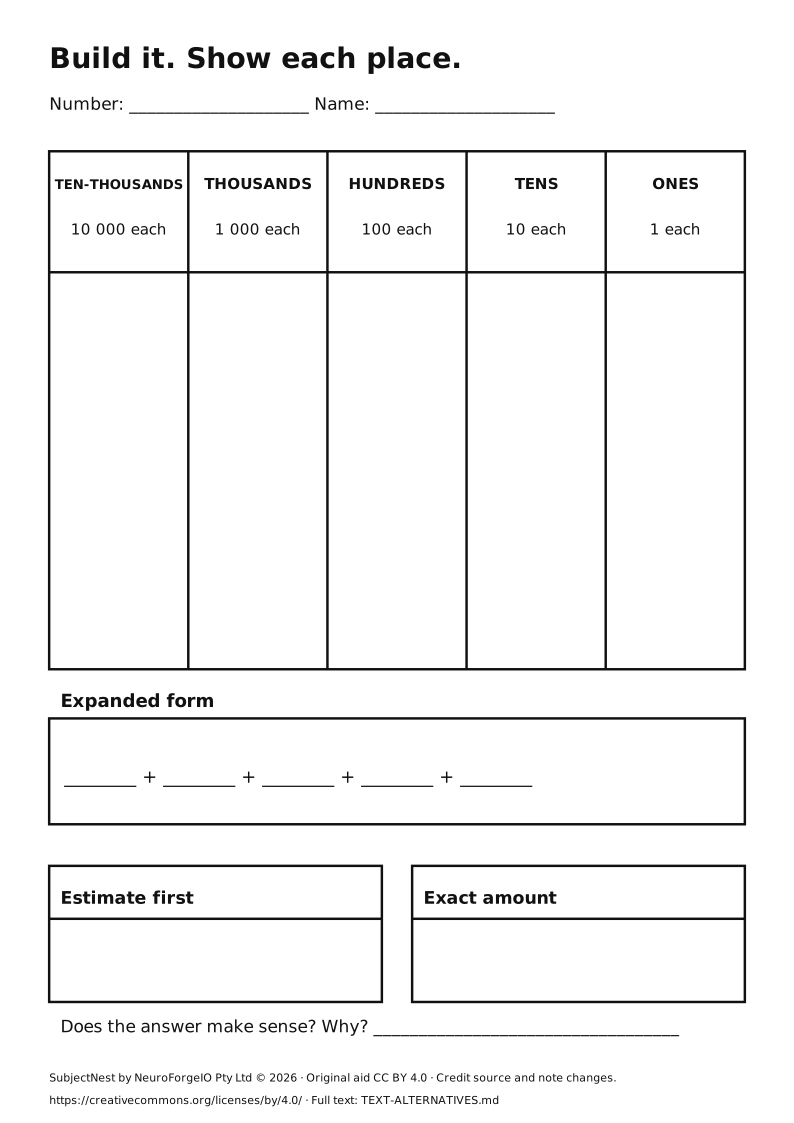
Day 1 — Five digits describe a quantity
Codes: AC9M3N01. Target: build and read 12 406 with ten-thousands, thousands, hundreds, tens and ones. Set out: place cards, digit tiles 1 2 4 0 6, paper quantity symbols.
- Launch · 3 min. Display
12 406. Ask: “Would counting one counter at a time be useful? What does each digit tell us?” Collect first thoughts without scoring. - Show the structure · 5 min. Place 1 ten-thousand card, 2 thousand cards, 4 hundred cards, no tens and 6 ones. Say: “Twelve thousand, four hundred and six. The 0 shows there are no tens. It keeps the other digits in their places.” Point as you read.
- Make together · 5 min. Switch the tiles to
12 460. Learners direct which cards must change. Ask why the last digit is now zero. Rebuild 12 406; say the full amount in words. - Try and check · 7 min. Partners build
10 235and21 035. One reads and records a place expansion; the other checks each place, then they switch. Do not use colour as the only column cue. Offer 23 105 as a challenge. - Use a context · 3 min. “A fictional visitor counter shows 12 406 visits across a year. What could the digit 4 mean?” Expected: 4 hundreds, or 400 visits within the numeral, not four individual visits.
- Brief check · 2 min. Everyone writes/selects the numeral for
1 ten-thousand, 3 thousands, 0 hundreds, 2 tens, 5 ones→ 13 025. Focus learners name the zero place. If the zero is omitted, compare builds tomorrow.
Access: raised place labels, enlarged spaced numeral, directed adult handling and verbal/AAC place names. The story context is invented and must not be reported as real attendance.
Day 2 — A zero saves the meaning
Codes: AC9M3N01. Target: distinguish 20 040, 20 400 and 2 040. Set out: five-place mat and three printed cards.
- Notice · 2 min. Show the cards side by side. Say: “They share digits but do not show the same quantity. Find the first place where they differ.”
- Think aloud · 6 min. Put
20 040into five columns: 2 ten-thousands, 0 thousands, 0 hundreds, 4 tens, 0 ones. Read “twenty thousand and forty.” Put2 040beneath it, right-aligned; point to its missing ten-thousands place. Compare20 400by the hundreds place. - Guided rename · 5 min. Model
20 040 = 20 000 + 40and20 400 = 20 000 + 400. Ask: “Which zero moved when the four moved?” Avoid saying a zero has no value; here its position communicates an empty place. - Card sort · 7 min. Pairs match spoken descriptions to all three cards, then rebuild from a blank five-place board. Teacher reads “two thousands and four tens”; the learner selects 2 040. Ask for a reason before showing the key.
- Look for an error · 3 min. Show a fictional note
20 040 = 2 040. Invite a correction using place names, not “wrong because it looks longer.” - Brief check · 2 min. Everyone represents 30 506 in five columns. Focus learners identify the thousands and tens as empty. If they say 3 056, rebuild the two numbers with cards.
Access: five tactile compartments with labels and an “empty” token; spoken numeral and print together; learner can direct placement instead of reaching across a desk.
Day 3 — Compare at the first difference
Codes: AC9M3N01. Target: order four five-digit numbers and justify the comparison. Set out: number cards 12 039, 12 309, 12 390, 13 002, rough number line 12 000–14 000.
- Start · 2 min. Ask: “Which is greater: 12 309 or 12 390? Say the place that decides.”
- Model · 5 min. Align place columns. Say: “The ten-thousands and thousands tie. The hundreds tie at three. Nine tens exceed zero tens, so 12 390 is greater.” Place the two roughly on the line without pretending the marks are exact scale.
- Guided order · 6 min. Compare 12 039 and 12 309. Let learners name zero hundreds versus three hundreds. Add 13 002; ask why it comes last even though it ends in 002.
- Independent pair order · 7 min. Pairs place all four least to greatest, then read their sequence and point to the deciding digit for each neighbour. Have them reorder shuffled cards without teacher demonstration. A ready pair can add 12 903 and defend its place.
- Reasonableness · 3 min. “Could 13 002 be nearer 12 000 than 12 039 is?” No: 13 002 is just over 13 000; ask learners to use the endpoints, not visual card length.
- Brief check · 2 min. Everyone selects the larger of 12 045 and 12 405 and names the hundreds place as deciding. Rebuild with place cards if the last two digits distract.
Access: desk or floor number line, text labels, paired auditory description, large cards. The explanation is the evidence, not only card position.
Day 4 — Estimate, then make the count checkable
Codes: AC9M3N05. Target: estimate a collection, group-count it and judge the estimate. Set out: the teacher's sealed clear container of 47 identical large paper counters or an accessible tray; count and record the true amount before class.
- Invite · 3 min. Show the container briefly. Say: “Without opening or counting each piece yet, what is a sensible estimate? Give a reason, such as ‘more than 30 but less than 60’.” Keep estimates private initially.
- Model a benchmark · 4 min. Show a separate visible group of ten counters. Say: “I can compare the container with this ten. I think there are several tens.” Do not reveal 47.
- Revise a guess · 6 min. Let children view from another angle. They write/select an interval and one estimate, then decide whether to revise. Ask: “What new observation changed your thinking?” An estimate is allowed to differ from the exact count.
- Count by groups · 7 min. Adult opens the container at a controlled desk; pairs organise into tens and singles or the teacher moves pieces at a child's direction. Count 4 tens and 7 singles = 47. If opening is inappropriate, use an adult-recorded video-free sequence of pictures or prepared tactile groups and note the change of evidence route.
- Compare · 3 min. Ask: “Was your estimate near 47? Was your interval wide enough? What would help next time?” Do not score precision alone; a reason and revision matter.
- Brief check · 2 min. Show 18 counters for 5 seconds. Everyone estimates
about 20and gives a comparison with 10. Focus learners explain. Recount together after collecting responses.
Access: large visible tokens, tactile ten bundles after the first estimate, private number selection or AAC. Keep counters away from mouths; use paper squares too large to be a choking hazard under local policy.
Day 5 — Place and estimate: a teaching check
Codes: AC9M3N01, AC9M3N05. Target: sample what is secure about five-digit place and estimate reasoning. Set out: Check A, mat, 38 paper counters hidden until the estimate task.
- Purpose · 2 min. Say: “Show how you chose, so I can choose useful practice for next week.”
- Rehearsal · 5 min. With the class build 16 230 and explain its zero ones. Rehearsal is not scored evidence.
- Place prompt · 6 min. Everyone represents 14 305 and compares it with 14 350. Ask for the first different place. Sample a small planned group privately at the side table; note help given.
- Estimate prompt · 7 min. Show the new 38-counter tray briefly. Learners record an interval/estimate before counting. Group into tens and ones, count 38 and explain how the estimate changed. A partner can count while learner directs groups; record who did what.
- Feedback · 3 min. Give a concrete observation: “You kept the zero tens in 14 305. Let's practise finding the first different place when we compare.” Let each learner repair one part.
- Close · 2 min. Child names a place or counting strategy to reuse. Teacher keeps check answers and a next step, not a permanent ability label.
Access: independent explanation can be collected later in a short quiet station. If vision or motor access blocks the first estimate, use tactile sealed bag size/weight with matched comparison bags, and note that it is a different estimation task.
Day 6 — Add by making places work
Codes: AC9M3N03, AC9M3A02. Target: add 268 + 157 by place-value regrouping, no calculator. Set out: hundreds/tens/ones cards, paper exchange tokens.
- Frame · 2 min. Ask: “About how much is 268 + 157?” Accept
about 270 + 160 = 430as a benchmark, not an exact answer. - Model · 5 min. Build 268 and 157. Combine ones: 8 + 7 = 15, exchange 10 ones for 1 ten. Combine tens: 6 + 5 + 1 = 12 tens, exchange 10 tens for 1 hundred. Combine hundreds: 2 + 1 + 1 = 4. Say: “The total is 425. It is close to our estimate.”
- Guided example · 6 min. Solve 146 + 185 together. Learners direct exchanges: 6 + 5 = 11 ones; 4 + 8 + 1 = 13 tens; 1 + 1 + 1 = 3 hundreds, 3 tens, 1 one → 331. Check by subtracting 185 if ready.
- Partner practice · 7 min. Offer 237 + 148 and 356 + 129; both equal 385 and 485 respectively. One partner explains the exchange, the other checks with a different decomposition. Use a two-digit example if needed while preserving exchange logic.
- Talk about errors · 3 min. Show
268 + 157 = 315and ask what happened to an exchanged hundred. Return to the models; do not simply say “carry the one.” - Brief check · 2 min. Everyone works 184 + 137 = 321 and points to the ten made from 4 + 7 ones. Focus learners explain an exchange or an alternative valid strategy.
Access: enlarged cards, tactile bundles, partner handling under learner direction, speech/AAC/drawing. Value reasoning matters more than neat columns.
Day 7 — Subtract with an exchange you can see
Codes: AC9M3N03, AC9M3A02. Target: explain 534 − 278 using place values or a checked number-line route. Set out: exchange cards, open number line.
- Frame · 2 min. Say: “If 278 is removed from 534, the answer must be smaller than 534. Roughly, 530 − 280 is 250.”
- Model · 5 min. Build 534. Exchange one ten for ten ones: 14 ones − 8 = 6. Exchange one hundred for ten tens: 12 tens − 7 = 5. Now 4 hundreds − 2 = 2. The remaining amount is 256; check with
256 + 278 = 534. - Second path · 6 min. Count up from 278: +22 to 300, +200 to 500, +34 to 534. Sum jumps
22 + 200 + 34 = 256. Ask why both paths solve the same missing-part question. - Partner attempts · 7 min. Choose 421 − 186 = 235 or 603 − 247 = 356. Partners show exchanges or count-up jumps, then verify by addition. Teacher listens for missing exchange or wrong total of jumps.
- Error repair · 3 min. Write an intentionally incomplete
534 − 278 = 344. Ask: “Could the ones be 4 when 4 − 8 needs an exchange?” Let children revise with pieces. - Brief check · 2 min. Everyone solves 302 − 157 = 145 or builds a count-up path 157→302. Focus learners state a check. If exchange across a zero is not yet secure, return to 302 with visible cards tomorrow.
Access: children can choose the equivalent number-line method; a scribe marks jumps they direct. Keep operation understanding separate from handwriting.
Day 8 — Addition can reveal a missing part
Codes: AC9M3A01, AC9M3N03. Target: solve □ + 185 = 432 and verify with the inverse. Set out: whole/part cards, number line.
- Notice · 2 min. Ask: “Which number is the whole? Is the box a part or a total?” Put 432 in the whole position.
- Model · 5 min. Say: “If a part and 185 make 432, I can find the missing part with
432 − 185.” Count up 185→200 (+15), 200→400 (+200), 400→432 (+32);15 + 200 + 32 = 247. Check247 + 185 = 432. - Guided task · 6 min. Solve
□ + 128 = 350as a class → 222. Invite one child to model 350−128 and another to check 222+128. Ask what “inverse” means here: an operation can undo the other for these whole/part quantities. - Choice practice · 7 min. Partners choose
276 + □ = 503→ 227, or□ − 168 = 245→ 413. Identify whether the unknown is whole or part first. Try objects, column cards or number line; record the checking sentence. - Discuss trap · 3 min. Ask why
185 − 432would not find a positive missing part for the first task. Let a learner use whole/part cards to explain. - Brief check · 2 min. Everyone fills
□ + 137 = 400→ 263 and shows400 − 137 = 263or another valid route. Focus learners explain which quantity is whole.
Access: raised whole/part cards, audible instructions, large spacing for the box, AAC labels for part, whole, check. Avoid a timed speed contest.
Day 9 — A practical story needs a sensible answer
Codes: AC9M3N03, AC9M3N05, AC9M3N06. Target: choose and interpret an additive model in a fictional useful context. Set out: problem cards, drawing sheet.
- Read the situation · 2 min. “The school library has 327 sorted books and 186 still to sort. How many books are in these two groups altogether?” Explain these are invented counts, not real school records.
- Estimate and model · 5 min. Ask for an approximate total, e.g. 330 + 190 ≈ 520. Draw two parts into one whole; write
327 + 186and solve by place value: 7 + 6 = 13, 2 + 8 + 1 = 11 tens, 3 + 1 + 1 = 5 hundreds → 513 books. - Guided reasonableness · 6 min. Compare 513 with the estimate and with an incorrect 1 513. Ask what an extra thousand would mean in this situation. Check
513 − 186 = 327. - Choice problems · 7 min. Pairs pick the book problem again with a different model, or “An art room had 600 paper tiles; 275 were used. How many remain?” → 325 tiles. Require a diagram or equation, a named unit and one check. Teacher asks “Which quantity is the whole?”
- Explain to a user · 3 min. Partners trade explanations. Listener asks whether the answer counts books or tiles and why the operation matches the story.
- Brief check · 2 min. Everyone writes/says a checking equation for their choice. Focus learners give a reasoned unit and check, not an unsupported numeral.
Access: adult read-aloud so English decoding does not control maths, manipulatives, picture-free text, scribed equation, AAC operation choice. Record any calculation prompt separately.
Day 10 — Choose the next model from evidence
Codes: AC9M3N01, AC9M3N03, AC9M3N05, AC9M3N06, AC9M3A01. Target: sample place-value reasoning and an additive problem; name a next practice step. Set out: Check B, number builder, quiet station.
- Purpose · 2 min. Say: “Today I want to see your model and your check. You can change your answer if you find a reason.”
- Rehearse · 5 min. Together represent 15 204 and solve 24 + 18 = 42. State that the new prompts, not this review, will be recorded.
- Place task · 6 min. Everyone builds 14 307 and chooses the larger of 14 307 and 14 370. Ask for the first different place. Quietly sample scheduled focus learners and note help.
- Problem task · 7 min. Read: “There are 346 tickets in one box and 178 in another. How many tickets altogether?” Children estimate, model, solve 524 tickets, then write/show an inverse check. Let classmates work independently while teacher samples; collect work before a shared answer.
- Feedback · 3 min. Respond to actual work: “Your estimate was in the right hundreds. Let's revisit the ten exchange that changed your exact answer.” Choose a model to practise next.
- Close · 2 min. Learners indicate a strategy they want to reuse. Mark
independent / with a prompt / not yet observed; a correct peer-copied number is not individual evidence.
Access and time: one teacher cannot privately hear every child in this 25-minute block. Rotate short 3–4 minute interviews across Days 8–10 or a later station. Do not turn the result into an end-of-year judgement.
Rights: Original lessons © NeuroForgeIO Pty Ltd 2026, SubjectNest, CC BY 4.0. Attribute, link and note changes. ACARA codes have separate terms.