Public educator selection · preserve first work before criteria or later sources. These pages are public; record prior access.
V02 · Complete staff assessmentYear 4 Maths · T2 W13–14 · Staff · Assessment / Staff / V02
Find how many groups, rather than how many in each
Local four criteria
• Formulate: identify what is known, what is unknown, and what the quantities count; choose a model that matches the supplied situation.
• Solve: connect a representation with a correct number sentence and use a suitable efficient strategy; distinguish selected no-calculator evidence from a digital check.
• Check: choose an estimate, inverse operation or second representation appropriate to the day; explain its limits for a close budget decision.
• Interpret: give the result with a contextual unit and a usable conclusion that respects the stated constraints and assumptions.
Record real exposure, reasoning and support. A/B/C/D choices are not independence or official A–E bands. Hide staff models before own work.
V02A · Complete held case
Whole neutral prompt
For envelopes of pretend tickets, there are 24 items in total and 6 items in each complete group. How many groups can be made? Show the grouping and label the answer.
Specific criterion
Use the known total and group size to find and label the unknown number of complete groups.
One acceptable staff response
24 ÷ 6 = 4 groups; 4 × 6 = 24 items checks the total.
Support/interpretation
Treat the worked model as one acceptable example, not an exhaustive answer list. Accept an equivalent accurate representation and explanation. Record actual reasoning, help and units; do not infer mastery from a copied answer.
Separate changed practice
A further complete group of 6 items arrives. With 30 items and 6 in each group, how many groups are there?
Changed practice staff model
30 ÷ 6 = 5 groups.
Named next lesson
If this target needs more teaching, use N05.
Give the exact material
Complete neutral V02A · Separate four-empty-response page · Exactly source-matched paper · Matched family blank SVG · Complete terms · Complete matching blank alternative · Full next teaching N05
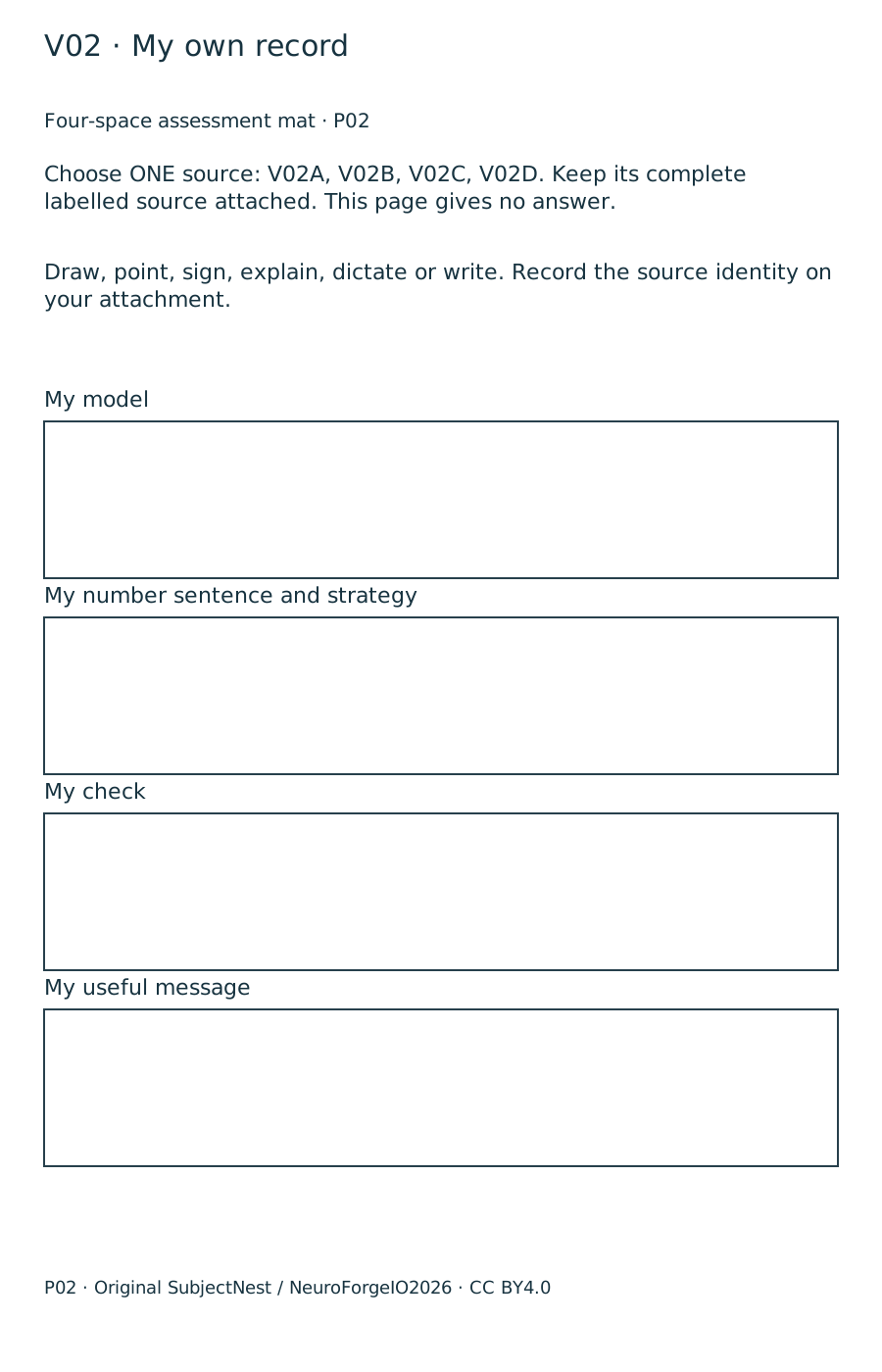
V02B · Complete held case
Whole neutral prompt
For bundles of workshop labels, there are 30 items in total and 5 items in each complete group. How many groups can be made? Show the grouping and label the answer.
Specific criterion
Use the known total and group size to find and label the unknown number of complete groups.
One acceptable staff response
30 ÷ 5 = 6 groups; 6 × 5 = 30 items checks the total.
Support/interpretation
Treat the worked model as one acceptable example, not an exhaustive answer list. Accept an equivalent accurate representation and explanation. Record actual reasoning, help and units; do not infer mastery from a copied answer.
Separate changed practice
A further complete group of 5 items arrives. With 35 items and 5 in each group, how many groups are there?
Changed practice staff model
35 ÷ 5 = 7 groups.
Named next lesson
If this target needs more teaching, use N06.
Give the exact material
Complete neutral V02B · Separate four-empty-response page · Exactly source-matched paper · Matched family blank SVG · Complete terms · Complete matching blank alternative · Full next teaching N06
V02C · Complete held case
Whole neutral prompt
For packs of game cards, there are 48 items in total and 8 items in each complete group. How many groups can be made? Show the grouping and label the answer.
Specific criterion
Use the known total and group size to find and label the unknown number of complete groups.
One acceptable staff response
48 ÷ 8 = 6 groups; 6 × 8 = 48 items checks the total.
Support/interpretation
Treat the worked model as one acceptable example, not an exhaustive answer list. Accept an equivalent accurate representation and explanation. Record actual reasoning, help and units; do not infer mastery from a copied answer.
Separate changed practice
A further complete group of 8 items arrives. With 56 items and 8 in each group, how many groups are there?
Changed practice staff model
56 ÷ 8 = 7 groups.
Named next lesson
If this target needs more teaching, use N07.
Give the exact material
Complete neutral V02C · Separate four-empty-response page · Exactly source-matched paper · Matched family blank SVG · Complete terms · Complete matching blank alternative · Full next teaching N07
V02D · Complete held case
Whole neutral prompt
For sets of display pictures, there are 72 items in total and 9 items in each complete group. How many groups can be made? Show the grouping and label the answer.
Specific criterion
Use the known total and group size to find and label the unknown number of complete groups.
One acceptable staff response
72 ÷ 9 = 8 groups; 8 × 9 = 72 items checks the total.
Support/interpretation
Treat the worked model as one acceptable example, not an exhaustive answer list. Accept an equivalent accurate representation and explanation. Record actual reasoning, help and units; do not infer mastery from a copied answer.
Separate changed practice
A further complete group of 9 items arrives. With 81 items and 9 in each group, how many groups are there?
Changed practice staff model
81 ÷ 9 = 9 groups.
Named next lesson
If this target needs more teaching, use N08.
Give the exact material
Complete neutral V02D · Separate four-empty-response page · Exactly source-matched paper · Matched family blank SVG · Complete terms · Complete matching blank alternative · Full next teaching N08
All four full next lessons
• N05
• N06
• N07
• N08
Ordinary paper is different
Ordinary eight-field paper is not this held four-space task. Use the matched source and paper above.
About this resource
Reviewed source editionSource review is complete for this two-week edition. Local suitability and classroom use still need review. Earlier candidate or pending-review words are retained in the original files; full-year coverage, translations and audio are not claimed.
Labels and search exclusions are distribution guidance; they do not authenticate or restrict access.
Exact source: 577058ced649e2f96e3de794aca72319074fb4c0 · 2026-10-15. Source edition, roles and hashes
Complete source and licence companions
Keep these complete conditions with PDF, SVG, text and ZIP copies. PDFs use the complete separate source and licence companions below; the downloadable packets keep their declared companions.