Public educator selection · preserve first work before criteria or later sources. These pages are public; record prior access.
Teacher plan · Day 62Year 4 Maths · T2 W13–14 · Teacher · Teacher / Day 62
About 35–45 minutes, or several shorter visits. This is an unpiloted planning suggestion, not a QCAA condition or a required dose.
Prepare and access
Prepare scrap paper, suitable large counters and labels. Prices/fees/offers and transport capacities are fictional. Device use is optional. Hide models before individual work.
• Keep the mathematical purpose when changing mode. Do not assume a diagnosis predicts a preferred way to learn.
• Offer a quiet place, one instruction at a time, a preview of the steps, a pause card and a visible finish point. No countdown, flashing rewards or forced sound.
• Provide large text, high contrast, plain borders and a complete text alternative to each visual. Colour must never carry the only meaning.
• For motor access, use a selection-and-destination control rather than drag-only interaction, large physical pieces or an adult moving pieces as directed.
• For language access, explain group, each, total, left, fee, estimate and budget using the current story. Home-language explanations and bilingual notes are welcome; mathematical reasoning is assessed separately from spelling or English fluency.
• Reduce a number range or show part of a model when appropriate, then record the change. These supports do not certify the original task independently completed.
• No translation is represented as verified without a fluent reviewer and a recorded version. No invented First Nations language words, stories or cultural designs; seek the appropriate community’s permission and language guidance before a local cultural adaptation.
Complete day sequence
Day62 · How many packs can we make?
Purpose: When the amount in each group is known, find the number of complete groups and label that unknown.
Materials: scrap paper,labelled groups,suitable large counters; plain fictional price/fee cards when relevant. No bought kit,device or printer required.
Demonstration · D62
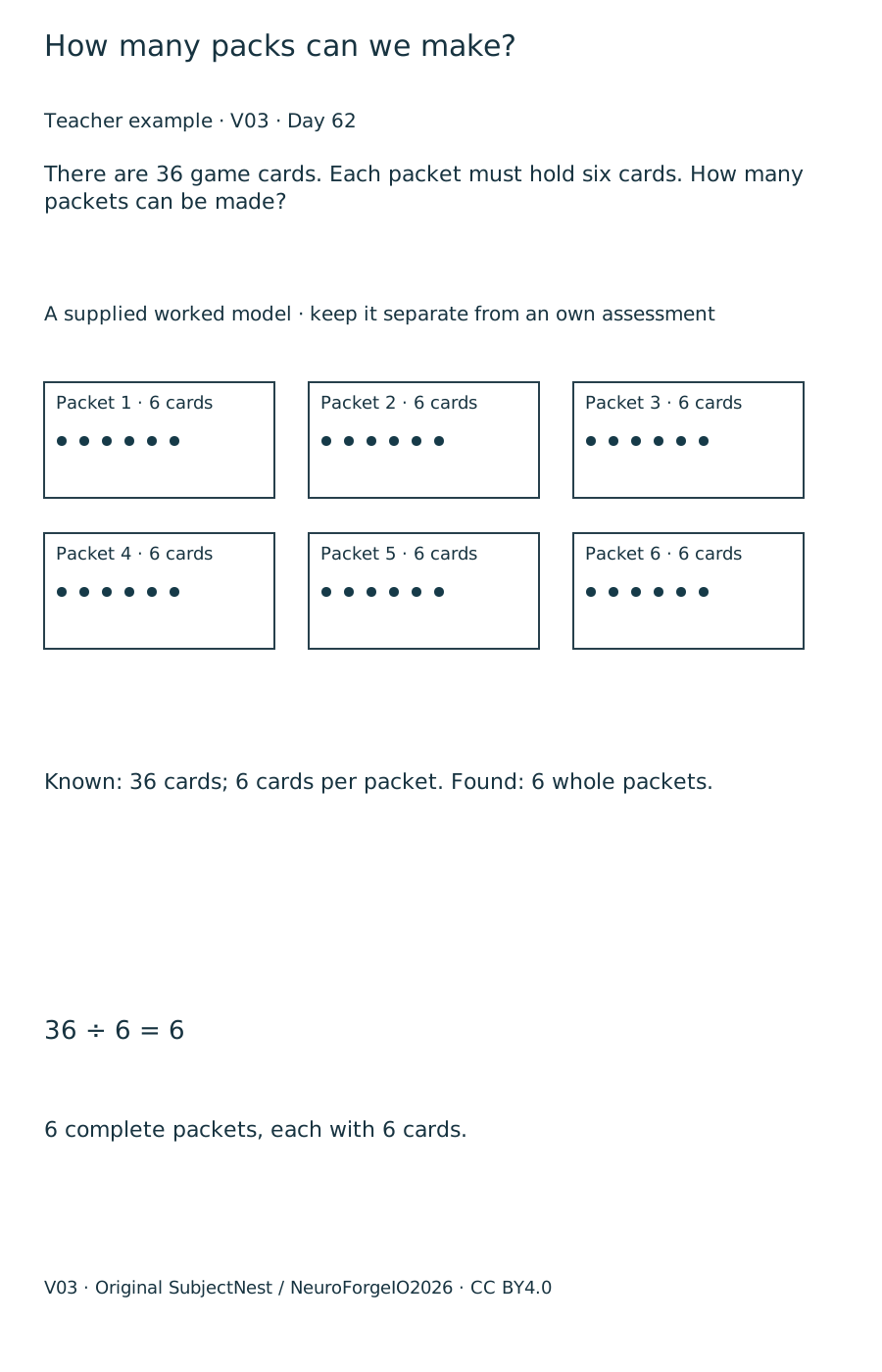
There are 36 game cards. Each packet must hold six cards. How many packets can be made?
Make one packet of six counters, then a second, without naming the total number of packets in advance. Keep making equal packets until all 36 are used. Circle each packet once while counting the six packets. Ask what the first six in 6 × 6 describes and what the second six describes: packets and cards per packet are different roles even when their values match. Show 6 × 6 = 36 and 36 ÷ 6 = 6 as a check. Include a contrast: knowing there are six packets would be a different question.
Model: 36 ÷ 6 = 6. 6 complete packets, each with 6 cards.
Transfer probe: Use 24 cards and six cards per packet. We need 4 packets; the answer counts packets, not cards in each.
Watch for: Writing '6 cards' for the unknown packets; drawing six groups merely because six appears in the question; stopping after one packet.
Three complete learner briefs
A: Put 24 pretend tickets into envelopes that hold four tickets each.
Teacher example: 24 ÷ 4 = 6 envelopes; label the unknown role.
B: Arrange 42 seed-picture cards in sets of six for an indoor paper garden.
Teacher example: 42 ÷ 6 = 7 sets; label the unknown role.
C: Sort 72 event labels into bundles of eight labels each.
Teacher example: 72 ÷ 8 = 9 bundles; label the unknown role.
Own, check and next
Use W02's four empty spaces and a complete selected brief. Ask for known/unknown quantities, model, sentence/strategy, check and useful message. Use C03/C04 individually and record actual support; copied work is not independent evidence. If needed choose the corresponding V01–V08target/fullN01–N32fresh mini-lesson. H02/X02 are optional new settings, not compulsory extra workload.
Complete class routine
• Connect: 3–5 minutes. Read the purpose. Ask what the numbers count and which amount is missing. Permit quiet thinking before replies.
• Model: 7–10 minutes. Use the day’s exact demonstration. Point to every term in the representation. Show the worked answer as a teacher example, then remove it before individual work.
• Try: 10–15 minutes. Learner chooses A, B or C after the teacher checks number demand. Make, draw, explain, sign, point or type; adults may scribe exactly what is dictated. Ask for the contextual unit and one check.
• Compare: 5–8 minutes. Share two strategies with consent. A learner may use an anonymous sample or work privately. Discuss the supplied work, not the person.
• Exit: 3–5 minutes. Use a C item individually. Record mathematical reasoning and the support given. Revisit the matching next-teaching target when needed.
Give the material
Learner day · Full worksheet/three briefs · Supplied teacher model · Complete terms · Full model alternative · Complete written read-aloud
First neutral exit · Second neutral exit · First staff exit · Second staff exit
Full worksheet staff note
Use the complete Day62 plan and C03/C04 exit. Record route and supports. Accept clear equivalent models; drawing neatness and spelling are not maths criteria.
About this resource
Reviewed source editionSource review is complete for this two-week edition. Local suitability and classroom use still need review. Earlier candidate or pending-review words are retained in the original files; full-year coverage, translations and audio are not claimed.
Labels and search exclusions are distribution guidance; they do not authenticate or restrict access.
Exact source: 577058ced649e2f96e3de794aca72319074fb4c0 · 2026-10-15. Source edition, roles and hashes
Complete source and licence companions
Keep these complete conditions with PDF, SVG, text and ZIP copies. PDFs use the complete separate source and licence companions below; the downloadable packets keep their declared companions.