Teacher plan · Day 65
About 35–45 minutes, or several shorter visits. This is an unpiloted planning suggestion, not a QCAA condition or a required dose.
Prepare and access
Prepare scrap paper, suitable large counters and labels. Prices/fees/offers and transport capacities are fictional. Device use is optional. Hide models before individual work.
• Keep the mathematical purpose when changing mode. Do not assume a diagnosis predicts a preferred way to learn.
• Offer a quiet place, one instruction at a time, a preview of the steps, a pause card and a visible finish point. No countdown, flashing rewards or forced sound.
• Provide large text, high contrast, plain borders and a complete text alternative to each visual. Colour must never carry the only meaning.
• For motor access, use a selection-and-destination control rather than drag-only interaction, large physical pieces or an adult moving pieces as directed.
• For language access, explain group, each, total, left, fee, estimate and budget using the current story. Home-language explanations and bilingual notes are welcome; mathematical reasoning is assessed separately from spelling or English fluency.
• Reduce a number range or show part of a model when appropriate, then record the change. These supports do not certify the original task independently completed.
• No translation is represented as verified without a fluent reviewer and a recorded version. No invented First Nations language words, stories or cultural designs; seek the appropriate community’s permission and language guidance before a local cultural adaptation.
Complete day sequence
Day65 · Two workable plans
Purpose: Compare two equal-group plans, explain the unknown in each and make a decision for a stated purpose.
Materials: scrap paper,labelled groups,suitable large counters; plain fictional price/fee cards when relevant. No bought kit,device or printer required.
Demonstration · D65
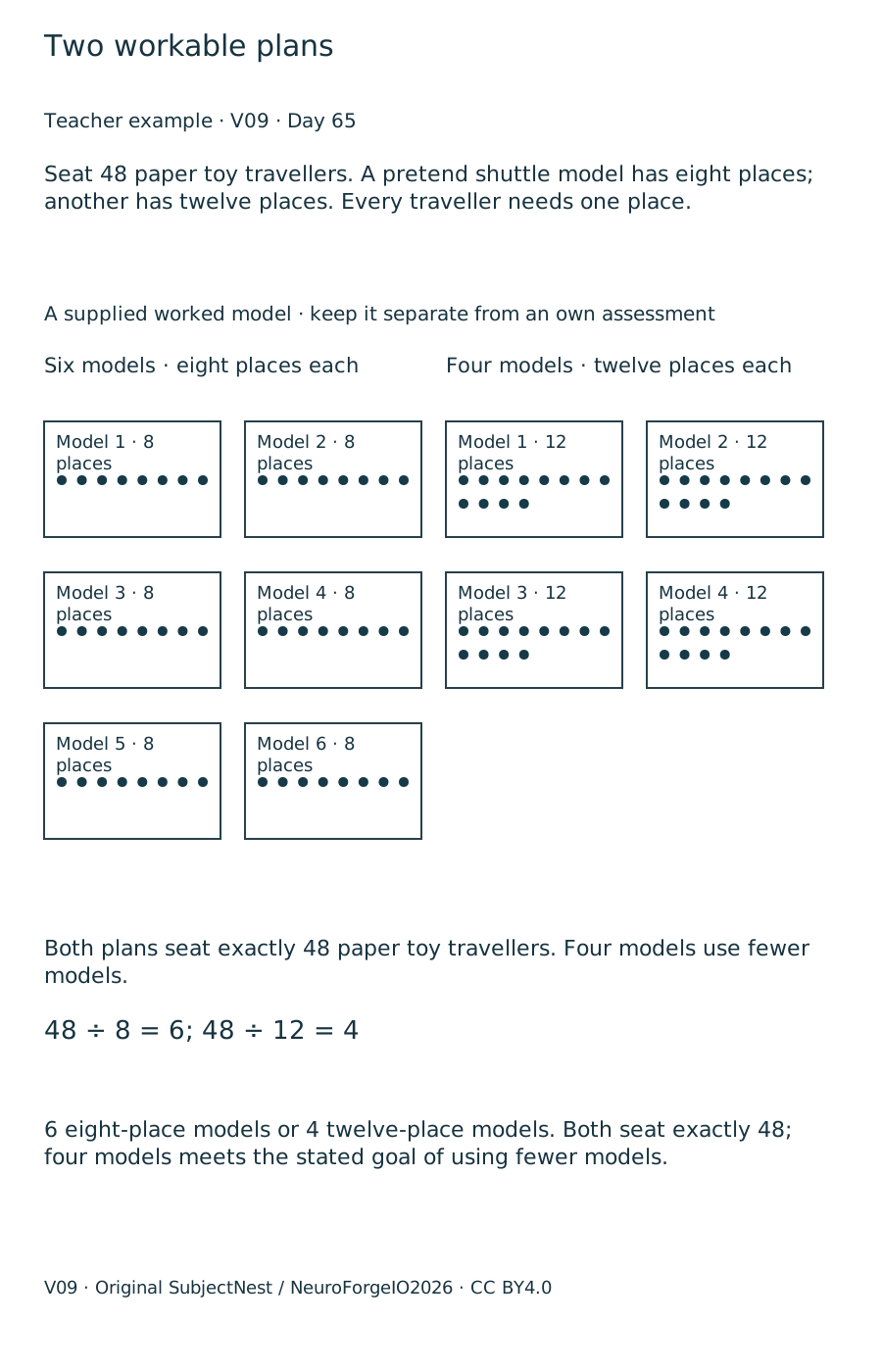
Seat 48 paper toy travellers. A pretend shuttle model has eight places; another has twelve places. Every traveller needs one place.
Read the purpose aloud: choose the plan that uses fewer paper models while giving each traveller one place. Model both divisions, then multiply each result by its capacity. Ask which number means travellers, places per model and models. The answer is conditional on the supplied purpose; using fewer models is not a claim about real transport safety, costs, emissions or actual vehicles. Invite a second purpose, such as fitting a narrow paper shelf, but supply the shelf facts before deciding. Use toy figures, dots or spoken reasoning; nobody must act as a passenger.
Model: 48 ÷ 8 = 6; 48 ÷ 12 = 4. 6 eight-place models or 4 twelve-place models. Both seat exactly 48; four models meets the stated goal of using fewer models.
Transfer probe: If the purpose changes to using the eight-place models already available, six may be a sensible choice. Mathematical validity and a practical preference need separate reasons.
Watch for: Choosing the larger capacity without calculating; comparing 8 and 12 as if they were numbers of vehicles; importing unsupplied facts about real buses.
Three complete learner briefs
A: Arrange 32 paper visitor tokens in rows of eight or rows of four. Choose fewer rows.
Teacher example: 32 ÷ 8 = 4 rows; 32 ÷ 4 = 8 rows. Both supply the required total; select fewer groups for the supplied purpose.
B: Seat 48 toy travellers in paper models with eight places or twelve places. Choose fewer models.
Teacher example: 48 ÷ 8 = 6 models; 48 ÷ 12 = 4 models. Both supply the required total; select fewer groups for the supplied purpose.
C: Bundle 72 blank cards in bundles of nine or bundles of eight. Choose fewer bundles.
Teacher example: 72 ÷ 9 = 8 bundles; 72 ÷ 8 = 9 bundles. Both supply the required total; select fewer groups for the supplied purpose.
Own, check and next
Use W05's four empty spaces and a complete selected brief. Ask for known/unknown quantities, model, sentence/strategy, check and useful message. Use C09/C10 individually and record actual support; copied work is not independent evidence. If needed choose the corresponding V01–V08target/fullN01–N32fresh mini-lesson. H05/X05 are optional new settings, not compulsory extra workload.
Complete class routine
• Connect: 3–5 minutes. Read the purpose. Ask what the numbers count and which amount is missing. Permit quiet thinking before replies.
• Model: 7–10 minutes. Use the day’s exact demonstration. Point to every term in the representation. Show the worked answer as a teacher example, then remove it before individual work.
• Try: 10–15 minutes. Learner chooses A, B or C after the teacher checks number demand. Make, draw, explain, sign, point or type; adults may scribe exactly what is dictated. Ask for the contextual unit and one check.
• Compare: 5–8 minutes. Share two strategies with consent. A learner may use an anonymous sample or work privately. Discuss the supplied work, not the person.
• Exit: 3–5 minutes. Use a C item individually. Record mathematical reasoning and the support given. Revisit the matching next-teaching target when needed.
Give the material
Learner day · Full worksheet/three briefs · Supplied teacher model · Full model alternative · Complete written read-aloud
First neutral exit · Second neutral exit · First staff exit · Second staff exit
Full worksheet staff note
Use the complete Day65 plan and C09/C10 exit. Record route and supports. Accept clear equivalent models; drawing neatness and spelling are not maths criteria.