Day 33 · Drops on the outside
Start: “Where could these outside drops come from?”
Purpose: Explain condensation as vapour becoming liquid droplets and use a comparison clue carefully.
Prepare
Read today's complete model and two contexts before the session. Paper, a pencil and the full written picture words are sufficient. Optional actual water work follows ordinary preparation; the teacher chooses suitable familiar materials/instruments. Use today's three routes without assigning a fixed learning-style label.
Run the session
- Reconnect: use the invisible vapour card; gas in air is water even when no drops are visible.
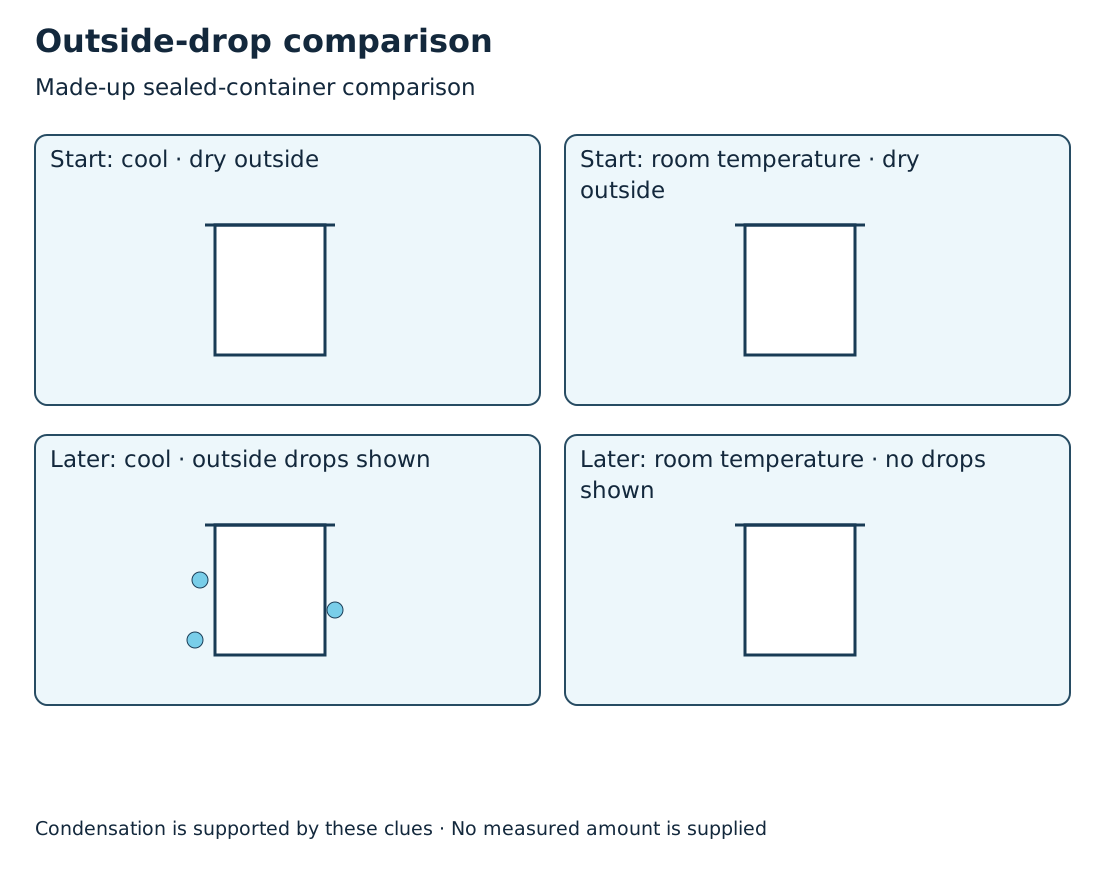
- Model: supplied source shows two dry sealed containers at the start, one cool and one room-temperature. Later tiny outside drops are shown on the cool one. Condensation is a supported explanation; this is not a leak test proving every wet container has the same cause.
- Try: sort labels “vapour in surrounding air”, “cool outside surface”, “liquid drops”. Optional adult-prepared safe sealed cool container observation uses a towel, no touching requirement and actual before/after records.
- Compare: ask why a dry starting outside, sealed top and comparison container help. If conditions are not matched or a spill occurs, record that limitation. We do not force a visible result.
- Make: label the direction vapour → condensation → liquid drops. Explain that these outside drops are not precipitation from a cloud.
- Exit: “Condensation changes __ into __. The supplied clue is __.” Retain source access.
Three ways in
Outside-drop diagram
Label the given sealed-cup comparison without touching water; use the written source table when the picture is hard to see.
Worked ordinary reasoning: Vapour in air changes into drops on the cool outside surface; condensation is supported by the supplied dry-start comparison.
Watch and record
Observe the teacher-prepared containers and dictate a before/after observation; describe whether drops actually appeared, including no visible change.
Worked ordinary reasoning: I saw __ on the outside at __; if nothing appeared I record that rather than copying the model result.
Direction puzzle
Choose which of two arrows fits “outside droplets formed”: liquid→gas or gas→liquid, then give the scientific name.
Worked ordinary reasoning: Gas→liquid; condensation. This source does not measure how many drops formed.
Look and choose the next teaching
Correct state direction, relevant supplied/actual clue and no rain/leak overclaim.
For a reversed arrow, compare this direction to Day 32 and use new bottle/window examples.
Today's complete resources
A03 · whole labelled picture · A03 · complete picture words
A05 · whole labelled picture · A05 · complete picture words
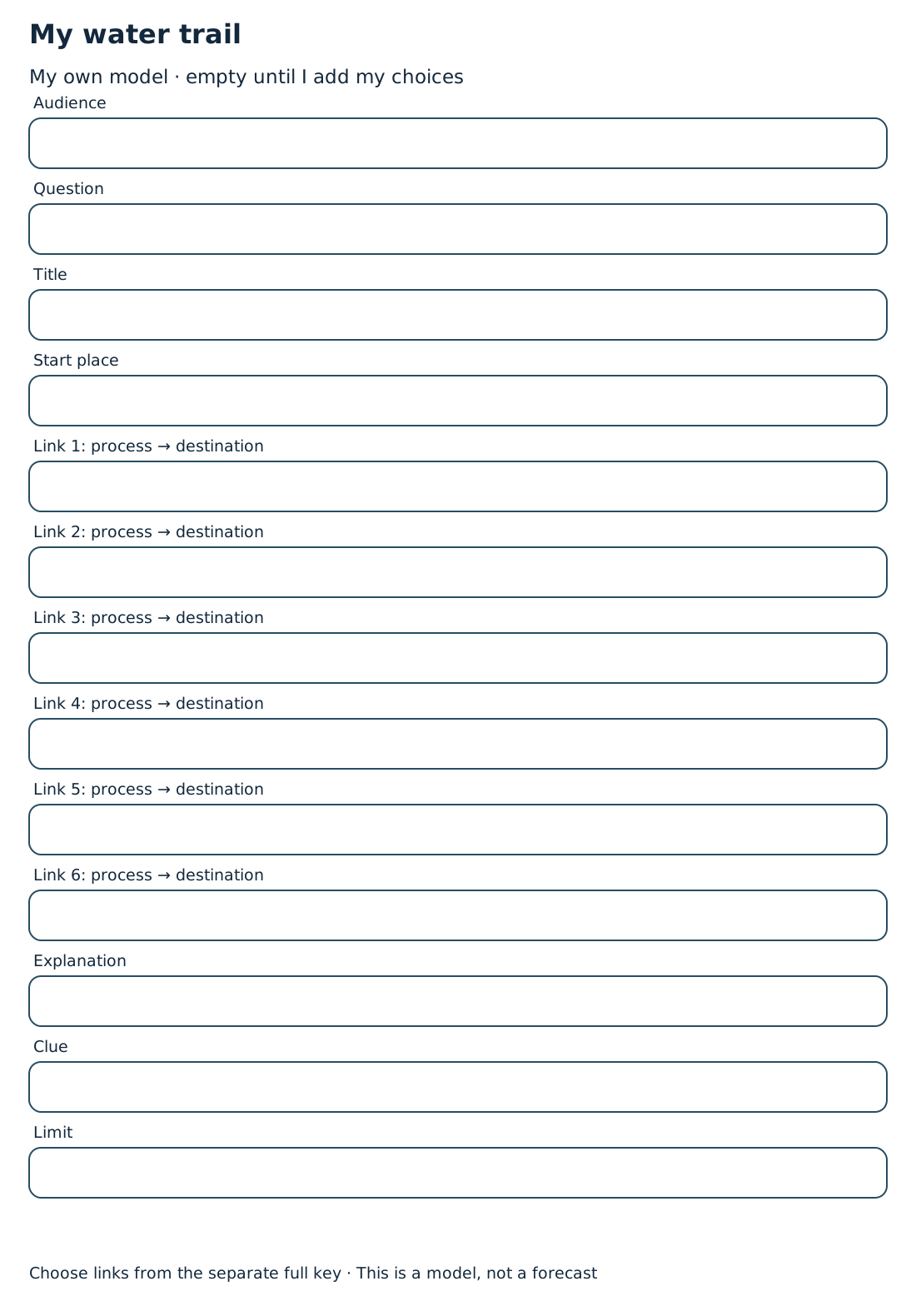
Short child start · Written read-aloud · Water Trail and paper
Partial opportunities: AC9S4U02, AC9S4I01, AC9S4I02, AC9S4H01 · Full mapping and limits
Grown-up help
Allow source access and neutral reading/support. Keep supplied story, child response, helper actions and actual observation distinct. Use component-specific criteria after the response, not a model answer before it. Suggested six-move timing 4/7/12/8/6/3 minutes may be split; there is no performance timer.
Modified from Year 4 Science alignment, standard elaborations and Years 3–4 techniques and conditions, © State of Queensland (QCAA) 2023, covered CC BY 4.0 with exceptions. Our task criteria are original; these are not official A–E bands. Actual folio and on-balance professional judgment remain necessary.