Start: “Make a trail from sky to land or ocean.”
Purpose: Identify precipitation and connect the three key processes through sky, landscape and ocean without a fixed-clock claim.
Prepare
Read today's complete model and two contexts before the session. Paper, a pencil and the full written picture words are sufficient. Optional actual water work follows ordinary preparation; the teacher chooses suitable familiar materials/instruments. Use today's three routes without assigning a fixed learning-style label.
Run the session
-
Reconnect: recall evaporation and condensation in either order of explanation; a water cycle has no required starting point.
-
Model: ocean liquid → evaporation → vapour in air → condensation → cloud droplets → precipitation → land water. Snow/ice forms are acknowledged; our selected simple trail uses liquid drops. Add a separate precipitation arrow to ocean.
-
Try: children construct one valid three-process trail starting from a named store. Label each arrow. A cloud is not a bag that must burst on a schedule.
-
Compare: contrast rain from a cloud with drops on a cup and a water delivery pipe. Only the first example is precipitation. Offer another path from land runoff to a river/ocean without implying every drop goes straight there.
-
Make: explain the trail to a chosen imaginary visitor using a drawing, cards, small performance seated if desired, dictated labels or the interactive model.
-
Exit: name the three processes and show what one changes or moves. Allow one-at-a-time answers.
Three ways in
Branching trail
Arrange a written/card model and add both cloud→land and cloud→ocean precipitation paths; a helper moves the selected cards.
Worked ordinary reasoning: Precipitation can fall to land or ocean. The drawing does not say exactly when it will rain.
Water messenger
Give a three-line explanation to an imaginary traveller; speak, sign, type or dictate. No class performance is required.
Worked ordinary reasoning: Liquid water evaporates to vapour; condensation forms droplets; precipitation takes water from clouds to the surface.
Model explorer
Use the model's named links and text result, then change the rain destination and describe the difference. Paper choices reproduce the same task.
Worked ordinary reasoning: Both trails include the key processes. Changing this model path is not forecasting my town's weather.
Look and choose the next teaching
Three key process names, accurate arrow jobs and a possible sky/land/ocean relationship.
Reteach the specific missing process with fresh small cards; do not repeat the complete assessed story.
Today's complete resources
A04 · whole labelled picture · Complete terms · A04 · complete picture words
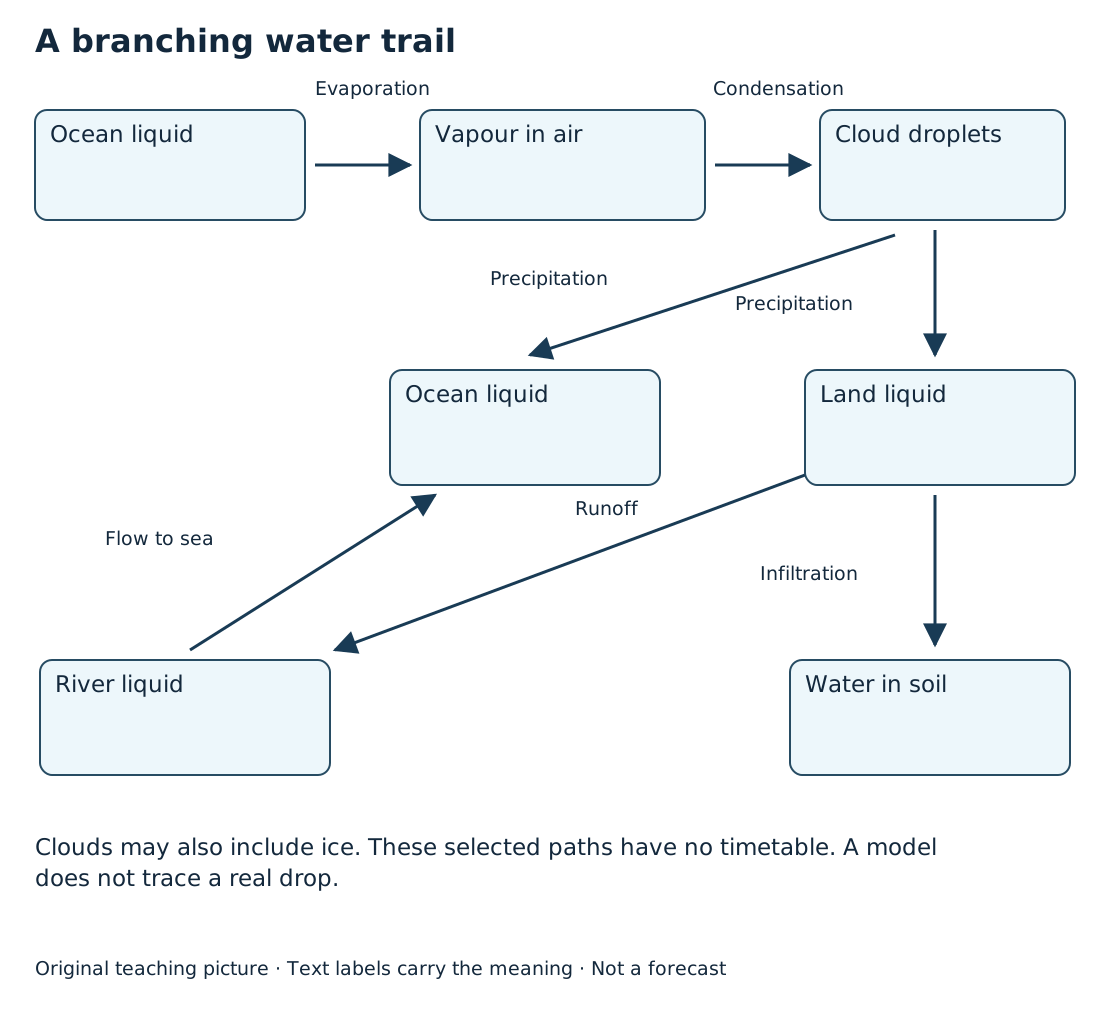
A05 · whole labelled picture · Complete terms · A05 · complete picture words
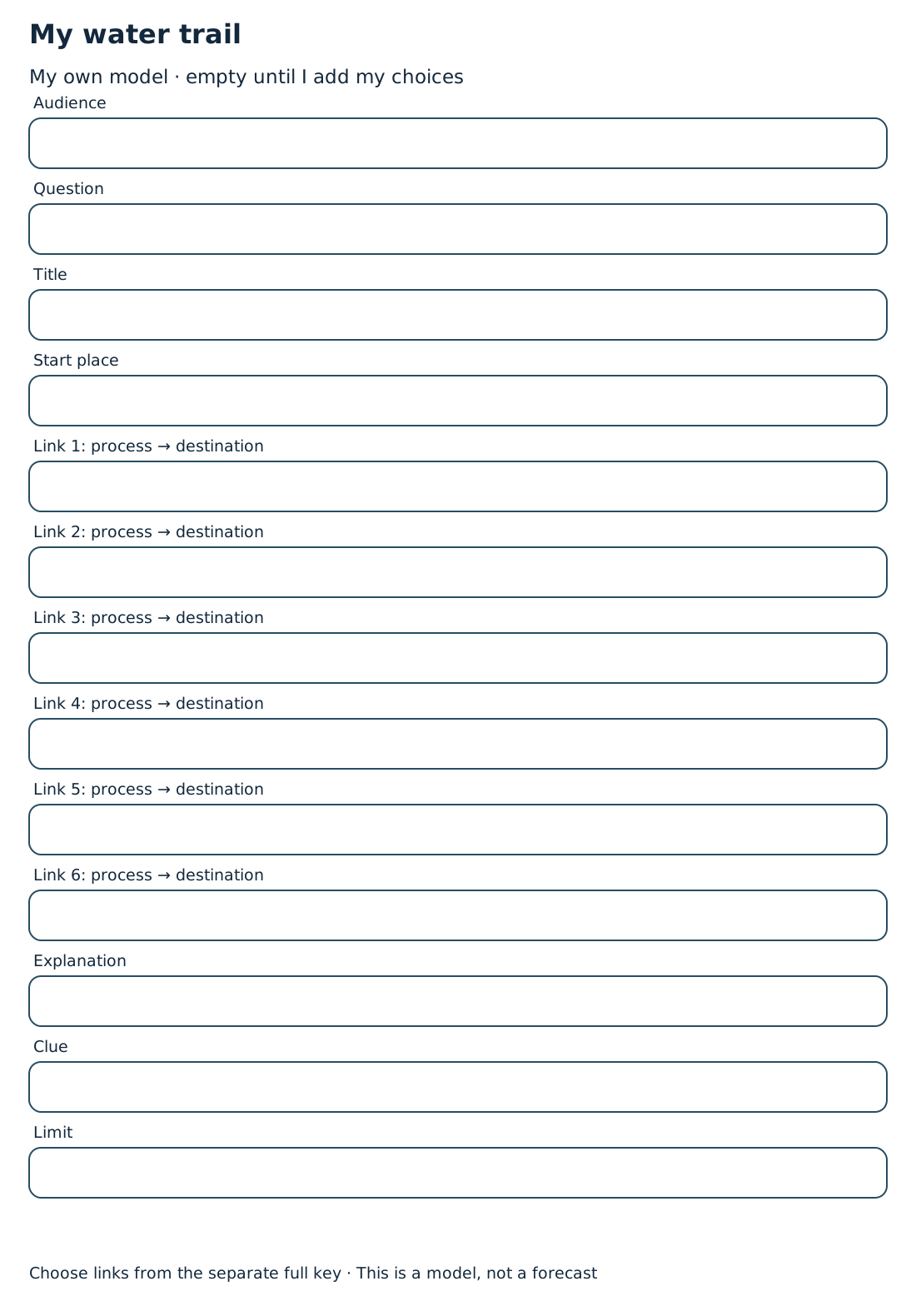
Short child start · Written read-aloud · Water Trail and paper
Partial opportunities: AC9S4U02, AC9S4I04, AC9S4I06 · Full mapping and limits