This is an author's simulation and file check, not a school pilot or testimony from a teacher, student or funder. It makes the current evidence and remaining work inspectable.
Monday teacher route
I followed the start guide to Day 1. English requires Text A and three sort labels; mathematics needs place-value cards or four columns; integrated science needs an indoor torch/card/screen setup. The 25-minute English lesson gives the teacher the exact misconception to listen for: 20 observations cannot be called 20 different users. The math exit has an exact key (0.005 for the 5 in 1.205). The integrated exit checks the control variable, not whether the child's prediction was “right”. Setup is described before class; the 85 minutes are only a curriculum slice. I have not established that transitions fit a particular school's day.
Student response routes tried on paper
- Decimal card B versus C:
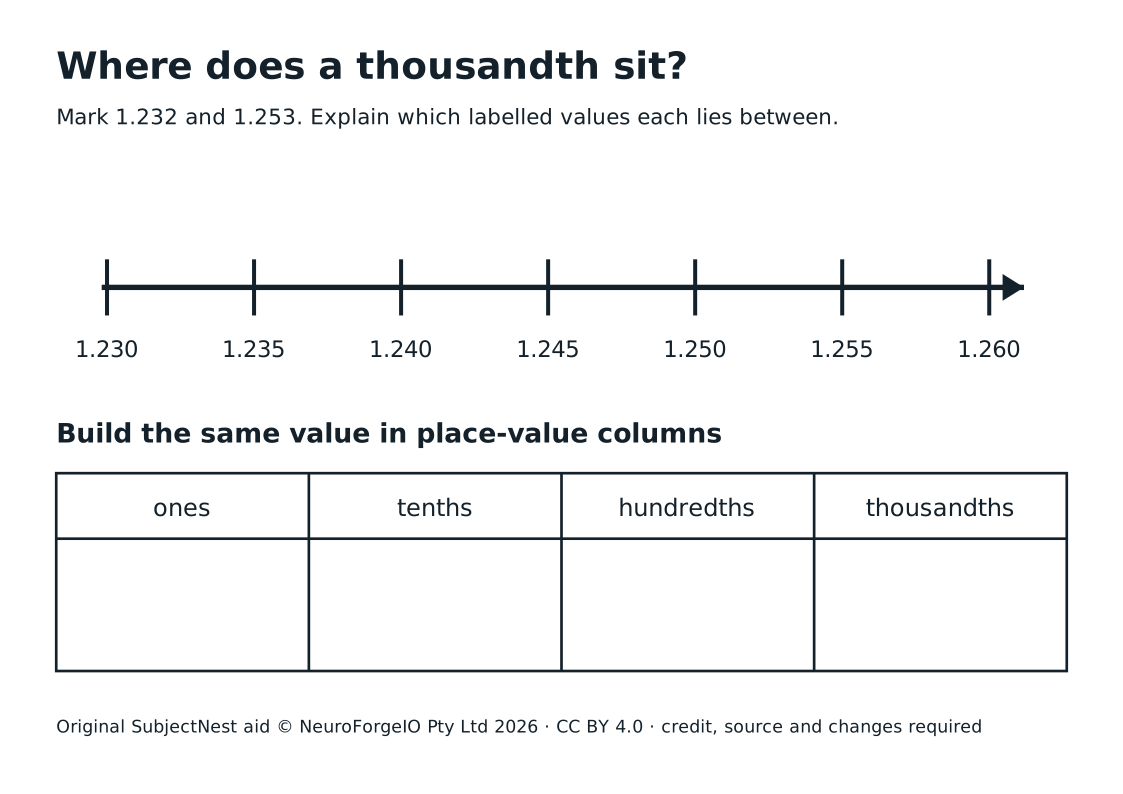
1.253 > 1.250because the first unequal place is thousandths (3>0). The line and text version both place1.253between1.250and1.255, nearer the latter. - Fresh decimal check:
3.072 < 3.207 < 3.270;0.687 > 0.678;1.406is 0.004 from 1.410 and 0.006 from 1.400. These match the answer key. - Five boxes:
36 = 5×7 + 1, so five equal whole-book shares cannot use all 36. If equality is relaxed,8+7+7+7+7=36uses five boxes of at most eight. The guide labels that as a changed requirement, avoiding a false contradiction. Four boxes of nine are numerically equal but exceed the available boxes' capacity of eight. - Fresh English check: 6 occupied seats then 9 yields 15 observations, not 15 unique children, and one Thursday cannot establish “always”. A bounded response asks about other days, unique users and space or costs. This matches the key.
Funder and rights read
The manifest hashes every pack file, records 23 Year 5 content-description codes at the correct level and pins the official ACARA workbook source hash. Original SubjectNest material has a CC BY 4.0 grant; ACARA curriculum and the embedded DejaVu font subsets keep their own terms. The fictional sources, numerical data and investigations are labelled. The first two weeks are authored; the remaining 38 are plan-only. No outcome, state compliance, translation, local First Nations authority or classroom trial is implied. This is a credible release boundary for a draft, not evidence of year-long readiness.
Print and access inspection
All three editable SVGs were rendered to A4 landscape PDFs and visually checked at screen size. The PDFs have selectable text and high-contrast black on white. They are not tagged PDFs; use the separate plain-text equivalents for screen-reader and braille workflows, and test with the actual learner's tools. Visual array understanding can be shown by tactile counters, a partner following learner directions or a text table. No format is assumed to fit every child.
Still required before calling this classroom proven
A Year 5 educator needs to run the exact sessions and time setup/transitions. Learners and families using different access and language routes should evaluate the materials in context. A curriculum leader must check the relevant state or territory syllabus and school's current obligations. For the torch task, the school's safety process decides whether the physical test is suitable or the model data route is used. Record the changes and rerun the verifier after every edit.
Rights: Original dry-run note © NeuroForgeIO Pty Ltd 2026, SubjectNest, CC BY 4.0; credit, source and changes required.