Use the original task cards, print line, factor array and assessment keys. Each lesson has 2 + 4 + 5 + 7 + 4 + 3 = 25 minutes. Model with concrete, spoken and written forms; invite a route that lets the learner show number reasoning. Codes are partial lesson links: AC9M5N01, AC9M5N02, AC9M5N09.
Day 1 — Make a thousandth visible
Success: read and build a number to three decimal places, including a zero placeholder. Prepare place-value cards or four-column table. (AC9M5N01)
- Notice · 2 min. Display
1.235. Ask what the last digit is worth; do not accept “five” without a place. - Model · 4 min. Build
1 + 0.2 + 0.03 + 0.005in columns. Say “one and two hundred thirty-five thousandths” and “one point two three five”; connect the forms. - Build together · 5 min. Learners show
1.205; ask why the hundredths position is zero. Contrast1.25by writing1.250. - Independent turn · 7 min. Build
2.074and0.905, say or label the value of the 7 and 5, and expand one number. Counters, typing or AAC selection allowed. - Explain · 4 min. Pairs compare
1.205and1.25: which place first differs? Teacher listens for hundredths0<5. - Exit · 3 min. “What is the value of 5 in
1.205?” Key:0.005, five thousandths. Record if learner says five hundredths.
Day 2 — Compare from the first different place
Success: compare decimals without treating a longer numeral as automatically greater. Prepare comparison set. (AC9M5N01)
- Hook · 2 min. Vote:
1.25or1.205greater? Ask for a reason, not speed. - Model · 4 min. Rename
1.25as1.250. Compare ones, tenths, then hundredths:5>0, so1.250>1.205. - Guided pairs · 5 min. Order
0.905, 0.950, 0.959, using columns. Ask whether0.905could mean 905 whole units. - Independent turn · 7 min. Learners order
2.074, 2.470, 2.407and write one<or>explanation. They may move cards or dictate the comparison. - Error clinic · 4 min. Show “2.074 is largest because 074 has three digits.” Learners explain the first differing place and repair the statement.
- Exit · 3 min. “Are
1.25and1.250equal?” Key: yes, a trailing zero does not change value.
Day 3 — Place numbers on a useful line
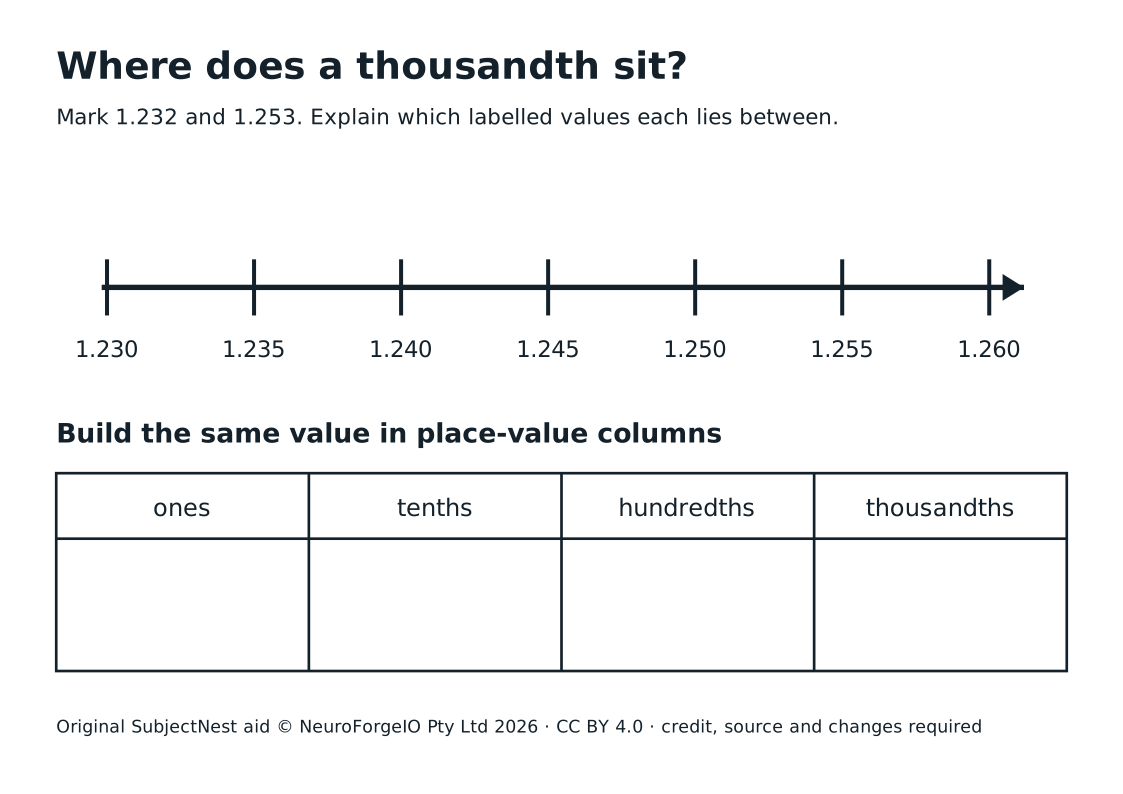
Success: locate thousandths relative to labelled hundredths and half-hundredths. Prepare line 1.230–1.260. (AC9M5N01)
- See · 2 min. Ask what changes from
1.230to1.235: five thousandths. - Model · 4 min. Label line ticks at
1.230, 1.235, 1.240 … 1.260. Point out1.250equals1.25. - Guided locate · 5 min. Learners place
1.245and1.255; ask where1.253sits between ticks and why. - Independent turn · 7 min. Mark
1.232and1.258approximately; then give exact intervals: between1.230–1.235and1.255–1.260respectively. A tactile strip or verbal interval statement is valid. - Compare · 4 min. Pairs explain whether
1.253is nearer1.250or1.255: distances0.003and0.002, so nearer1.255. - Exit · 3 min. “Which tick is immediately after
1.245?” Key:1.250.
Day 4 — The shorter model route
Success: compare and order a set with units and check a claim against the actual numbers. Prepare fictional route cards A–D. (AC9M5N01)
- Context · 2 min. Say clearly that the route values are invented; no real travel advice is being given.
- Model · 4 min. Compare A
1.235 kmand B1.253 kmby aligned place values. A is shorter; do not compare 235 with 253 alone without the shared whole. - Guided sort · 5 min. Class orders D
1.205, A1.235, C1.250, B1.253km. Ask why C may be written1.25. - Independent turn · 7 min. Learners challenge “B is shortest because 253 has a bigger final digit.” Write a corrected sentence, naming the first decimal place where A and B differ.
- Transfer · 4 min. Substitute paper strip lengths with the same numerals but a chosen common unit. Ask why every card must use the same unit before comparison.
- Exit · 3 min. “Which is longer, C or B?” Key: B, since
1.253>1.250by0.003 km.
Day 5 — Decimal check without a shared answer
Success: independently order, locate and justify three-place decimals. Prepare new card, not the worked route set. (AC9M5N01)
- Ready · 2 min. Explain independent check and access options; read numbers neutrally if needed.
- Example of format · 4 min. Show unrelated
0.5=0.500; do not solve the check values. - Plan · 5 min. Learners draw columns or line and select a comparison strategy.
- Independent response · 7 min. Complete all three fresh items on paper, keyboard or accessible number cards. No peer answer during this stage.
- Self-check · 4 min. Ask whether trailing zeros changed values and whether their order makes sense; collect both initial and revised work.
- Exit · 3 min. Explain in one sentence the first different place for two chosen values. Use key and next teaching.
Day 6 — See all the rectangles
Success: build factor pairs and name all factors of 24. Prepare 24 counters or array mat. (AC9M5N02)
- Hook · 2 min. Ask whether 24 can make 5 equal rows of whole counters. Accept “let's test”.
- Model · 4 min. Arrange
1×24and2×12; turn each rectangle to show a rotated pair is not a new factor pair. - Guided arrays · 5 min. Make
3×8and4×6. Test5×?and explain why no whole row length works. - Independent turn · 7 min. Learners list all four unordered pairs and the factor set
{1,2,3,4,6,8,12,24}. They may direct a partner to place tiles or use a multiplication table. - Completeness check · 4 min. Ask why stopping at
4×6is enough: swapped pairs then repeat. Do not demand formal square-root terminology. - Exit · 3 min. “Is 8 a factor of 24? Show the matching number.” Key: yes,
8×3=24.
Day 7 — Multiples meet
Success: recognise common multiples by generating and checking lists. Prepare multiples cards from materials. (AC9M5N02)
- Warm · 2 min. Count by fours to 20; ask what a multiple means.
- Model · 4 min. List positive multiples of 4 and 6 to 36. Circle
12, 24, 36as common values. - Guided why · 5 min. Show that
12=3×4=2×6. Ask if18appears on both lists; it does not appear on the 4 list. - Independent turn · 7 min. Find common multiples of 3 and 5 up to 30; key
15, 30. Then invent a packing or calendar situation where a common multiple matters, without claiming an actual timetable. - Check method · 4 min. Partners swap lists, circle an error, and verify it with multiplication rather than agreement.
- Exit · 3 min. “Is 24 a multiple of 6? Give the fact.” Key: yes,
6×4=24.
Day 8 — Divisible, with a reason
Success: determine divisibility by factor evidence and show a remainder when appropriate. Prepare 36 counters or number cards. (AC9M5N02)
- Recall · 2 min. Ask whether a factor pair gives a division fact. Example
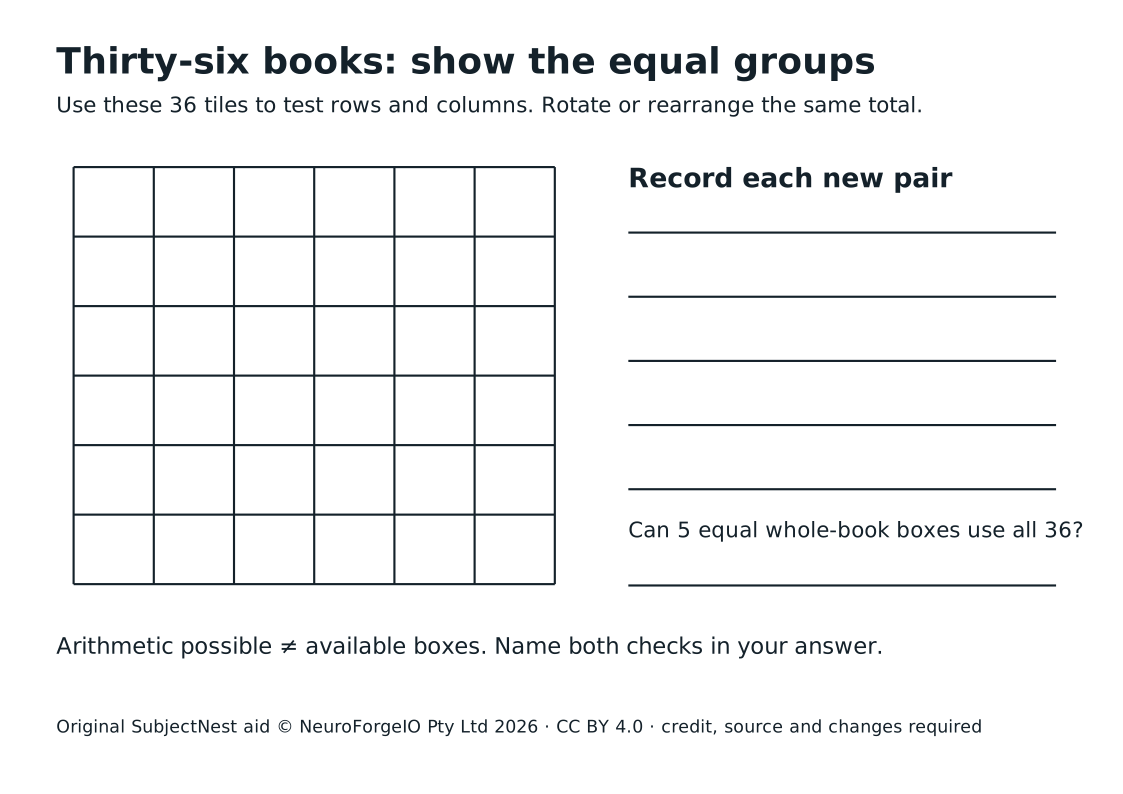
4×6=24gives24÷6=4. - Model · 4 min. Arrange 36 into six equal rows:
36÷6=6. Test five rows: five groups of seven use 35, one remains. - Guided compare · 5 min. Check divisibility of 36 by 4, 9 and 5 with facts:
4×9,9×4, and no whole factor 5. - Independent turn · 7 min. For 30, test divisors 3, 4, 5 and 6. Key: yes
3×10, no4×7=28with 2 left, yes5×6, yes6×5. - Explain · 4 min. Learners compare a quick rule with an array or inverse multiplication check. Teacher looks for reasoning, not a memorised slogan.
- Exit · 3 min. “Is 36 divisible by 5 into whole equal groups?” Key: no; one is left after seven in each of five groups.
Day 9 — Model a real choice without hidden assumptions
Success: test equal-box plans against both arithmetic and constraints. Prepare fictional 36-book scenario. (AC9M5N02, AC9M5N09)
- Frame · 2 min. Read the constraint: six boxes available, capacity eight each. This is an invented problem.
- Model · 4 min. Put six books in each available box:
6×6=36,6≤8, so equal sharing and capacity both work. - Guided options · 5 min. Test four boxes of nine: arithmetic works, but nine exceeds each box's capacity of eight. Test five boxes: 7 each and one left; not equal shares of all 36.
- Independent choice · 7 min. Learners recommend a plan in a table
number of boxes / books each / spare capacity / constraint. They may recommend four boxes of nine only if boxes with capacity at least nine become available, and say why. - Partner audit · 4 min. Partners ask whether the plan fits every stated condition. No prices have been supplied, so no one can calculate cheapest.
- Exit · 3 min. “Why isn't four boxes of nine the immediate plan?” Key: each available box holds at most eight books.
Day 10 — Fresh factor and grouping check
Success: independently find factor pairs and interpret a remainder for a new grouping problem. Prepare 42-card assessment. (AC9M5N02, AC9M5N09)
- Set task · 2 min. Explain that values are new and the goal is reasoning; allow arrays, number facts or text.
- Read card · 4 min. Present 42 cards and 7 trays; do not point out the solution. Clarify that cards stay whole.
- Plan · 5 min. Learners select an array, multiplication fact family or systematic factor list.
- Independent response · 7 min. Answer all items, including a sentence about a five-tray plan. Record supports.
- Reasonableness check · 4 min. Learners multiply back and check whether their plan uses all 42 cards.
- Exit · 3 min. “What new information would you need to choose the cheapest plan?” Key: actual tray costs and availability, possibly reuse/waste conditions. See key.
Rights: Original lesson prose © NeuroForgeIO Pty Ltd 2026, SubjectNest, CC BY 4.0; credit, link and indicate changes.