Five 35-minute Economics and Business + English + mathematics sessions. Year 7 ACARA v9: AC9HE7K01, AC9HE7S01, AC9HE7S02, AC9HE7S03, AC9HE7S04, AC9HE7S05; English AC9E7LA02, AC9E7LY03, AC9E7LY06; mathematics AC9M7N06, AC9M7N09. The club brief and all prices/poll counts are fictional practice data. This is an introduction to opportunity cost and evidence-based recommendations, not a full-year economics course or a real purchasing process.
Fixed conditions: one Friday 35-minute activity slot; $60 discretionary supplies limit; accessible room, supervision and required safety equipment are already provided. The club can choose one activity for that slot. Students must not treat basic access or safety as optional savings. Options A $45 repair/play, B $50 model observation, C $35 mural. Poll A12/B10/C8 (30 self-selected responses). All options fit the cap: A leaves $15, B $10, C $25. The value of the next-best feasible option given up is the opportunity cost for a particular ranking; the purchase price is a monetary cost, a different concept. No personal family finances or real child preferences are requested.
Equipment: printed brief and decision board, pencil, optional 60 counters. Use verbal, tactile or text board. No screen needed; optional projected accessible text does not collect data.
Day 1 — Limited resources create a choice
Question: Why can the club not run every valuable option this Friday? Evidence: constraint statement and initial ranking.
- Enter · 3 min. Say: “You have one activity slot, even though several activities could be useful. What is the scarce resource?” Answer: time/slot; money also has a limit.
- Read · 5 min. Read the fictional brief. Point to the fixed access and safety conditions; they are not options to cut.
- Model · 8 min. Place A, B, C in three boxes. Calculate remaining discretionary funds: $60−$45=$15, $60−$50=$10, $60−$35=$25. Check addition backwards.
- Rank · 10 min. Pairs rank options against at least two stated criteria (e.g. learning benefit, future reuse, inclusion), then each learner records their own ranking. Different rankings are allowed.
- Discuss · 6 min. Ask: “Why might another pair rank differently using the same prices?” Draw out differing predicted benefits and missing evidence, not “wrong taste”.
- Exit · 3 min. Everyone completes: “The club cannot do all three this Friday because ___.” Key: one slot; $60 is also limited, but choosing one is required even if funds remain.
Access: physical cards or text list; money counters; do not require oral public preference. If price arithmetic is difficult, let student use a calculator after explaining the subtraction.
Day 2 — Opportunity cost depends on the next-best choice
Question: What exactly is given up when one activity is selected? Evidence: ranking and forgone benefit explanation.
- Retrieve · 3 min. Two students with different rankings explain the criterion behind each, without naming themselves if they prefer.
- Model · 5 min. Rank B > A > C on a board. If B is selected, next-best A is forgone; its possible reuse benefit is the opportunity cost in this ranking. The $50 paid for B is its price, not that benefit.
- Guided case · 8 min. Rank C > B > A. If C is selected, next-best B's closer-observation benefit is forgone. Ask why A is not added to B as the opportunity cost.
- Individual route · 10 min. Students choose and rank all three, name chosen activity, name next-best feasible activity and state one benefit they give up. Partner checks that rank 2 matches the sentence.
- Test error · 6 min. Present “Opportunity cost of B is $50.” Students repair: $50 is monetary cost; opportunity cost is benefit of next-best option under a stated ranking. A learner may also mention alternative use of $50 if that is explicitly ranked, but do not conflate it with this brief's one-slot choice.
- Exit · 3 min. Everyone completes “I choose . My next-best option is . I give up its possible benefit of __.” Key permits justified choices.
Access: ordinal tokens 1/2/3, visual/tactile ordering, sentence frame and AAC. Assess relation among choices rather than English fluency alone.
Day 3 — Inspect source and missing information
Question: What does the brief tell us, and what does it leave open? Evidence: source table and investigable question.
- Prompt · 3 min. “Twelve votes for A: what can we say exactly?” Answer: 12 of 30 fictional respondents chose A, not all students.
- Model · 5 min. On the board separate quote/poll data, predicted benefit, and unknown. The $45 quote is given; actual repairs needed are unknown.
- Source audit · 8 min. Groups tag every brief item as given fictional data, prediction or missing check. Check B's access route and C's display permission as conditions to verify.
- Question design · 10 min. Each learner writes one question that could change a decision, names a suitable ethical source (e.g. local equipment check, adult access review) and says what answer would matter. No actual child survey or purchase.
- Evaluate · 6 min. Compare “Would you like fun?” with “Which of the available games can safely be repaired with the supplied tools?” Discuss specificity and why privacy/access policy would govern any real inquiry.
- Exit · 3 min. Everyone writes one supported fact and one unanswered question. Teacher samples focus learners' distinction.
Access: symbol labels F/P/? with text names, spoken/AAC response, large-print brief. Do not gather real student preference data as part of this lesson.
Day 4 — Prepare a balanced recommendation
Question: How can a recommendation account for benefits, costs, an alternative and uncertainty? Evidence: decision board draft.
- Set audience · 3 min. “A fictional committee needs a choice it can check. You may disagree with me if your reasons are clear.”
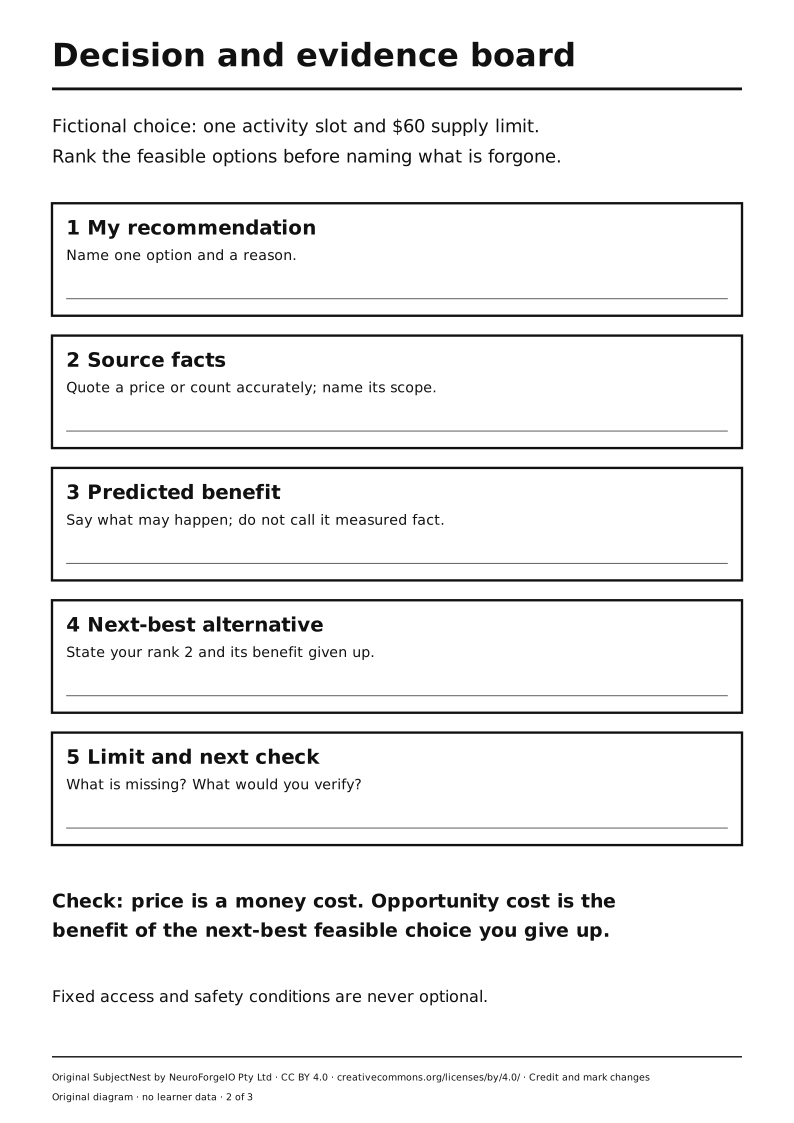
- Model · 5 min. Fill the board for A: claim A, quote $45 and $15 left, possible game reuse, B as next best in this model ranking, B's observation benefit forgone, repair needs unknown. Label predictions honestly.
- Calculate · 8 min. Students check the three remainders and compare A/B difference $5, A/C $10, B/C $15. An arithmetic check does not decide value by itself.
- Draft · 10 min. Individually choose option and complete decision board. Include one advantage of a competing choice and one condition to verify before action.
- Peer audit · 6 min. Partners use questions: Is the quote under $60? Is next best the author's rank 2? Is a poll claim scoped to 30 responses? Is access/safety fixed?
- Exit · 3 min. Everyone revises one sentence and labels the reason for change. Teacher stores only local evidence.
Access: dictated or typed board; partner can place counters to learner instruction. Provide private review, not a public debate requirement.
Day 5 — Communicate and decide provisionally
Question: Can the recommendation survive a fair question? Evidence: individual proposal and response to a question.
- Frame · 3 min. Say: “This is a practice decision; no real order will be placed. A strong proposal can name what still needs checking.”
- Rehearse · 5 min. Students rehearse a 45-second proposal or read a written paragraph. Give a quiet/AAC route equal standing.
- Present · 8 min. In small groups, each learner states option, source fact, reason, next-best forgone benefit and one uncertainty. Teacher observes 2–3 focus learners, rotating or following up later; peers listen rather than score personalities.
- Ask and revise · 10 min. Each group asks one evidence or access question. Learner may answer, change recommendation, or state what must be found out. Record a revised line.
- Individual check · 6 min. Everyone completes the key prompt below independently in writing, audio with transcript, AAC or text board.
- Close · 3 min. Share that different defensible choices are possible. Name the next local inquiry, then stop before any real action.
Key prompt: “For a ranking A > B > C, choose A and explain (i) whether it fits $60, (ii) the next-best forgone benefit, (iii) one limit of the poll.” Key: A costs $45, leaves $15; B is next best, so possible model-observation benefit is forgone; 12 of 30 self-selected responses do not establish all students' view. If learner says $45 is opportunity cost, separate price from forgone next-best benefit and rerun a two-option ranking. If learner says C is next best, ask them to read the given ranking. If arithmetic is the only barrier, supply 60 counters or a post-method calculator check before assessing the concept.
Teacher record: day | focus learner code | exact claim/calculation/reason | independent/prompted/not yet observed | access route | next move. Keep locally under school policy; do not send child data to SubjectNest.