Version: v0.1, 29 September 2026. Five 35-minute paper-only Science sessions. Draft for educator, science, accessibility and local-syllabus review. Students build and challenge an original A4 energy-flow diagram (PNG) with a complete plain-text alternative. The numbers are invented for a simplified steady model over one interval; no physical lamp was measured. This block assesses scientific energy accounting and claim validity, not the day's mathematics or English mark.
National links: AC9S9U05 addresses conservation of energy and efficiency as inputs, outputs, transfers and transformations. AC9S9I04 concerns representations; AC9S9I05 patterns/anomalies; AC9S9I06 validity/uncertainty; AC9S9I07 evidence-based arguments. These are partial exact Year 9 content descriptions in the official ACARA v9 download, retrieved 29 September 2026; workbook SHA-256 db446882d2c00cf7c085a03e250e2442fda6c44011fc114680c46c1dc7a822c3. OpenStax College Physics 2e, section 7.6 states that energy is conserved while changing form/transferring, and defines efficiency as useful output divided by total input. It supports the principle and calculation, not our fictional values or any device claim.
Safety and access: Paper cards only. No mains devices, exposed wiring, hot lamps, lasers, battery dismantling or direct sunlight. Print the diagram or use its exact text, high contrast, raised/large arrows, screen reader, tactile counters, keyboard, AAC, sign or learner-directed adult placement. A student can critique the model without drawing an arrow. The 100 J input in this illustration is an invented energy amount over a stipulated interval, not 100 W or a real specification. The model assumes no energy is stored in the chosen system during that interval; otherwise input minus output could be stored. Other transfer is not energy destroyed and is not necessarily only heat in every real device.
Day 1 — Define the system before adding numbers
Question: What enters, leaves or stays in a model system? 35 = 5 notice + 7 model + 12 build + 8 audit + 3 check.
- Notice, 5: Show paper box labelled fictional model lamp. Ask “What is the system boundary?” Key: the drawn box around lamp for one stipulated interval, not the whole room.
- Model, 7: Teacher places
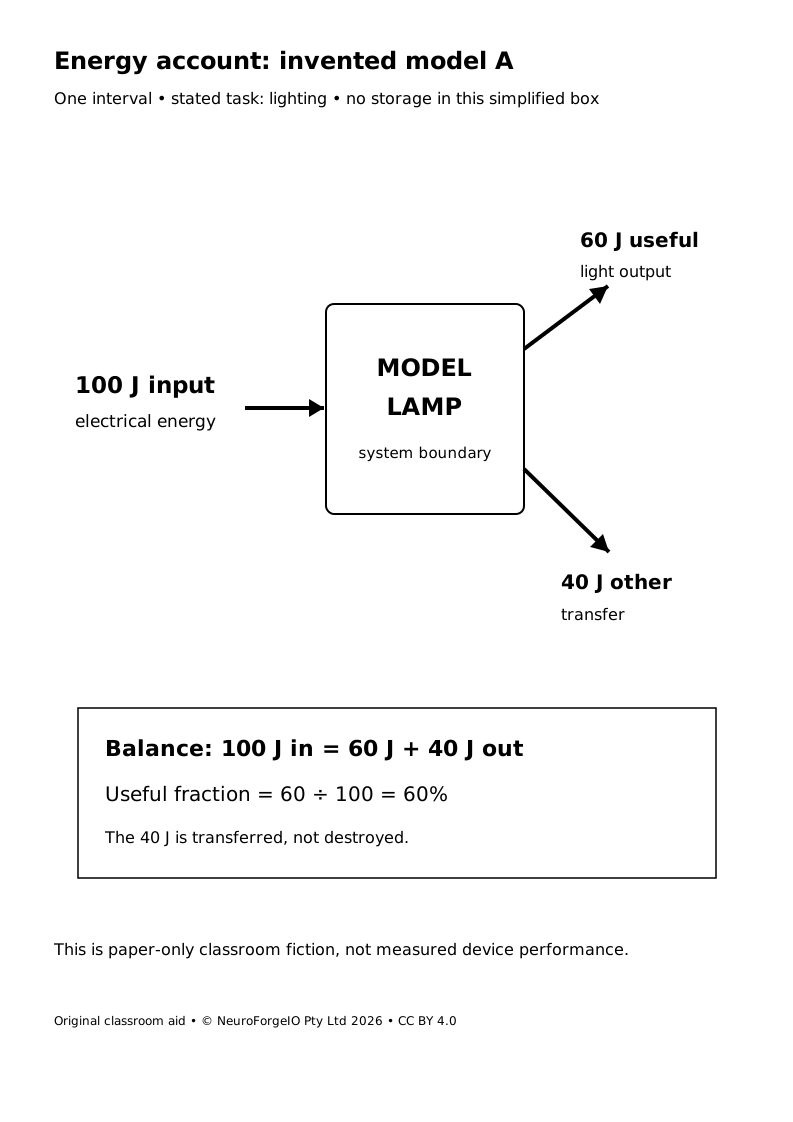
electrical input 100 Jarrow into box,useful light 60 Jandother transfer 40 Jarrows out. “In this simplified steady model, 100 in = 60 + 40 out; none disappears.” Name light/thermal as possible forms without claiming a measured lamp. - Build, 12: Learners arrange 10-J paper tiles in 10/6/4 groups or use text/tactile counts. Draw or dictate arrows with units and boundary. Explain why both output arrows count.
- Audit, 8: Present flawed diagram
100 in → 60 usefulwith no other arrow. Ask what is unaccounted for. Key: 40 J; one cannot say it vanished. Addother transfer 40 Jor explicitly name possible storage if model changes. - Check, 3: “Is 40 J destroyed?” Key: no, transferred/transformed outside the useful category. Next: rebuild balance with all arrows.
Day 2 — Useful depends on the stated purpose
Question: What counts as useful output for a chosen task? 35 = 5 retrieve + 7 model + 12 sort + 8 explain + 3 check.
- Retrieve, 5: Point to input, useful and other arrows. Verify 60+40=100 and J versus W distinction: joule is energy; do not call the 100 J arrow “100 watts”.
- Model, 7: “For our model lamp's lighting task, light is named useful and the other transfer is not the target. For a fictional food warmer, thermal output could be useful.
Usefulis purpose-dependent; energy is still conserved.” No real efficiency figures supplied. - Sort, 12: Learners classify qualitative cards for a stage lamp, phone speaker, model bike generator and food warmer: desired output, possible other transfer, what would require a measurement. Do not score a specific numeric transfer from these cards.
- Explain, 8: Pairs choose one device and state a system boundary, intended output and an unknown. Ask whether a different purpose would change the useful label but not the conservation rule.
- Check, 3: “If we call thermal energy useful for a heater, did we create extra energy?” Key: no; classification changes, accounting remains. Next: revisit purpose before percentages.
Day 3 — Calculate efficiency and keep units honest
Question: What share of input becomes the stipulated useful output? 35 = 5 recall + 7 model + 12 calculate + 8 compare + 3 check.
- Recall, 5: Read 100 J in, 60 J useful, 40 J other. Key: totals balance.
- Model, 7: “Efficiency for this purpose = useful output/input ×100 = 60/100×100 = 60%. Both numerator and denominator are J over the same model interval, so the ratio has no unit.” A percentage is not a brightness measurement.
- Calculate, 12: New fictional same-purpose model B has 100 J input, 75 J useful light, 25 J other transfer. Key: 75%; 75+25=100. Learners use tiles, fraction bar or calculator and identify what stays comparable.
- Compare, 8: “B has a higher modelled useful-energy fraction than A under these stated conditions.” Do not claim B is brighter, cheaper, safer, longer-lasting or a real product. Ask what real performance data and time window would be needed.
- Check, 3: “Can an 80 J useful output come from 60 J total input in our steady box without another source?” Key: no. Next: inspect system boundary and omitted input/storage before trusting a figure.
Day 4 — Audit claims, assumptions and uncertainty
Question: Which sentence follows from a paper model and which outruns it? 35 = 5 identify + 7 model + 12 audit + 8 revise + 3 check.
- Identify, 5: Read fictional caption: “Model A has no energy transfer beyond light.” Key: contradicted by 40 J other arrow.
- Model, 7: Teacher revises: “This paper model assigns 60% of A's 100 J input to useful light over the chosen interval; 40 J is assigned to other transfer. It does not measure a real lamp.” Name assumption of no stored energy and same boundary.
- Audit, 12: Sort claims:
A totals 100 J outputsupported;A is 60% efficient for stated purposesupported;B is better for all usesunsupported;40 J disappearscontradicted. For each, cite an arrow or missing measurement. - Revise, 8: Learners write/point/dictate a fair claim for a modelled bike generator or phone speaker without inventing values, then list one measurement needed before quantifying it.
- Check, 3: “Why can a 60% label not prove actual room lighting performance?” Key: fictional energy amounts, no real device/interval/measurement/conditions; useful fraction is a narrower construct. Next: label source status before conclusion.
Day 5 — Fresh model and an evidence-based argument
Question: Can a learner account for energy and critique a new model independently? 35 = 5 plan + 7 model + 12 unseen task + 8 peer check + 3 exit.
- Plan, 5: Review success criteria, not new answers: boundary/interval, input/output balance, useful fraction, one defensible claim and one limit.
- Model, 7: Use unscored 50 J input, 20 J useful and 30 J other. Key: 40% useful; conservation 20+30=50. Show what an explanation looks like.
- Unseen task, 12: Give Model C: 250 J in, 175 J useful, 75 J other; Model D: 250 J in, 200 J useful, 50 J other, same stated task/interval. Learner makes text, tactile, diagram or AAC response. Teacher keys: both balance 250; C=70%, D=80%; D has higher modelled useful fraction by 10 percentage points. No real lamp conclusion.
- Peer check, 8: Partner checks totals and source label, then challenges “D is always the best real lamp”. Key response: our fictional same-purpose figures do not establish real performance, quality, suitability or cost. Learner revises one claim.
- Exit, 3: “If our box stored 20 J during the interval, what would change?” Key: outputs need total input minus 20 J (or explicit stored-energy term); do not force 100% into outgoing arrows. Next: reteach boundary/storage if learner says energy vanishes.
Plain-text energy flow and original learner card
FICTIONAL MODEL A, ONE INTERVAL, NO STORAGE
                  60 J useful light ─────►
100 J input ───► [MODEL LAMP]
                  40 J other transfer ───►
Balance: 100 J in = 60 J + 40 J out.
Useful fraction = 60/100 = 60% for the stated lighting task.
This is NOT a measurement of any real lamp.

MY SYSTEM BOUNDARY/INTERVAL: ____________________________
INPUT(S): __________  USEFUL OUTPUT: ___________________
OTHER TRANSFER(S) OR STORAGE: __________________________
BALANCE: ________  USEFUL FRACTION: _____________________
WHAT THE MODEL SUPPORTS: _______________________________
ONE REAL-WORLD CLAIM IT CANNOT SUPPORT: ________________
RESPONSE ROUTE / CONTENT CUE: __________________________
Formative scoring: Award 0 = not yet with access, 1 = after scientific content cue, 2 = independent for each of four criteria: correct boundary/energy balance, correct fraction for stated purpose, evidence-linked claim, stated model limit. /8 selects instruction, not Year 9 attainment. If balance weak, retile input/output with storage term; if fraction weak, align units and divide useful by total; if claim weak, point to a labelled arrow; if limit weak, distinguish invented model from measured device. Fresh recheck outside lessons: fictional steady Model E has 180 J input, 126 J useful and 54 J other; key: balances, 70%; no measured device claim. Keep records private.
Rights: Original guide/model/diagram © NeuroForgeIO Pty Ltd 2026, CC BY 4.0. Credit SubjectNest Year 9 Australian-first opening pack, v0.1, source, licence and changes. ACARA/OpenStax have separate terms; no third-party figure or data is reproduced. Integrated-file hashes. Science/educator review pending.