Everything in this file is original to this pack. Oral texts A–E and the adult-read notices are teacher-read and include untaught spellings. Keep their print hidden during a child decoding check. Read them live or make a local recording from these exact transcripts; any shared recording needs separate voice/recording rights and an identical accessible transcript. Child-read material appears only under its own headings below.
Oral text A — The Library Path (Days 31 and 33)
At the town library, a small spill made the front path slippery. Mira told the librarian. The librarian placed a notice by the path and directed visitors to a dry entrance while another adult cleaned the spill. When the area was dry, Mira drew three pictures: the spill, the adults helping, and visitors using the clear path. The notice helped people choose where to go at that moment. Mira's pictures told what happened earlier.
Ask: Who did Mira tell? What did the notice help people do? What did Mira's picture story tell? The story is fictional. Do not use a child-made sign in place of the school's actual safety procedure; an adult handles a real spill.
Adult-read paired messages B — A Notice and a Story (Days 34–35)
Notice, read aloud: “Please leave the walkway clear. Ask the adult in charge if you need help.”
Story, read aloud: “Nia saw boxes beside the classroom door. She told the adult in charge. Together they moved the boxes so everyone could pass.”
Ask: Which message asks people to act now? Which tells events that happened? What information did both communicate? Both are original examples, not official school signs. The adult supplies the full safety meaning; the controlled child-read sign Stop. below is a print lesson, not a complete safety protocol.
Oral rhyme C — Sand, Hand, Dish, Fish (Days 36 and 38)
A shell on the sand.
A bell in my hand.
A chip in a dish.
A wish for a fish.
Teacher note: Read twice with natural Australian English rhythm. sand/hand and dish/fish rhyme; notice /ʃ/ in shell, dish, wish, fish and /tʃ/ in chip. The rhyme print is adult-only: ll, a as an unstressed article and other patterns have not been taught for child reading. If a learner's local pronunciation changes a pair, use a locally clear spoken rhyme and record the change. A learner may show the beat with taps, counters, a visual mark or a switch.
Oral story D — Two Taps and a Rest (Day 38)
At the community art room, Imani made a welcome pattern: tap, tap, rest; tap, tap, rest. Jules chose to follow it with cards instead of sound: a dot, a dot, a blank space. When one card fell under the table, the group paused. Imani pointed to the repeating three-part unit, Jules replaced the missing card, and the group began again. Everyone could choose to tap, point, watch or listen.
Ask: What three parts repeated? What went missing? How did they restart? Tap–tap–rest and dot–dot–blank represent the same repeating unit. No learner is required to make noise or move their body to show understanding.
Oral assessment story E — The Puppet Beat (Day 40 only)
At the puppet table, Teo made a beat for a puppet entrance: tap, clap, tap, clap. Rani copied it with two kinds of picture cards. She placed two clap cards together by mistake. They compared the cards with the beat, moved one card, and performed the pattern again. Teo thanked Rani for helping check it.
Assessment questions are in ASSESSMENT.md. Read twice with the print hidden. This is a new listening story, not child-reading material.
Fresh adult-read assessment notice: “Please keep the space beside the puppet table clear so everyone can pass.” Read once with print hidden. It asks for action now; the puppet story reports events. This is an original fictional notice, not a school instruction.
Controlled child-reading cards by first use
Print one word at a time without a picture. Touch each grapheme; when a grapheme has more than one letter, keep it together. For x in this set, show that one printed letter contributes two spoken sounds. Give meaning only after the attempt to decode.
| Day | Child-facing cards | Exact boundary |
|---|---|---|
| 31 | y, Y, yes, yet, yam, yum, yap | Initial y = /j/; capital Y is letter-recognition only. |
| 32 | x, X, box, fox, six, mix, wax | Final x = /k/ then /s/; capital X is letter-recognition only. |
| 33 | stop, step, Stop., Sam got wet. | st has two separate sounds; Stop. is a one-word printed direction. |
| 34 | help, felt, Stop., Sam can help. | lp and lt retain two sounds; can has taught c = /k/. |
| 35 | Stop., Kit got wet. Sam can help. | Compare a direction with a brief problem and possible-help story; can help does not say help already happened. |
| 36 | sh, ship, shop, shed, fish, dish, mash, wish | sh is one /ʃ/ sound at the start or end of these words. |
| 37 | ch, chat, chip, chin, chop, much, rich | ch is one /tʃ/ sound at the start or end of these words. |
| 38 | ship/chip, shop/chop, dish/fish | Say the rhyme pairs aloud first, then decode each printed word. |
The spoken examples yellow, xylophone, school, chair, cheese, shell may enrich talk, but their printed forms are not child-reading cards here. xylophone does not use the final /ks/ value; school and cheese contain untaught spelling patterns. q/qu, vowel y, ch = /k/ or /ʃ/, and the word was remain outside child reading in this pack.
Mini-text F1 — Sam and Kit (Day 39 choice)
Sam can dash.
Kit can hum.
Sam and Kit chat.
Mini-text F2 — Val and Jem (Day 39 choice)
Val can shop.
Jem can jog.
Val and Jem chat.
Both mini-texts use the same controlled correspondences, a person–action–shared-action structure and a sh and ch word. Model and in its careful /ænd/ form before the independent text read; can can likewise be read carefully as /kæn/. In natural connected speech these words may reduce. Let children blend the full printed form and then reread naturally; do not call an ordinary reduced spoken form a decoding error. A learner chooses by interest, not by a “strong/weak” label. Ask who did each action and what happened together. A sketch of a shop or movement is an optional interpretation after decoding; it cannot prove an event beyond the printed words.
Controlled variation tiles: Sam / Kit / Val / Jem / can / dash / hum / shop / jog / and / chat / . Learners may change a name or action and check both sound links and meaning. Adult-scribed unrestricted ideas belong on a separate strip and are not scored as independent decoding.
Text alternatives for the print aids
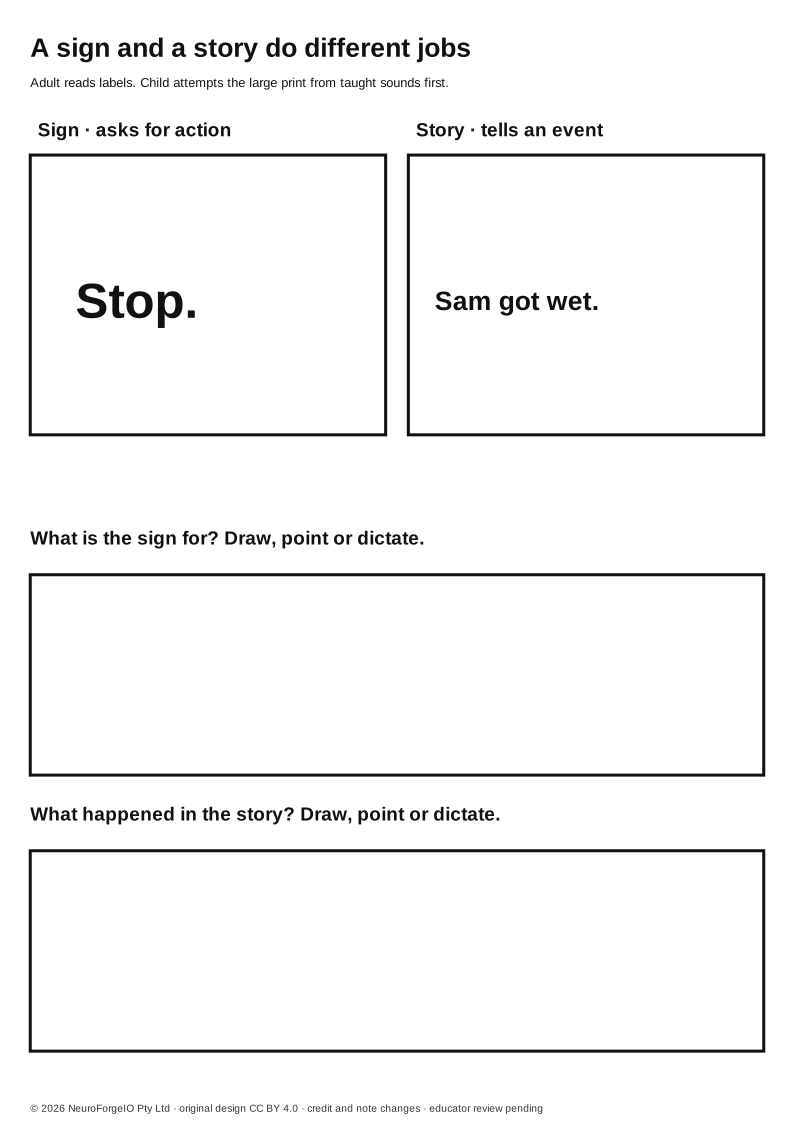
The sign/story comparison sheet contains a large bordered Stop. panel labelled “Sign”, a large bordered Sam got wet. panel labelled “Story”, and two blank response boxes, “What is this for?” and “What happened?”. An adult reads the labels and supports the meaning questions. The child-reading strings Stop. and Sam got wet. are controlled after Day 33.
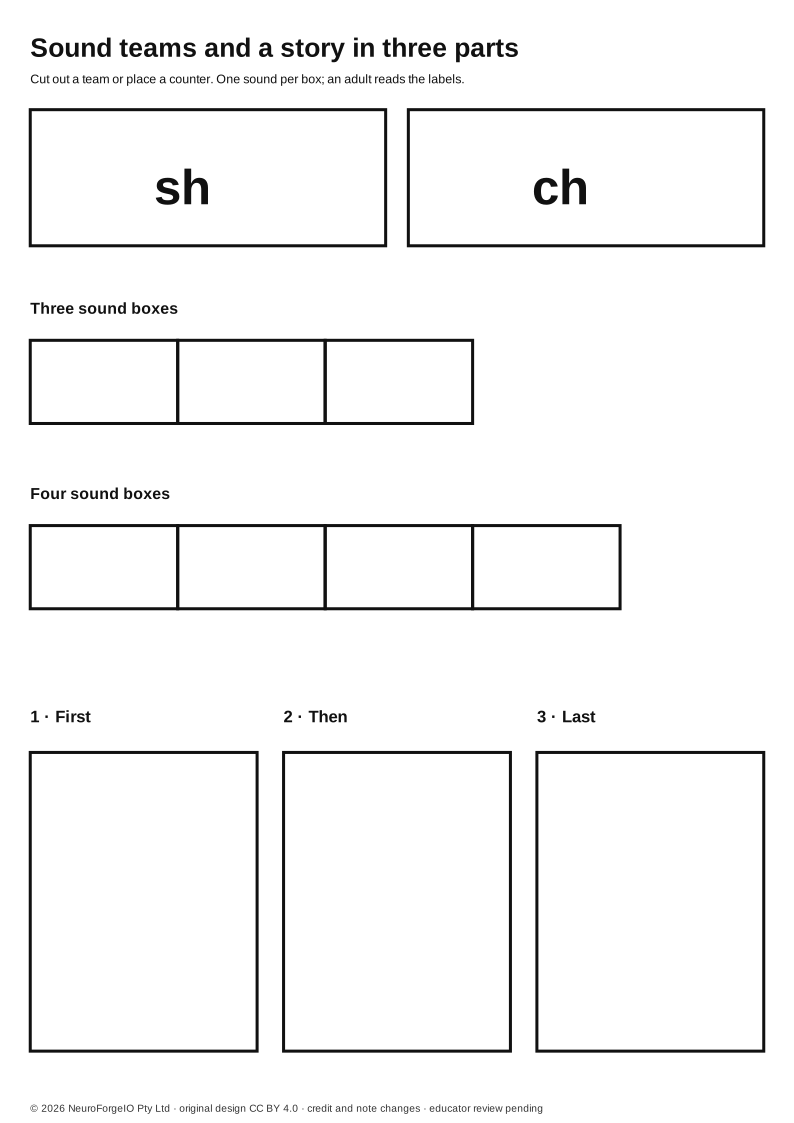
The sound and retell mat contains large sh and ch tiles, one row of three empty phoneme boxes, one row of four empty phoneme boxes, and three blank retell boxes labelled “First”, “Then”, “Last”. Adult reads the labels. The boxes accept drawn marks, loose objects, pointing, tactile tokens or dictated ideas. For ship, place sh in one sound box; for box, represent /b/ /ɒ/ /k/ /s/ in four boxes even though print has three letters. Do not equate letter count with phoneme count.
Reusable record line: date / learner code / exact prompt and response / independent or prompted / route / next move. Store identifiable records only in the school's approved local system.