All teaching scripts, stories, captions, print design and vector art in this pack are original. Adult-read texts A–D are teacher-read, with print hidden during child decoding. They use vocabulary beyond the taught graphemes. Read live or make a local recording from these transcripts; a shared recording needs its own voice/recording rights and accessible transcript. The child-reading set begins at the heading below.
Adult-read information text A — A Fish in Water (Day 43)
Fishes come in many kinds and shapes. They breathe using gills. Most spend their time in water, but some can spend time out of water. Many swim, but they do not all move in the same way. The simple drawing on our page is an invented pond fish. It helps us talk about one example; it does not show every fish or identify a real local species.
Evidence boundary: This is original wording informed by the Australian Museum's fish overview and swimming-shape discussion, checked 29 September 2026. The museum explains fish diversity and exceptions; avoid adding “all fish have scales” or “all fish have fins”. The child-read line A fish is in a pond. describes the invented illustration, not an observation of a real specimen. A fish can swim. expresses a general capability, not a claim that every fish swims in the same way or always swims.
Teacher questions: Which line tells what our drawing shows? Which line could be checked in a source about fish? What would we need before claiming that a fish pictured was a real local species? Accept “a real observation/source” rather than requiring that phrase.
Adult-read observation model B — The Box Test (Days 42 and 44)
I put a small empty box on a mat and looked before I wrote. I could see the box on the mat. I gently lifted one side and saw that it could tip. Then I put it down again. My page can say what I saw. It should not say what is inside a closed box unless I looked inside.
Use a safe real box and mat if available. If the box cannot tip in the actual setup, change the adult model or use only the observed first sentence; never ask a child to copy a claim contradicted by the object. “On a mat” is an observation only when the setup actually shows it. A box can tip is a possibility shown by a safe demonstration, not a universal statement about every box.
Adult-read literary story C — The Box and the Hat (Days 46–47)
At the making table, Kit found a cardboard box. Kit put a paper hat inside and closed the lid. Jem arrived after the tidy-up song. Kit opened the box, and Jem laughed at the hat. Jem tried it on, then asked Kit to help decorate it. They drew spots on the paper and placed the box back on the shelf.
This is fiction. Ask what Kit put inside, what Jem did, and how the story ends. The controlled child text below is a shorter version; a child should not be scored as having decoded details that appear only in this adult-read passage. The story does not say how every real box is used.
Adult-read rhyme D — Box, Fox; Fish, Dish (Days 47–48)
A box by a fox.
A fish by a dish.
Tap, tap, stop.
Then let the story hop.
Read aloud only. box/fox and fish/dish rhyme in the intended pronunciation. Its a article is taught in this pack, but by, the, story and other print patterns are not child-reading tasks. A learner may hear, choose, tap or indicate a pair through an accessible route. Do not call matching the printed ending alone proof of hearing a rhyme.
Child-reading cards by first-use day
Show a card without a picture first. The adult explains meaning after an attempted blend. Use careful pronunciations for print work and allow normal reduced connected speech on rereading. A slash separates alternative cards, not letters to be read as one word.
| Day | Child-facing print | Boundary |
|---|---|---|
| 41 | a bag / a hat / a box; A box. | Standalone article a/A /ə/ is taught here; internal a in bag/hat stays /æ/. A box. is a caption fragment, not a full sentence. |
| 42 | is / It / A box is on a mat. | is /ɪz/ is taught as a common whole word; It /ɪt/ uses capital I here only. Put a box on a mat for meaning. |
| 43 | A fish is in a pond. / A fish can swim. | pond has four separate sounds; swim begins /s/ /w/. |
| 44 | A box is on a mat. / It can tip. or the two fish lines | The box lines require a matching observed/safely tested setup. |
| 45 | Child's verified two-line information page | Report the claim and its source/observation; do not add an unverified fact. |
| 46 | Kit got a box. Kit hid a hat in it. Jem got a hat. | it /ɪt/ is lower-case in the second sentence. Jem's hat may be the same hat, but the short print does not explicitly say so. |
| 47 | The Day 46 text with hat → bag or hat → map on both occurrences | Reread and check that the revision keeps a meaningful sequence. |
| 48–49 | Choice of the learner's information page and controlled story | Independent reading, meaning and revision are separate observations. |
The child-readable fish page prints exactly:
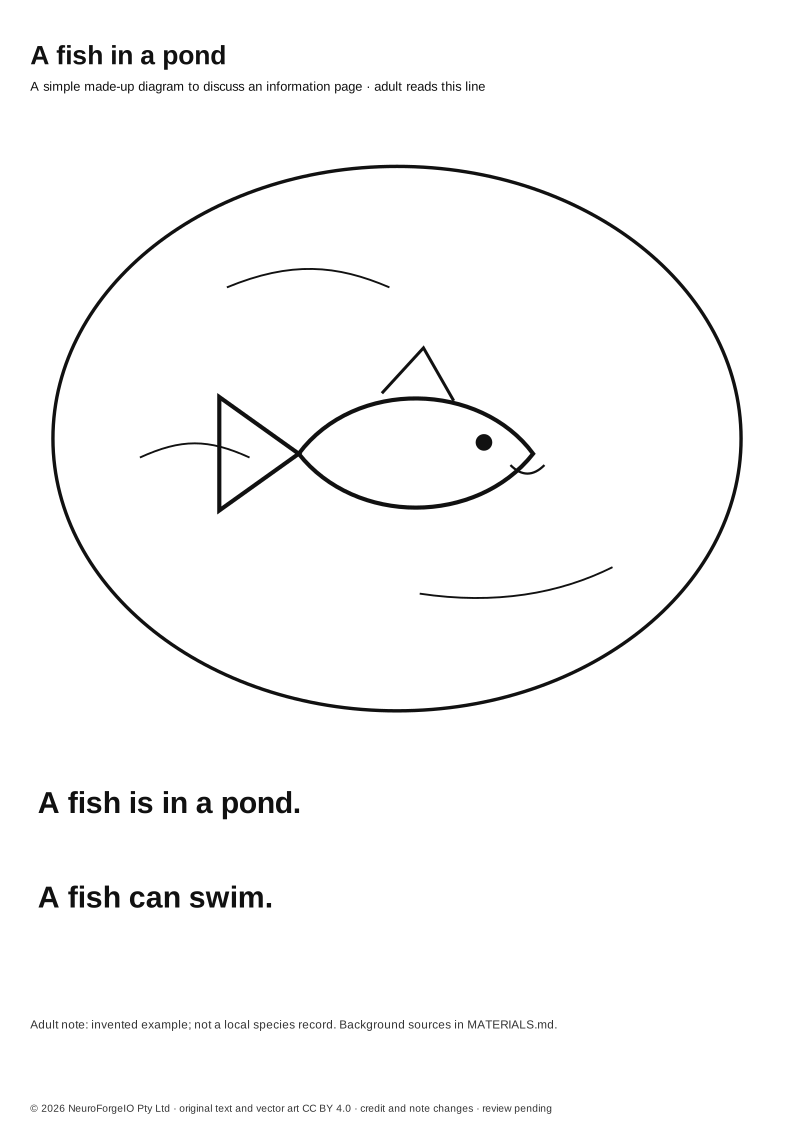
A fish is in a pond.
A fish can swim.
Its black-and-white picture is an original invented pond fish with a simple pond outline. The drawing is not a factual photograph or a local species identification. The adult reads the small labels and source note. For a child who cannot access the image, say: “A simple outline fish is drawn inside an oval pond. A few curved lines mark water. No species, colour or size is claimed.”
Controlled story S — Kit, Jem and a Box (Days 46–48)
Kit got a box.
Kit hid a hat in it.
Jem got a hat.
Literal check: Kit got a box; Kit hid a hat in it; Jem got a hat. Possible inference: Jem's hat is the hidden one. Ask “Does the short print say where Jem got the hat?” It does not. The longer adult story has extra events, so keep its evidence separate from this child-read sample.
Variation tiles: Kit / Jem / Sam / Val / got / a / box / bag / map / hat / hid / in / it / . Change both hat cards to map or bag, reread and ask if the new mini-story makes sense. Richer spoken endings may be adult-scribed on a separate strip and are not counted as independent decoding.
Information-page and portfolio text alternative
The page and portfolio mat is a black-and-white A4 page with a title line; two large fact-line spaces; a large drawing/object area; an adult-read “How did we check?” space; and two small portfolio boxes, “I can show” and “My next step”. It contains no prefilled child facts. A child may draw, attach a tactile shape, select words, dictate, type or write. The teacher records whether a line came from direct observation, the cited adult-read fish source or an imagined idea. If the route is AAC or an adult-scribed text, record the child's choices and the adult's exact support.
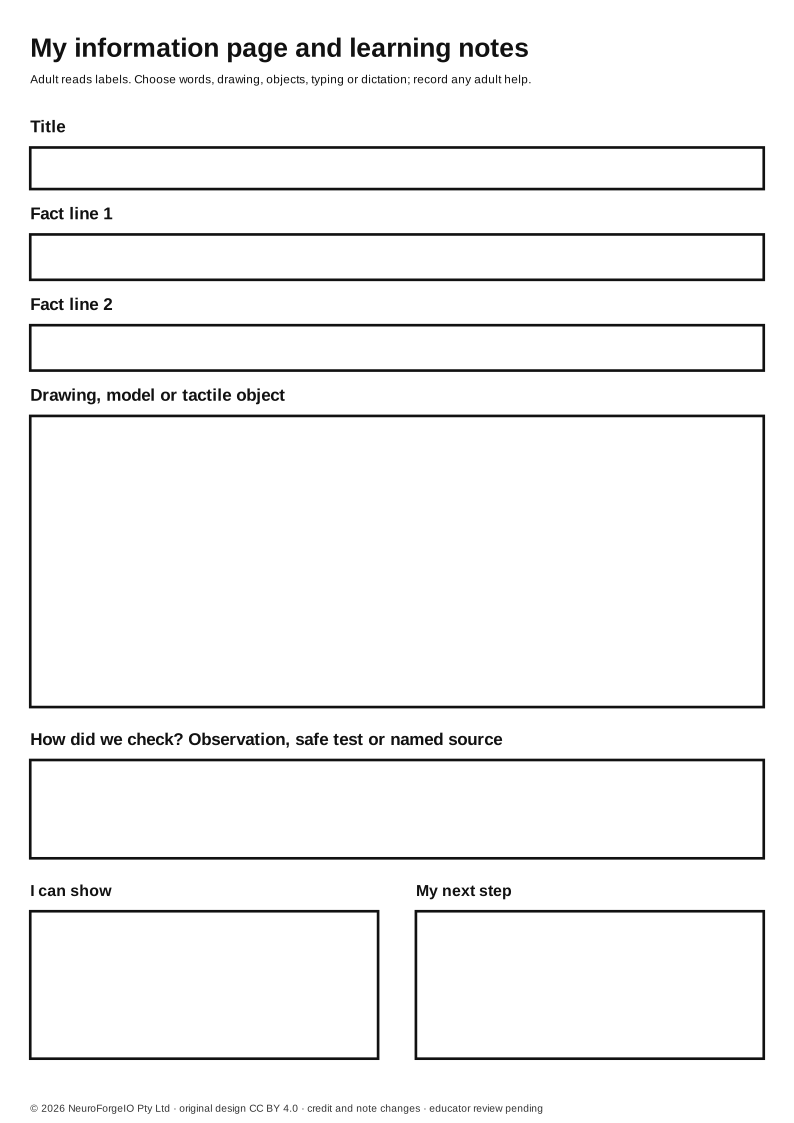
Reusable evidence line: date / learner code / exact text or response / independent or prompted / format and source / next teaching move. Store identifiable copies only in the school's approved local system.