Keep this page and the response key away from learner cards and the first four lessons of each week. The following texts are new combinations of character, setting, problem, quantities and wording relative to teaching. Use a familiar quiet setting. Adult may read every rich word and describe every image neutrally. Offer large print, a linear transcript, tactile broad cards, sign, AAC, point or spoken response; record the access route and exact adult support. A pass/pause is allowed. Save the first independent answer before discussion. Do not use either short check as a whole achievement-standard judgment.
Day 155 · unseen book, sign and two-frame paper screen
Fresh book (adult read): Front cover: “Elin's paper kite”. Page 1: Elin made a small kite from paper. Page 2: One paper strip slipped away from its tail. Page 3: Elin kept the strip on the table and asked an adult where to place it. Page 4: The adult pointed to a wide scrap tray. Elin put the loose strip there. The book does not say the kite was repaired or flown.
Fresh sign (adult read): “After making a paper kite, put loose strips in the wide scrap tray. Ask an adult before using scissors.” Neutral image description: a plain loose strip and a broad arrow point to an open tray; no person or scissors is drawn. The words carry the timing and safety request. The drawing helps locate the tray, not prove what happened.
Fresh paper-screen mockup (adult read): Frame 1 title “Choose a next step”. Labelled paper choices “I need another strip” and “I am finished”. Labelled Next leads to Frame 2 titled “Put loose strips in the scrap tray. Ask an adult for help.” Labelled Back leads to Frame 1. Text at the bottom: “No name or photo needed.” Both paper choices lead to this same general instruction; nothing records a selection. Show two large described pages, not a working device.
With the three texts in neutral positions and the blank three-text aid, ask in this order:
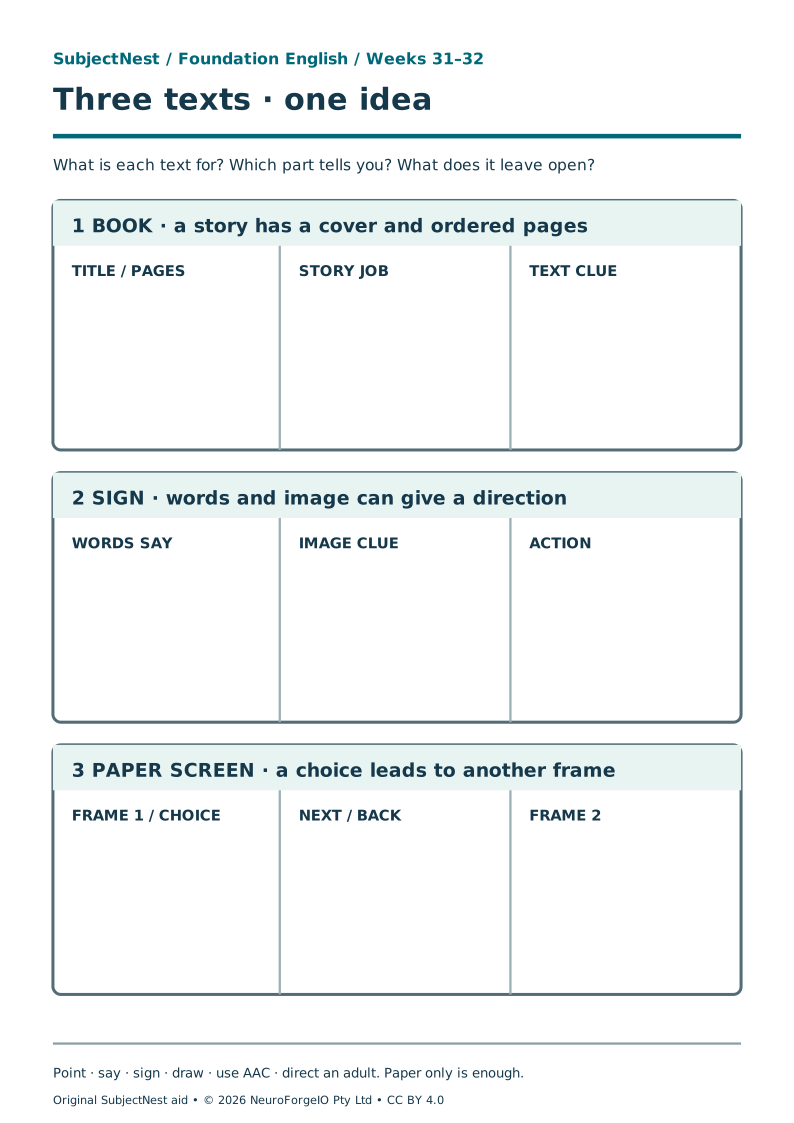
- “Which text tells what happened to Elin? What part shows you?” Record source and clue.
- “Which text tells someone what to do after making? Which words matter?” Do not gesture to the sign.
- “Which text has a choice and a Next step? What would Back do?” Allow paper-direction or spoken answer.
- “What does the sign's picture help you find? What do the words add that the picture cannot say?” Read the image description on request.
- “Did the book tell us the kite flew? Did it tell us the strip was repaired?” Record not stated, not a prediction.
- Optional taught-point print, separate: show cob and nip one at a time without a picture. Ask for blend, then hide print and dictate one for child-chosen letters/tiles/scribe-as-directed. First check all required grapheme–sound links; if untaught, mark not administered and choose a documented, equally new taught-point CVC item later. Do not count this as evidence of source comprehension.
Day 160 · unseen event report
Fresh adult-read report:
Lila put four large paper flags on a pretend parade table. Sam brought three more paper flags. There were seven flags together. Lila wrote “7” on a small paper label beside them. The account does not say that a parade happened.
Neutral diagram: one row of four empty broad flag outlines and a separate row of three empty flag outlines; no total, arrow or success tick. Read that description to a learner using a text route. Do not join rows or give a count until the first response is saved.
Ask in this order:
- “Who was there? What was on the table first?”
- “What did Sam do next? How many flags were together in this account?”
- “What did Lila put beside them? Does that prove a parade happened?”
- “Tell this event in first / action / then order. Make one short sentence using what the source actually says.” The child may speak, sign, select AAC, draw and dictate, use letter tiles or write. Mark exactly which words, capitals or end marks were the child's choices and which the adult supplied.
- “Ask one answerable question we could ask if we had the broad paper flags in front of us.” A child might ask how many there would be after one more; this is a question, not a claim the event occurred.
- Optional taught-point print, separate: show fed and lug individually with no picture, then hide print and ask for one sound-to-letter attempt. If a link is untaught or an item is already familiar in the local class, mark not administered or substitute a different documented taught-point item. Keep oral phonemes, CVC blending and reported meaning distinct.
After saving the first record, offer supportive feedback and a different practice source. The later integrated Week 31/32 activities are not a repeat of these independent checks.
Recording grid
| Day and component | First exact response/mode | Adult read, repeat, prompt or scribe | Source clue / print link actually observed | Next 3–5 minute teaching move and date |
|---|---|---|---|---|
| 155 text form and purpose | ||||
| 155 words/image and bounded meaning | ||||
| 155 optional CVC print | ||||
| 160 who/first/action/result/unknown | ||||
| 160 short report and question | ||||
| 160 optional CVC print |
Original SubjectNest held checks © 2026 NeuroForgeIO Pty Ltd, CC BY 4.0. Credit, link and indicate changes. Human educator, accessibility and local assessment review remain pending.