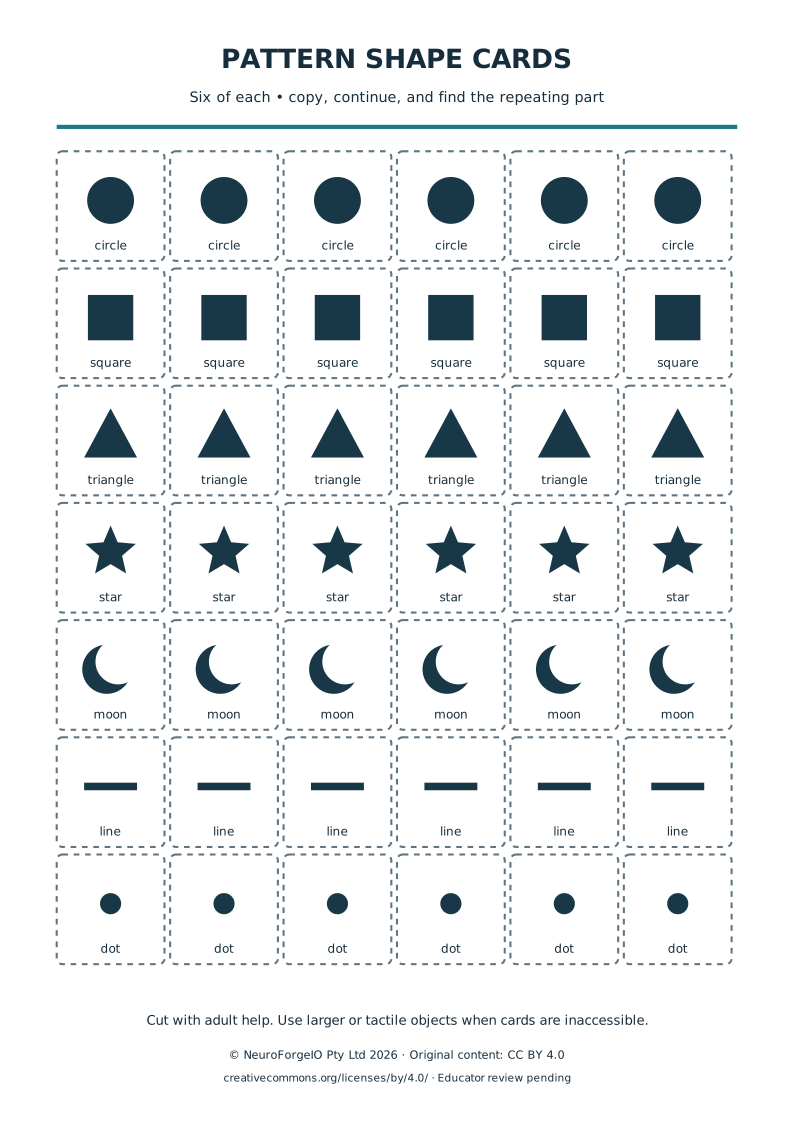
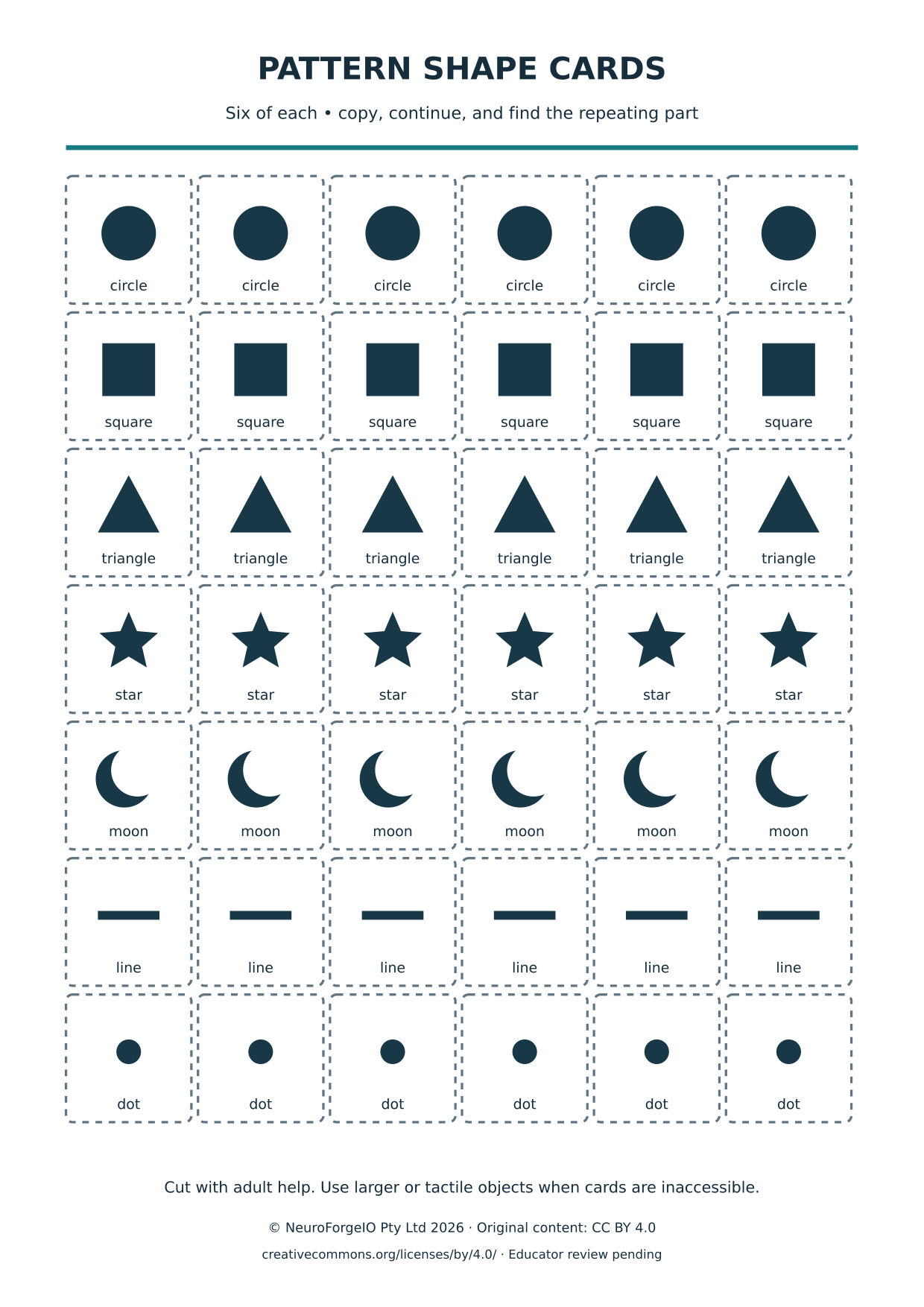
Original SubjectNest draft · educator and accessibility review pending. © NeuroForgeIO Pty Ltd 2026, CC BY 4.0. Attribution and separate ACARA terms are in README.md. Use the A4 vector page or PNG preview for large boxes, and the cut-apart shape cards or card preview for reusable symbols. These plain-text forms can be read aloud, translated after review, enlarged or adapted to tactile objects.
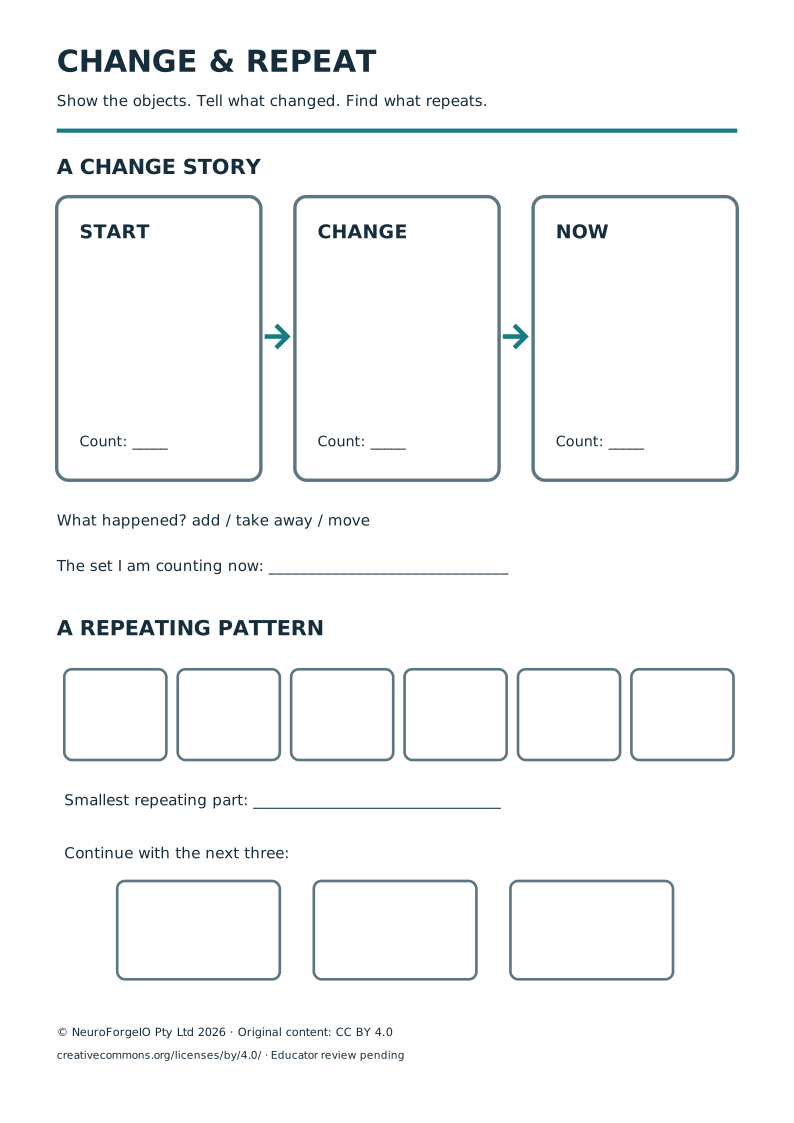
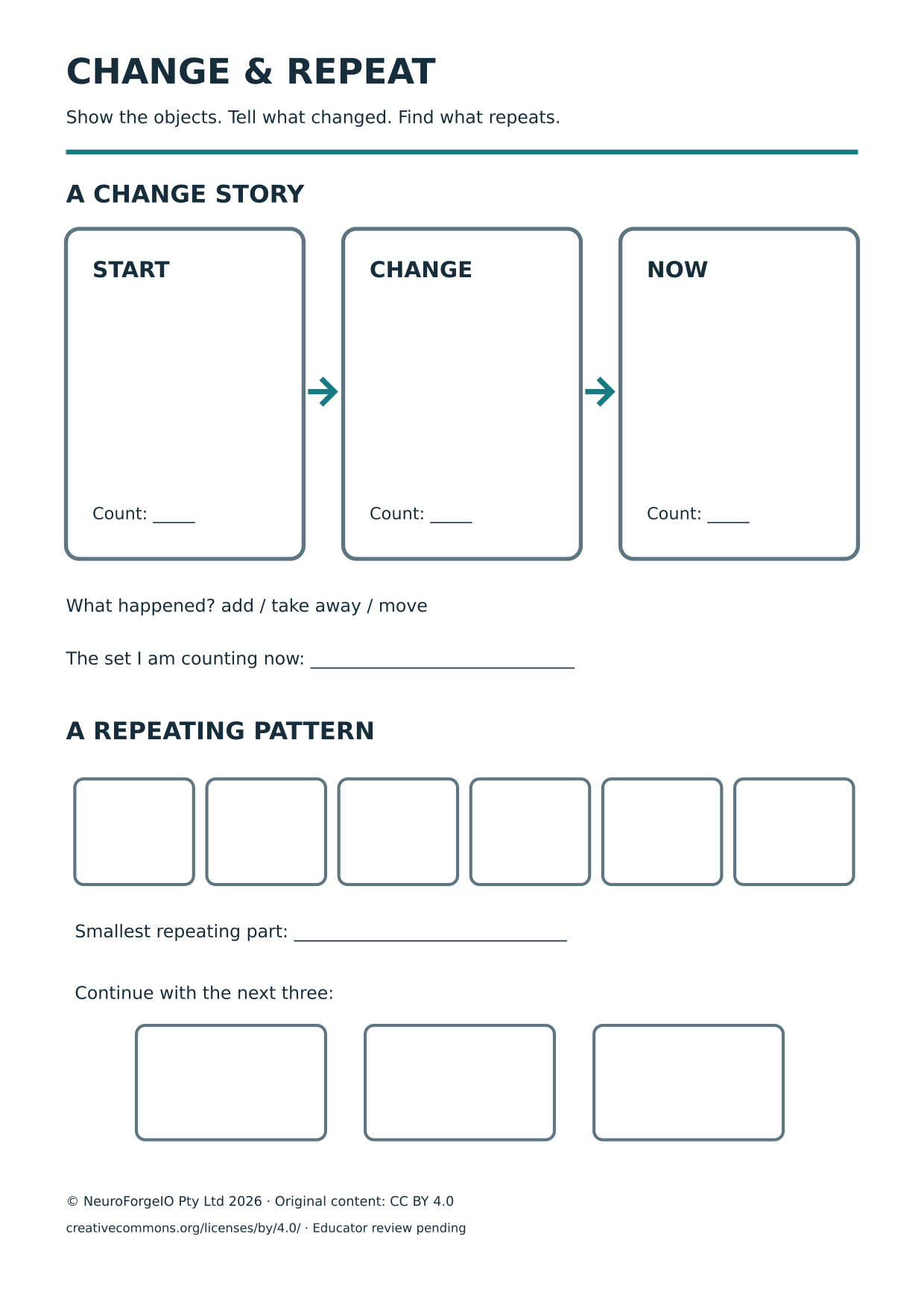
Start / change / now mat
THE SET I AM COUNTING: ___________________________________________
START — show the objects:       [                               ]
CHANGE — add / take away / move: [                               ]
NOW — show the counted set:     [                               ]
I started with ____ . I added / took away / moved ____ .
There are ____ in the named set now. I checked by ________________ .
An adult may write exactly what a child says or does. Keep the removed or moved objects visible in a separate place so the action can be checked. For a story about one shelf, count what is on that shelf, not every object in the room.
Practical change cards
Use large reusable counters for every scene. All stories are pretend; the named items and places are not claims about a child's home. These cards use 0–10 while the child learns the new operations.
| Card | Teacher story and question | Key |
|---|---|---|
| 1 | Library: “Three books are on the return trolley. Two more arrive. How many now?” | 3 + 2 = 5 |
| 2 | Community garden: “Four empty pot markers are on the table. Add three. How many now?” | 4 + 3 = 7 |
| 3 | Bike workshop: “Five paper job cards are waiting. One more arrives. How many now?” | 5 + 1 = 6 |
| 4 | Theatre: “Two ticket cards are on the desk. Four more are added. How many now?” | 2 + 4 = 6 |
| 5 | Bus stop: “Six paper passenger cards wait. Two leave the waiting area. How many remain there?” | 6 − 2 = 4 |
| 6 | Sports shed: “Eight cone cards are on the floor mat. Three move into the storage tray. How many remain on the floor mat?” | 8 − 3 = 5; all 8 still exist across both places |
| 7 | Parcel desk: “Nine parcel cards are on the desk. Four move to a shelf. How many remain on the desk?” | 9 − 4 = 5; all 9 still exist across both places |
| 8 | Museum: “Seven label cards are on a board. Zero new cards are added. How many remain?” | 7 + 0 = 7 |
| 9 | Art room: “The shape tray is empty. Five paper shapes are placed in it. How many now?” | 0 + 5 = 5 |
| 10 | Animal shelter: “Four paper bowl cards are ready. Four more are placed beside them. How many now?” | 4 + 4 = 8 |
| 11 | Music room: “Ten shaker cards are out. Six move to the pack-away tray. How many remain out?” | 10 − 6 = 4; all 10 still exist |
| 12 | Recycling desk: “Seven box cards are sorted. Three more are added. How many are sorted now?” | 7 + 3 = 10 |
| 13 | Health supplies: “Eight clean-cloth cards are on a shelf. Five are moved to a box. How many remain on the shelf?” | 8 − 5 = 3; all 8 still exist |
| 14 | Play table: “Five blocks are on a mat. Two are taken off the mat. How many remain on it?” | 5 − 2 = 3 |
The expressions in the key are teacher checks, not required child notation. If a child uses counting all, counting on, counting back or a recognised small group appropriately, record the strategy. A move between locations changes the location count but need not change the total number of objects.
Pattern strip and cards
MY PATTERN:   [     ] [     ] [     ] [     ] [     ] [     ]
REPEATING PART: [                         ]
NEXT THREE:  [     ] [     ] [     ]
I checked by reading or showing the pattern twice: ______________
For the table below, A, B and C stand for different objects, shapes, movements or cues named in that row. The child sees or feels the actual representations, not just these letters. The key gives the smallest repeating unit and next three positions. Avoid colour-only differences and forced sound or movement. Cover the printed word labels for a shape-only check when appropriate; keep them or use tactile labels when they support access, and record which cues were available.
| Card | Context and displayed pattern | Smallest unit | Next three |
|---|---|---|---|
| P1 | Book / block: book, block, book, block, book, block | book–block | book, block, book |
| P2 | Path marks: dot, dash, dot, dash, dot, dash | dot–dash | dot, dash, dot |
| P3 | Quiet rhythm marks: tap, rest, tap, rest, tap, rest | tap–rest | tap, rest, tap |
| P4 | Garden tokens: leaf, leaf, pot, leaf, leaf, pot | leaf–leaf–pot | leaf, leaf, pot |
| P5 | Shape cards: circle, circle, square, circle, circle, square | circle–circle–square | circle, circle, square |
| P6 | Tactile marks: line, dot, dot, line, dot, dot | line–dot–dot | line, dot, dot |
| P7 | Museum labels: shell, stone, feather, shell, stone, feather | shell–stone–feather | shell, stone, feather |
| P8 | Movement choices: reach, sway, pause, reach, sway, pause | reach–sway–pause | reach, sway, pause |
| P9 | Music cards: drum, bell, shaker, drum, bell, shaker | drum–bell–shaker | drum, bell, shaker |
| P10 | Train cards: engine, carriage, engine, carriage, engine, carriage | engine–carriage | engine, carriage, engine |
| P11 | Recycling marks: paper, paper, box, paper, paper, box | paper–paper–box | paper, paper, box |
| P12 | Building shapes: arch, column, roof, arch, column, roof | arch–column–roof | arch, column, roof |
Use drawings, paper shapes, objects or accessible word cards you create locally; the words above are the original content. “Rest” can be a visible empty symbol or still gesture. A learner who cannot perform a movement can select or direct it. Do not require contact with shells, feathers or other actual natural materials; cards or safe stand-ins work.