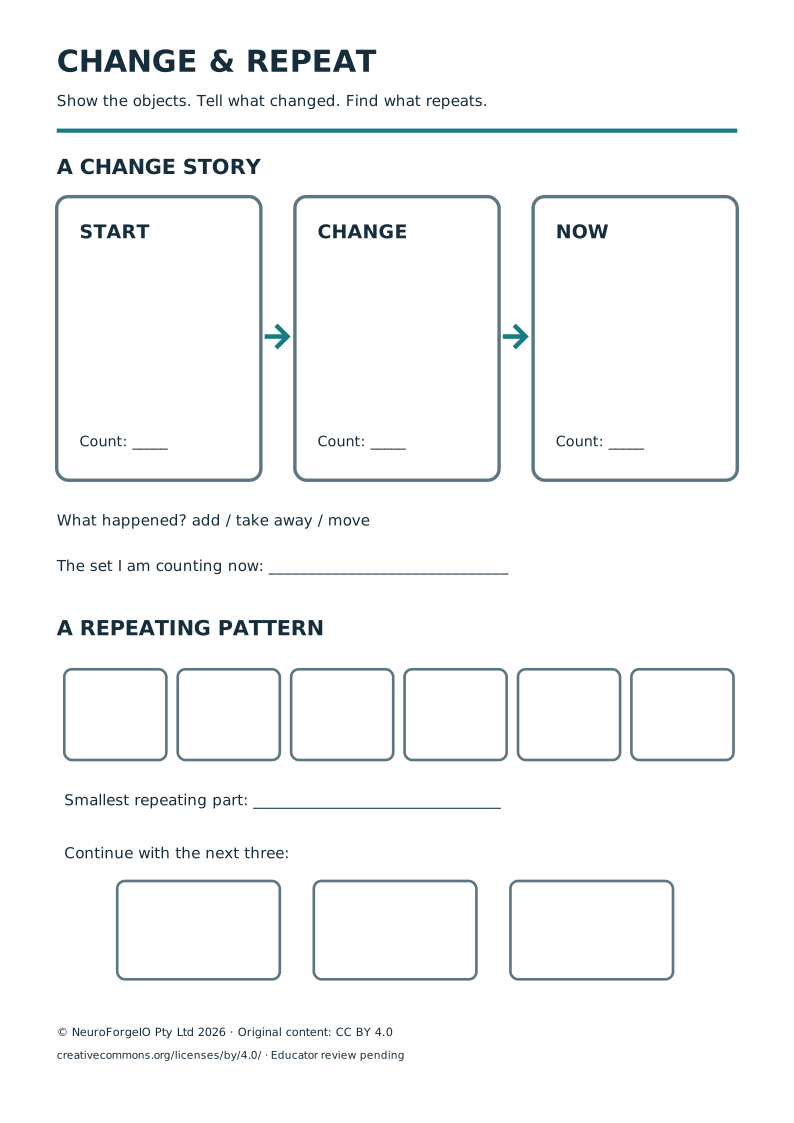
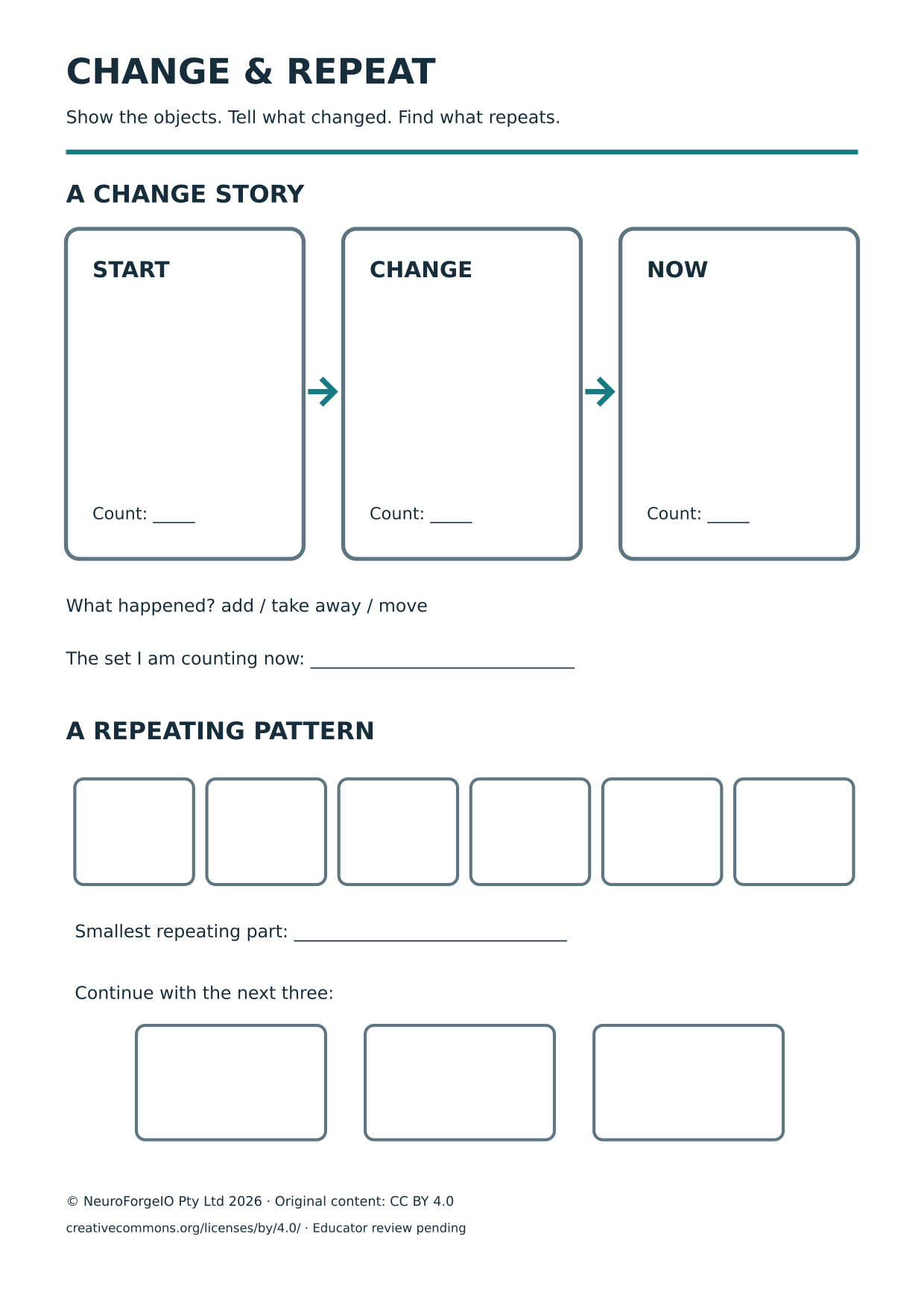
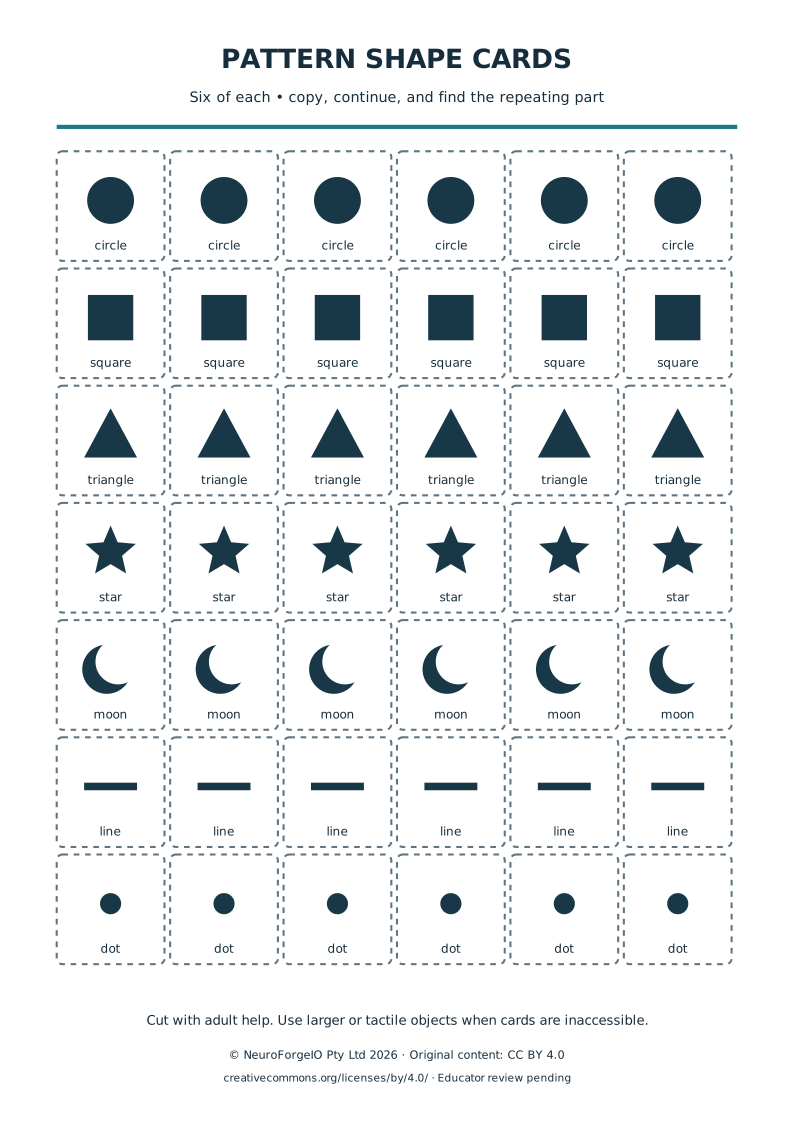
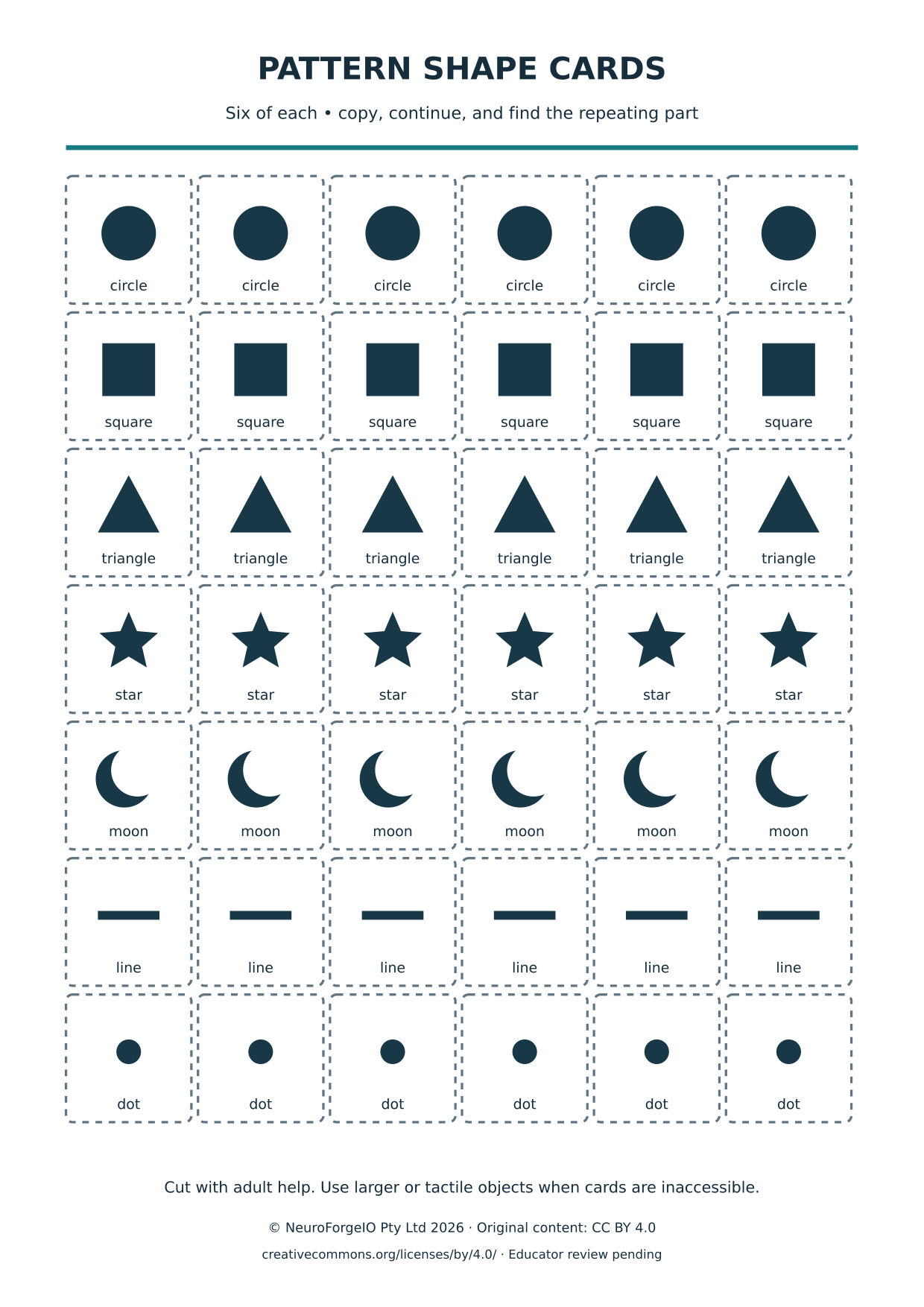
Version: v0.1 draft, 29 September 2026. Status: educator, accessibility and local-syllabus review pending. Audience: Foundation / Queensland Prep after Weeks 5–6. Use: ten 25-minute lessons, original print and text aids, an A4 vector activity page with PNG preview, original cut-apart shape cards with PNG preview, and a formative assessment.
| Day | Main idea | Curriculum link |
|---|---|---|
| 31 | Join two groups and count the new whole | AC9MFN05 |
| 32 | Start with a set, add more, show what changed | AC9MFN05 |
| 33 | Take objects away and count what remains | AC9MFN05 |
| 34 | Track what remains in one place when objects move | AC9MFN05 |
| 35 | Decide whether a story adds, removes or leaves a set unchanged | AC9MFN05 |
| 36 | Recognise, copy and continue an AB pattern | AC9MFA01 |
| 37 | Recognise and continue an AAB pattern | AC9MFA01 |
| 38 | Recognise and continue an ABC pattern | AC9MFA01 |
| 39 | Keep a repeating pattern when its form changes | AC9MFA01 |
| 40 | Show a practical change and explain a repeating unit | AC9MFN05 and AC9MFA01 |
Week 7 uses quantities 0–10 for new addition and subtraction work; children can revisit up to 20 for counting and ordering, and extend practical stories when ready. Every change story names its starting set, the action and the set being counted now. Moving objects between two places reduces the number in one place while the combined total can stay unchanged. This distinction is made explicit on Day 34. Do not treat a bare number sentence as the only proof: objects, actions, drawings and explanation all count.
Week 8 teaches a repeating unit. A pattern must keep repeating; one alternating pair alone is not enough evidence. Representations include objects, shapes, movement and optionally quiet rhythm. No child must hear a sound, perform publicly or rely on colour alone. Copying a pattern, continuing it and finding its repeating part are recorded separately. The assessment checks both number and pattern strands across several days, not in one speed test.
Prepare and include
Per pair: two mats, up to ten large reusable objects for the story, a small tray or box, numeral cards 0–10, a start/change/now mat, paper shape cards in at least two tactile or visually distinct forms, and a pattern strip. Use the original print and text aids, large A4 activity page and shape card sheet where useful. The shape cards can stand in for book/block, leaf/pot or other contextual tokens while preserving the exact pattern structure. Optional school-approved accessible virtual counters can replay a story; physical materials remain the default. Check loose-part and movement safety under school policy. Use classroom-safe pretend stories; no learner must disclose a home routine or respond to a warning scenario as a mathematics test.
Offer large print, high contrast, raised borders, grippable objects, spoken or plain-text descriptions, AAC, sign and child-directed partner placement. A quiet solo route is available. A sound pattern has an equivalent visual or tactile task, though a different format may give different evidence about what the child perceived; note the route. Adjust with the learner, family and relevant school team, without assigning a fixed learning style. Each lesson names five blocks totalling 25 minutes and includes one fresh independent check, a misconception response and a next teaching note.
Curriculum, evidence and rights
National authority: Australian Curriculum Version 9.0 downloads, Foundation Mathematics. The exact code wording below was checked against ACARA's official workbook downloaded 29 September 2026 (SHA-256 db446882d2c00cf7c085a03e250e2442fda6c44011fc114680c46c1dc7a822c3) and local import data/frameworks/acara-v9.json.
- AC9MFN05: “represent practical situations involving addition, subtraction and quantification with physical and virtual materials and use counting or subitising strategies.” Week 7 uses physical objects, drawings and optional virtual transfer, so this is partial practice, not a full achievement claim.
- AC9MFA01: “recognise, copy and continue repeating patterns represented in different ways.” Week 8 covers this with multiple original patterns and formats; evidence still needs review across contexts.
Curriculum wording is reproduced without modification. © Australian Curriculum, Assessment and Reporting Authority (ACARA) 2010 to present, unless otherwise indicated. See ACARA copyright and terms. ACARA has not endorsed this pack. Check the currently adopted local syllabus before use.
Original material licence: © NeuroForgeIO Pty Ltd 2026. Original lessons, scripts, games, scene cards, print aids and assessment in this folder are CC BY 4.0, including commercial reuse with attribution. Suggested credit: “NeuroForgeIO Pty Ltd, SubjectNest: Change and repeat — Foundation mathematics, Weeks 7–8, v0.1 (2026), source, CC BY 4.0”; indicate changes. The licence does not relicense ACARA text or separately sourced material. No third-party image, worksheet, song or story is embedded. Any translation needs exact locale and qualified human review.
AERO early numeracy informs the purposeful play, talk and object work. AERO monitoring progress informs the short checks and next-step decisions. These sources do not establish that this unpiloted pack improves outcomes.