Version: v0.1 draft, 29 September 2026. Status: original draft; educator, accessibility, cultural and local-syllabus review pending. Audience: Foundation / Queensland Prep after Weeks 3–4. Use: ten 25-minute lessons, original print and text aids with an A4 vector part-whole mat and PNG preview, and an assessment with next steps. Repeat a smaller number range when a check shows it is needed; these weeks are a teachable sequence, not a demand that every child progress at the same rate.
| Day | Main work | Curriculum link |
|---|---|---|
| 21 | Count a loose 0–20 set once and tell the total | AC9MFN01 and AC9MFN03 |
| 22 | Recognise that rearranging does not change a count | AC9MFN01 and AC9MFN03 |
| 23 | Compare and explain more, fewer and same to 20 | AC9MFN03 |
| 24 | Match quantities, numerals and order from 0–20 | AC9MFN01 |
| 25 | Use count/compare in a new scene; review small groups | AC9MFN01, AC9MFN02 and AC9MFN03 |
| 26 | Split up to five into two visible parts | AC9MFN04, AC9MFN02 |
| 27 | Find different splits of five, including zero | AC9MFN04 |
| 28 | Make and name parts of six and seven | AC9MFN04 |
| 29 | Make and name parts of eight, nine and ten | AC9MFN04 |
| 30 | Explain a split, combine it and transfer it | AC9MFN04; retrieval of AC9MFN01 and AC9MFN03 |
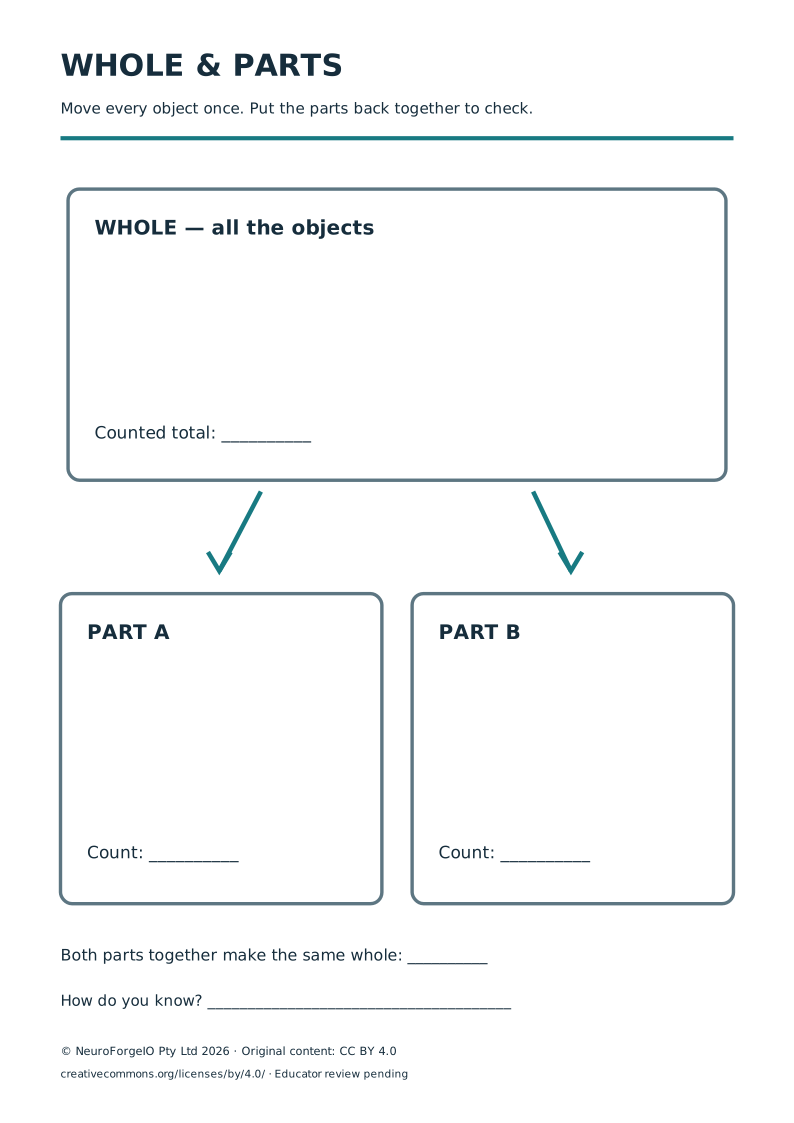
In Week 5, “living things” are optional pretend counting scenes, not a science classification test. Counting leaves, pots, animal picture cards or shells does not establish which are living. The teacher checks the count and comparison. In Week 6, a whole is the full collection and the two parts are non-overlapping groups that together account for every object. Teach with objects before recording 3 and 2 make 5. The number sentence is a later notation, not the only valid evidence. For subitising, show small parts briefly and invite the child to describe what they saw; count afterward to confirm.
Prepare once for the fortnight
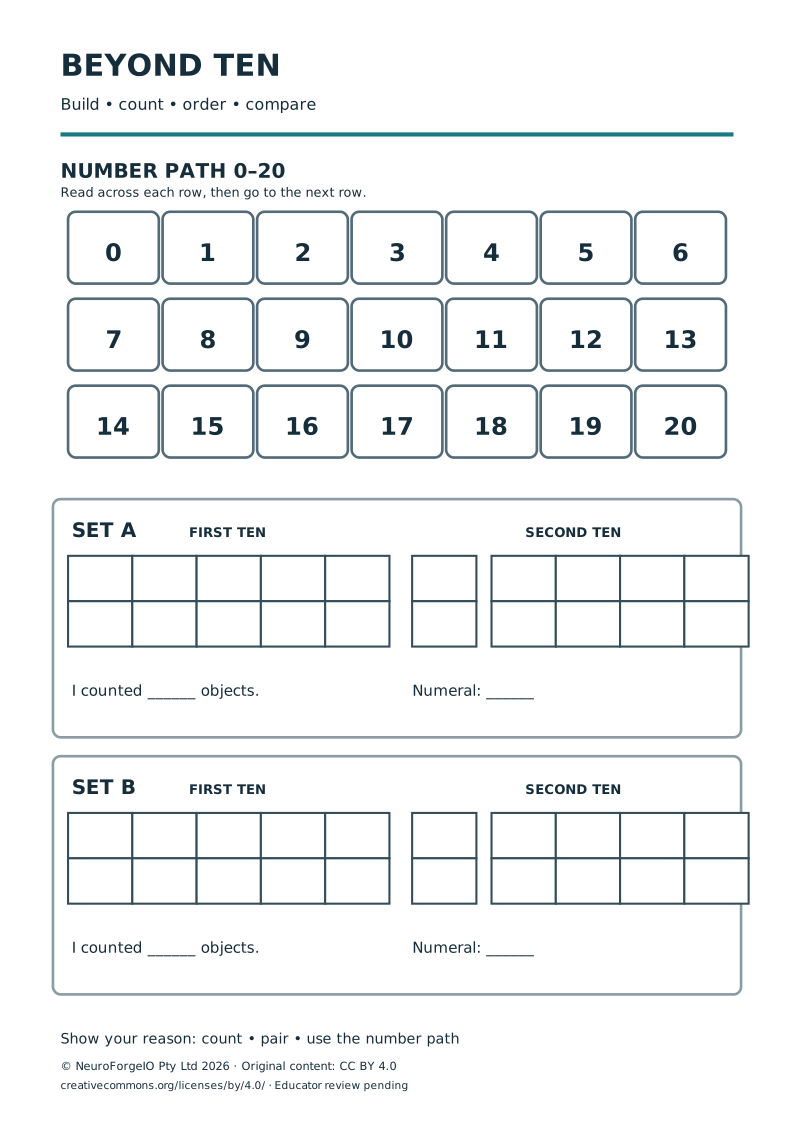
For each pair: two distinct mats, four ten-frames, 40 large reusable counters for two 20-object sets, numeral cards 0–20, one part-whole mat, ten small counters for splitting, two shallow bowls or outlined part spaces, and scene and dot cards. Reuse the 0–20 number page where helpful. Keep a set of simple, original object drawings or blank cards; do not depend on photographs of children or third-party artwork. Check loose-part and sensory safety with the school. Make the two parts distinct by position and boundary, never colour alone.
Each day has five named blocks totalling 25 minutes: retrieve, model, guided game, fresh individual try and check. Record the exact response and support. If a child counts reliably only in frames, offer a loose set; if a spoken name is difficult in English, allow a verified home-language, sign or AAC response while teaching the local English label. Offer large print, high contrast, raised/tactile borders, grippable pieces, plain-text descriptions and partner placement under the learner's direction. A quiet solo route is available. Adjust with the learner, family and specialist team rather than assigning a fixed learning style. An accessible school-approved virtual material can repeat a task, but these lessons do not depend on a screen.
Source, alignment and rights
The authority is the Australian Curriculum Version 9.0 downloads page, Foundation Mathematics, Number. Exact wording below was checked against the official workbook downloaded 29 September 2026, SHA-256 db446882d2c00cf7c085a03e250e2442fda6c44011fc114680c46c1dc7a822c3, and the local normalized copy data/frameworks/acara-v9.json.
- AC9MFN01: “name, represent and order numbers including zero to at least 20, using physical and virtual materials and numerals.”
- AC9MFN02: “recognise and name the number of objects within a collection up to 5 using subitising.”
- AC9MFN03: “quantify and compare collections to at least 20 using counting and explain or demonstrate reasoning.”
- AC9MFN04: “partition and combine collections up to 10 using part-part-whole relationships and subitising to recognise and name the parts.”
AC9MFN01 and AC9MFN03 are revisited to 20. AC9MFN02 supplies a small-part recognition strategy. AC9MFN04 is introduced and practised to ten, but a single successful split does not demonstrate secure achievement. Curriculum wording is reproduced without modification. © Australian Curriculum, Assessment and Reporting Authority (ACARA) 2010 to present, unless otherwise indicated. See ACARA rights and terms. ACARA has not endorsed this pack. Check the locally adopted state or territory syllabus before teaching.
Original material licence: © NeuroForgeIO Pty Ltd 2026. The original lessons, scenes, print aids and assessment in this folder are CC BY 4.0: free to copy, adapt and reuse commercially with attribution. Suggested credit: “NeuroForgeIO Pty Ltd, SubjectNest: Count, compare, split — Foundation mathematics, Weeks 5–6, v0.1 (2026), source, CC BY 4.0”; indicate changes. This licence does not relicense the credited ACARA wording or external material. No third-party image, worksheet, song or story is embedded. Any translation needs exact locale and qualified human review before use.
The teaching design draws on AERO early numeracy for purposeful play, talk and manipulatives and AERO monitoring progress for checking and responding. These are design sources, not evidence that this unpiloted pack improves outcomes.