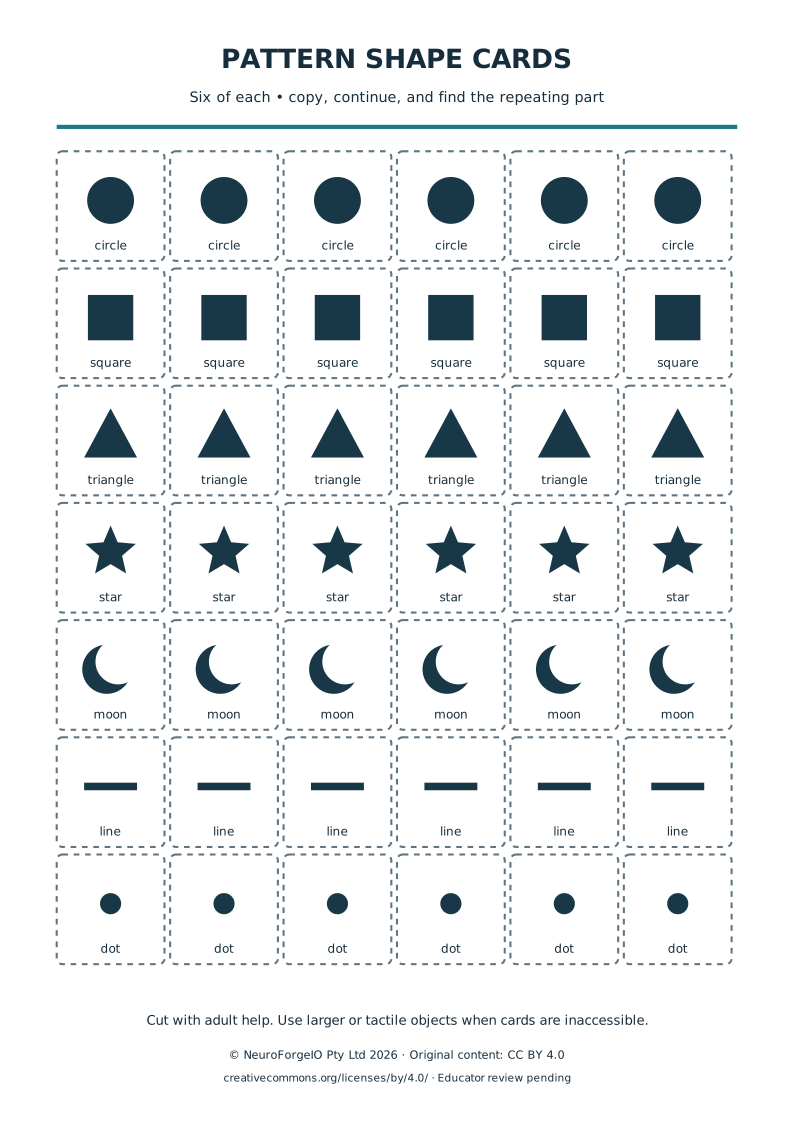
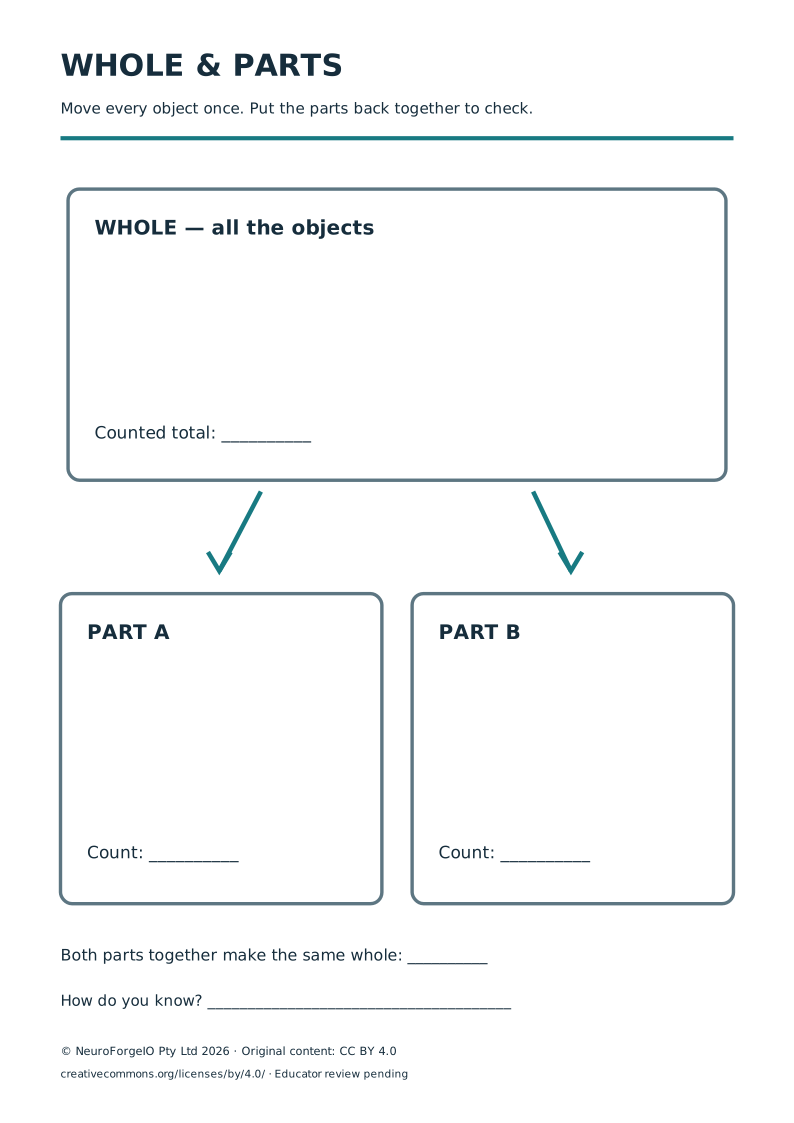
Original SubjectNest draft · educator and accessibility review pending. © NeuroForgeIO Pty Ltd 2026, CC BY 4.0. Source, attribution and separate ACARA rights are in README.md. Use the A4 vector data page or PNG preview for a large paper display; the plain-text layouts below support read-aloud, enlarged and tactile adaptation.
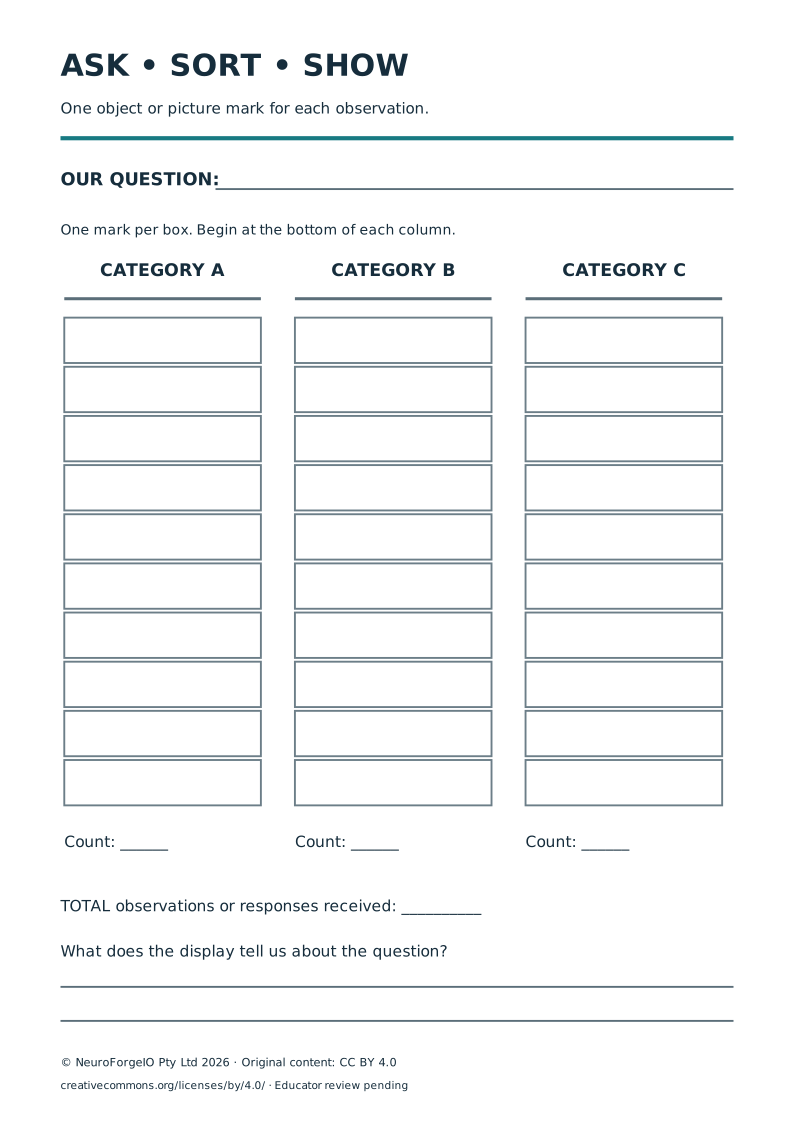
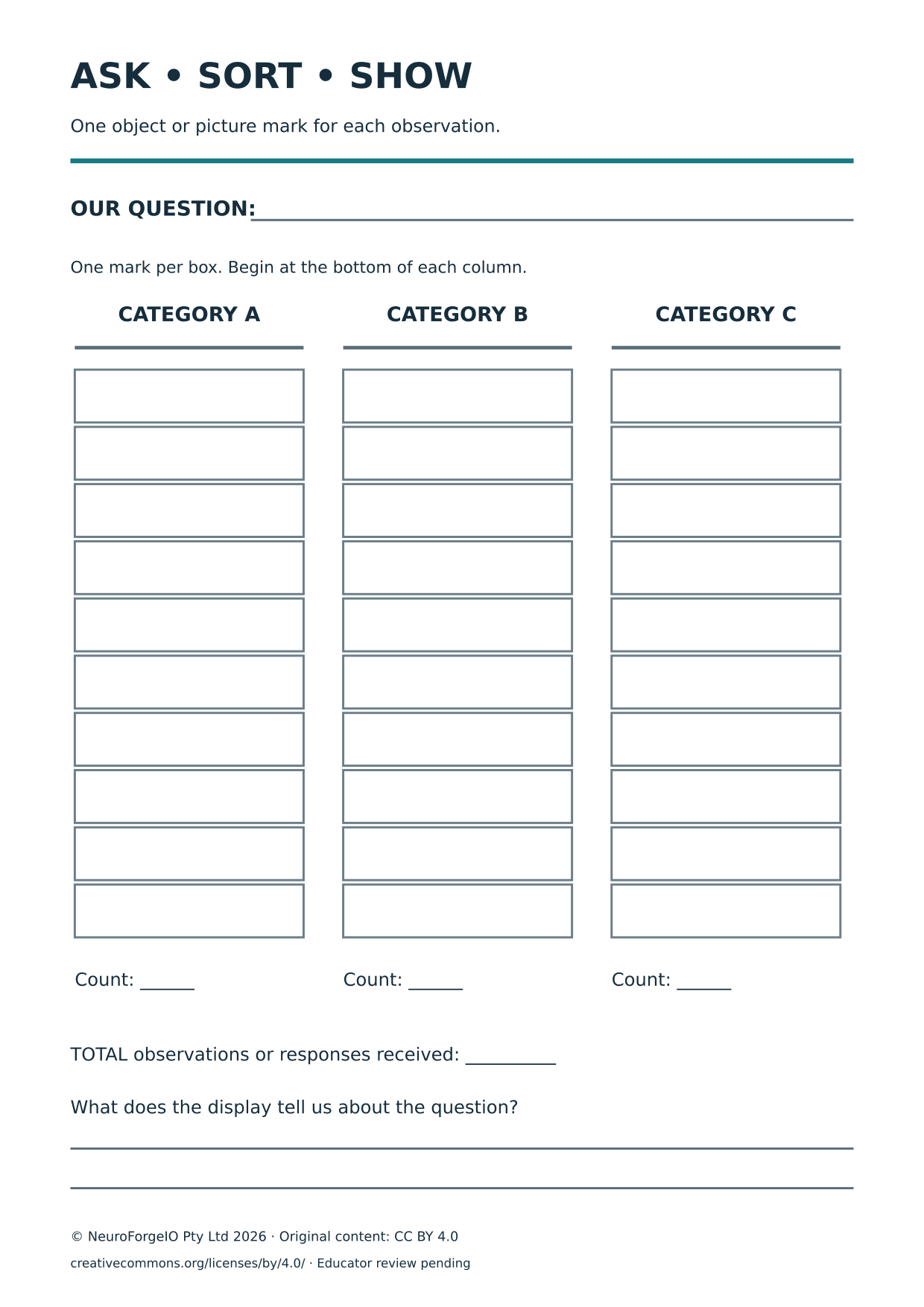
Investigate with one mark per observation
OUR QUESTION: _____________________________________________________
WHAT WE LOOKED AT OR ASKED: ______________________________________
SORTING RULE (one place for each item): __________________________

CATEGORY A: __________   OBJECTS / PICTURE MARKS: __________  COUNT: ___
CATEGORY B: __________   OBJECTS / PICTURE MARKS: __________  COUNT: ___
CATEGORY C: __________   OBJECTS / PICTURE MARKS: __________  COUNT: ___

TOTAL OBSERVATIONS / RESPONSES RECEIVED: ______
THE QUESTION'S ANSWER FROM OUR DATA: _____________________________
I know because: ___________________________________________________
Use an object or picture for one observed item. Keep a category for an empty result when zero matters. Do not assume an uncollected or non-response belongs in another category. A real class vote has no fixed numerical answer key.
Original fixed data decks
For each deck, make the listed number of large safe objects or word-and-shape picture cards. Place them mixed in a bag; the child draws one at a time to collect it, then sorts it into three labelled category mats. The counts are the answer key. Different scenes make the same mathematical routine useful in varied domains; the data are fictional, not a claim about the actual classroom.
| Deck | Given investigative question and mixed contents | Key from collected data |
|---|---|---|
| D1 | Building box: “Which piece type appears most?” 5 cube, 4 flat tile, 3 arch tokens | cube most (5); arch fewest (3); total 12 |
| D2 | Classroom signs: “Which picture appears most?” 6 book, 4 leaf, 2 cup cards | book most (6); cup fewest (2); total 12 |
| D3 | Art kit labels: “Which label appears most?” 4 crayon, 6 brush, 2 sponge cards | brush most (6); sponge fewest (2); total 12 |
| D4 | Sports shed labels: “Which is tied for most?” 5 ball, 5 cone, 0 hoop cards | ball and cone tied (5 each); hoop zero; total 10 |
| D5 | Weather picture log: “Which symbol was recorded most in this pretend log?” 7 sun, 3 cloud, 2 rain cards | sun most (7); rain fewest (2); total 12 |
| D6 | Museum mark cards: “Which mark appears most?” 3 spiral, 6 star, 1 square cards | star most (6); square fewest (1); total 10 |
| D7 | Toy transport labels: “Are any counts the same?” 4 wheel, 4 door, 4 window cards | all three equal (4); total 12 |
| D8 | Garden tool markers: “Which tool picture appears most?” 7 spade, 1 watering can, 2 glove cards | spade most (7); watering can fewest (1); total 10 |
| D9 | Route-marker cards: “Which mark appears most?” 6 arrow, 2 dot, 2 stop cards | arrow most (6); dot/stop tied (2); total 10 |
| D10 | Shared table labels: “Which picture appears most?” 4 cup, 3 spoon, 5 plate cards | plate most (5); spoon fewest (3); total 12 |
Make cards with the printed words and a simple line drawing or tangible marker. If an object fits two everyday descriptions, its printed category label determines this deck's sorting rule. Use no copied logos or third-party illustrations. For D4, make a labelled but empty hoop category mat; zero is not a physical hoop card to put in the bag.
Original review cards
Use these as fresh or follow-up tasks, with objects and the child's response route. They sample different work from Days 1–45; no single card certifies a curriculum description.
| Card | Prompt | Key |
|---|---|---|
| R1 | Empty tray and one block: show their numerals and which has more. | 0 and 1; one is more |
| R2 | Mix 13, 15, 14; put in order and build 14. | 13, 14, 15; 14 objects |
| R3 | Fill two ten-frames. How many objects and which numeral? | 20; 20 |
| R4 | Compare 16 objects with 18, despite different spacing. | 18 more by 2 |
| R5 | Briefly show four dots as two close pairs. How many without one-by-one counting? | 4; two and two |
| R6 | Split five counters into two parts, then recombine. | e.g. 2 and 3 make 5; other valid splits accepted |
| R7 | Split ten counters as six and four; recombine. | 6 and 4 make 10 |
| R8 | Six library cards; three join. How many now? | 6 + 3 = 9 |
| R9 | Nine shelf cards; four move to a tray. How many remain on the shelf? | 9 − 4 = 5; all 9 still exist |
| R10 | Copy circle–square three times; show unit and next three. | unit circle–square; next circle, square, circle |
For R5, a tactile or described grouping can show quantity knowledge but does not establish visual subitising. When a part split differs from the example but every object belongs to exactly one part and recombines to the whole, accept it. Use shape cards and earlier part-whole mat as needed.