25 minutes · AC9MFN03 · educator review pending
Success: Child counts two printed dot sets and resists judging quantity by dot size or spacing. These dots stand for imaginary seed pictures; no real seeds are handled or counted.
Prepare: teacher-drawn or printed seed-dot symbols, L02 A15/B16 with A dots drawn large and close and B dots smaller and spread, A/B boundaries. Fresh check: A15/B17 with A larger symbols. Keep dot sizes distinguishable but countable.
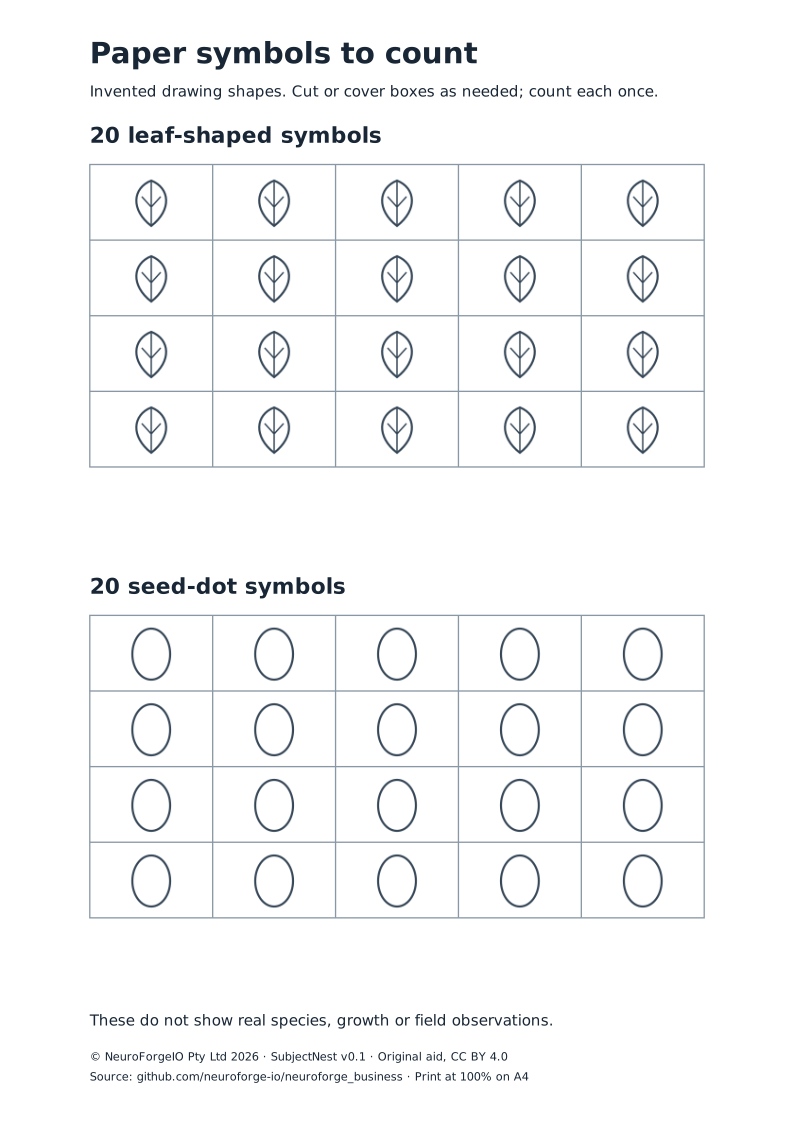
- Retrieve, 3 min. Show yesterday's paper leaves and ask how a pairing proved B had more.
- Model, 5 min. Display L02. Say, “Large dots take more space, but one dot is still one mark.” Touch/mark each A dot once (fifteen), then each B dot once (sixteen). Pair corresponding paper tokens or trace pairs with a pencil: one B dot remains unmatched.
- Dot detective, 10 min. Partners compare L02 and L08 (paper marks standing for imagined insect-picture tokens, 14/12) using count first, then pairing. One explains the result without using “looks bigger”; the other checks no symbol was skipped. Teacher observes three focus learners' ability to keep one mark per counted item.
- Fresh check, 4 min. Provide A15 large dot symbols and B17 smaller, spread symbols in a new arrangement. Child counts and identifies B more; pairing leaves two B unmatched. Record if counting is supported.
- Close, 3 min. Ask, “Did drawing the dots larger add more dots?” Key: L02 B more 16/15, one unmatched; L08 A more 14/12, two unmatched; fresh B more 17/15, two unmatched.
If the child treats one oversized dot as several: Cover the visual area around it; touch and count the symbol boundary once, then use same-sized tactile tokens to recheck. Access and record: Enlarge the whole page without changing counts, use embossed dots or large counters, and accept sign/AAC. Note whether size, spacing or count drove the first claim.