25 minutes · AC9MFN03 · educator review pending
Success: Child checks equality when A and B use different fictional living-thing symbols; every symbol in A pairs with one in B, and both sets have the same counted total. The picture identity is irrelevant to the score.
Prepare: L03 leaf symbols A18/seed-dot symbols B18 and L09 leaf symbols A11/seed-dot symbols B11; use paper-symbols.svg. New check: A19 leaf symbols and B19 seed-dot symbols. Use two textures or word labels so colour is not the only distinction.
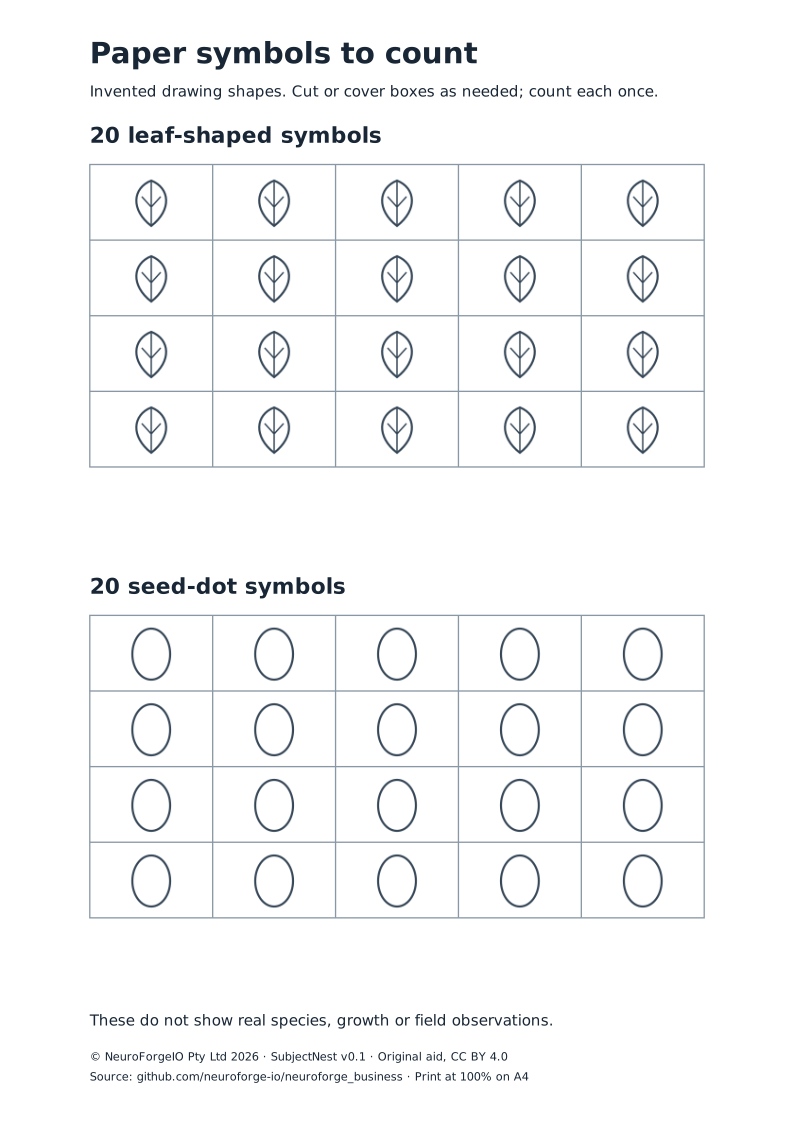
- Retrieve, 3 min. Ask what equal sets looked like on Day 62: no unmatched object on either side.
- Model, 5 min. Place L03 paper symbols in differently shaped rows. Pair one A picture to one B picture until both are empty. Count each set as eighteen. Say, “The pictures could look different; each set still has eighteen symbols.”
- Equal-set workshop, 10 min. Partners use L03 then L09. They first predict, then pair all symbols, then count both sets. One partner watches for reuse of a symbol; the other states the conclusion. Teacher asks three learners whether pair matching requires the pictures to look identical.
- Fresh check, 4 min. Give A19 leaf symbols and B19 seed-dot symbols in two different arrangements. Child pairs and counts nineteen in each, or directs equivalent tactile token moves.
- Close, 3 min. Ask, “What made the sets equal?” Key: L03 18/18, L09 11/11, fresh 19/19; none unmatched. The shapes, names and sizes do not decide quantity.
If the child pairs only matching pictures: Clarify that the relation is one item from A with one item from B; visual sameness is not a condition. Access and record: Use word-labelled or tactile A/B counters, raised pairing lanes, read-aloud prompts, sign/AAC. Record pairing and count separately; no biology vocabulary is assessed.