25 minutes · AC9MFN04 · educator review pending
Success: Child partitions the same eight objects into two different pairs of parts, then recombines each to eight without adding or losing an object. A small part may be recognised at a glance where accessible; count it if needed to check.
Prepare: eight large counters per pair, part-whole mat, P01 3/5 and P09 4/4. Keep all other counters outside the whole boundary. Fresh check: whole eight, A two.
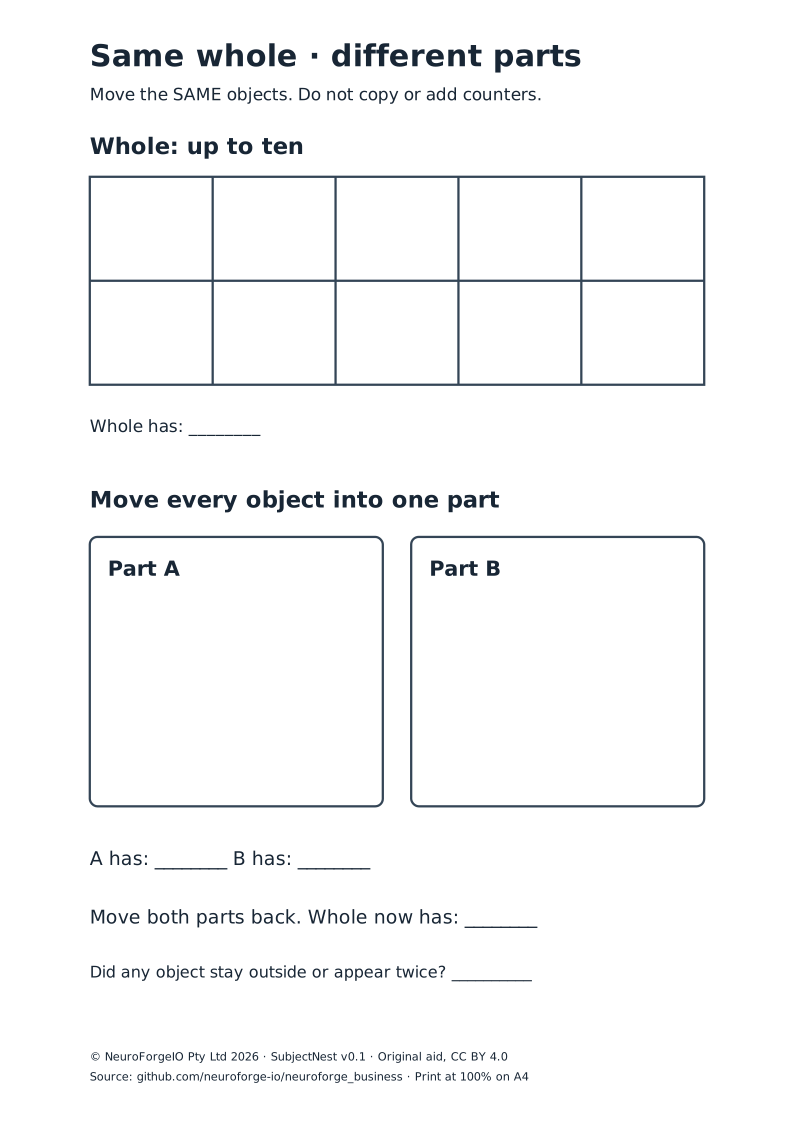
- Retrieve, 3 min. Count eight loose objects from last term's comparison work and say, “This is one whole eight.”
- Model, 5 min. Move three of the eight to A and five to B. Say, “These parts use the same eight. I did not make another eight.” Show the three briefly as a small group, then count each part and move both back to the whole.
- Partner game, 10 min. Pairs act out P01 and P09. One maker chooses positions, the checker looks for any object left in the whole or placed twice. Recombine after each. Teacher asks three focus learners to name a part and then show the unchanged whole.
- Fresh check, 4 min. Give a newly arranged whole eight; put two in A and ask the child to move the remaining objects into B, then recombine. Record 2/6/8 and whether every object was tracked.
- Close, 3 min. Ask what changed and what stayed the same. Key: P01 3+5=8; P09 4+4=8; fresh 2+6=8. Only the split changed.
If a child adds the parts to the whole as extra objects: Empty the whole starting space while moving counters to A/B; count the same eight on recombination. Access and record: Raised regions, grippable counters, verbal/AAC labels and child-directed adult movement are available. Record the route used to name a small part rather than assuming visual subitising.