Original SubjectNest formative draft · educator, accessibility and local-syllabus review pending. © 2026 NeuroForgeIO Pty Ltd, CC BY 4.0. This check samples AC9MFST01, a small count/comparison part of AC9MFN03, and AC9MFSP02. It is not a standardised score, diagnosis, report grade, proof of real place care or a complete Foundation achievement-standard decision. See README.md for exact ACARA wording and separate rights.
Fair administration
Do not show A90 or map B in Days 81–89 practice. Day 90 has one protected focus slot of about eight to nine minutes; schedule other learners across Days 86–90 independent-work rotations and a later window until each has a real opportunity. A group chorus is not an individual check. A teacher can repeat a direction once without giving the answer; record that repeat. Save the first independent action before a mathematical hint, then a supported retry separately. If an accessible route or actual source was unavailable, record not observed, not zero.
Use large/raised symbols and chart lanes, real cards/counters, exact text and tactile maps, stable page orientation, spoken or transcribed labels, sign, AAC, pointing, digital drag or child-directed adult placement. Do not score visual acuity, small-motor speed, label reading, ability to walk a path or speech clarity as the mathematics. A mathematically informative prompt such as “move by SHADE” changes independence; an access description such as “the raised line links BENCH and SHADE” may be needed and must be recorded. Co-plan an adjusted route with learner/family/specialist when a sensory or motor need changes what the check can show. Keep records in the school's approved private system.
D · Held-out fictional picture-response deck
Read the given question exactly: “What should our page show first: CLOSE, WIDE or PAIR?” Remind the learner the A90 cards are made-up responses about the invented cup-and-tray page, not the class's real result. Give the shuffled eight cards: 2 C, 3 W, 3 P. Show three category mats and a blank display. Ask in order, without revealing the key:
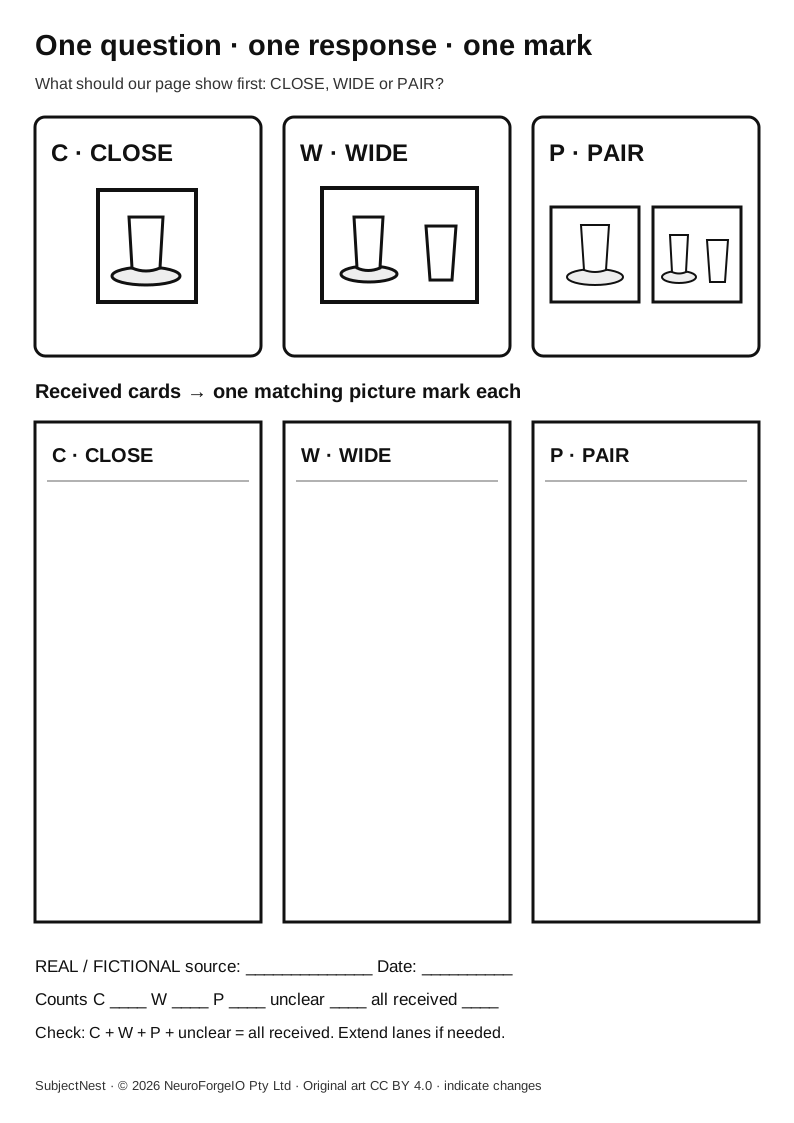
- “Collect each card from the bag and put it where your one sorting rule says it belongs.” Expect exactly one category per card.
- “Show each card with one matching picture mark. Check the card and mark counts.” Expect C2/W3/P3 and eight marks, no duplication.
- “Which category has most? Is there a tie? How many cards were received in this fictional set?” Expect W and P tied at 3, C2, total 8.
- “Can this bag tell us how every child in our real class chose?” Expect no. If a separate real class count was actually gathered, ask the learner to identify its record without substituting its numbers into A90.
If a card is missing, inspect the set before scoring; the child cannot be expected to recover a card the adult failed to provide. If a category is empty in another set, its labelled lane remains with count zero; a person who passed in a live survey is not assigned to any lane.
S · Fresh invented map B
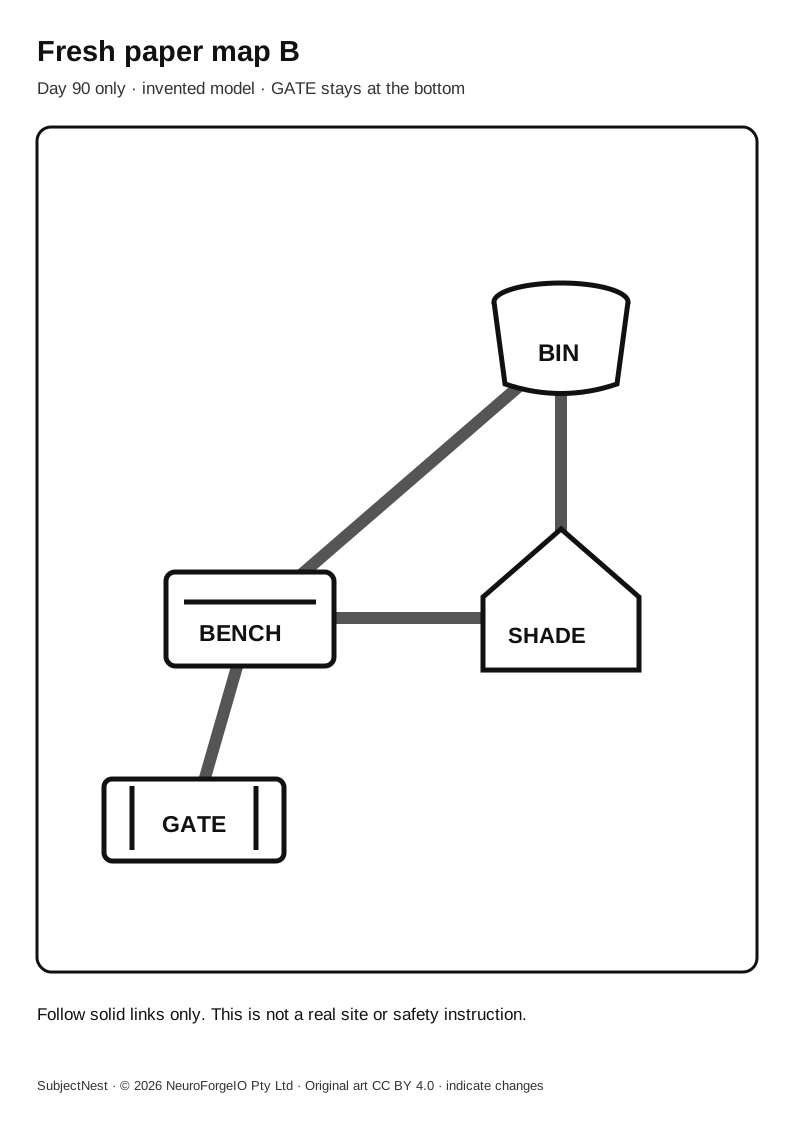
Reveal map B or its exact text/tactile alternative, GATE at the bottom. It is a paper shared yard, not a real site. Adult may read place labels. Use a large marker and ask exactly:
- “Where is SHADE compared with BENCH on this page?” Expect to the right of BENCH, naming the reference and fixed orientation.
- “Where is BIN compared with SHADE?” Expect above SHADE on this page.
- “Start at GATE and reach BIN by following solid lines. Show and name one route.” Accept GATE→BENCH→BIN (two links) or GATE→BENCH→SHADE→BIN (three links). No jump from GATE directly to BIN.
- “Now reach BIN by SHADE. Show and name every place in order.” Expect GATE→BENCH→SHADE→BIN, three connected links. The word by makes the indirect route necessary.
- “Does this paper drawing tell us which real school path is safe or open today?” Expect no, a current approved site and adult check would be needed.
Use a separate real classroom note from Day 86 if the child described their own actual position relative to a named familiar object. The fresh map alone samples object/map position and routes, not bodily self-location in a real space. Do not invent a self-location result. A paper route's link count is not a walking distance or time.
Analytic rubric and record
Rate domains separately; do not add numbers or set a pass line. I = independently shown after standard direction and non-content access. S = shown after a mathematical hint/model. N = attempted on an accessible task but not yet shown. NA = not accessibly observed. The levels below summarise the first independent sample; NA receives no level.
| Domain | 0 · No independent evidence | 1 · Emerging | 2 · Developing | 3 · Secure in this sample |
|---|---|---|---|---|
| D1. Question and one-rule sort | 0–2 of eight cards correctly placed or no stable rule | 3–5 placed under one rule | 6–7 placed, or eight after one category hint | All eight in exactly one correct category each; says what one card represents |
| D2. Object–picture transfer | No consistent one-card/one-mark relation | 1–4 of eight correctly paired | 5–7 paired, or eight with recount prompt | All eight paired one-to-one and C2/W3/P3 recount agrees |
| D3. Compare, total and source | No independent count/comparison in a completed check | One category count or total independently correct | Counts/tie or total correct, but source limit needs a prompt | C2/W3/P3, tie W/P, total8 and “fictional, not real class” independently supported |
| S1. Relative position | Neither fresh-map relation accurately described | One place located but reference/orientation unclear | One of two relations accurate with named reference; second prompted | SHADE right of BENCH and BIN above SHADE, with gate-bottom page orientation |
| S2. Connected route | No connected gate-to-bin route after an accessible attempt | Reaches BENCH or another valid first link only | One valid gate-to-bin route, but via-SHADE route needs a prompt | Valid route plus required GATE→BENCH→SHADE→BIN via-SHADE route, every link connected |
| S3. Paper-versus-real boundary | Claims paper route establishes real safety after accessible questioning | Says map is pretend after prompt | Separates paper route from real site but cannot name needed check independently | States invented map does not certify a real route; names adult/current approved-site check |
Self-location note: I/S/N/NA from Day 86 actual familiar-space observation, with exact named reference: __. It is not merged into the map score. Real outdoor care action: record actual approved site, adult check and child contribution if performed; otherwise not observed. A fictional route is never marked as a real care result.
Learner code: __________  dates: __________  access format: __________
D1 sort: ____  exact placement errors: _____________________________
D2 object/mark: ____  paired count C/W/P: __________________________
D3 compare/total/source: ____  exact child reason: _________________
S1 position: ____  relation/reference: _____________________________
S2 route: ____  actual path sequence: _____________________________
S3 paper/real: ____  exact child words: _____________________________
Day 86 real self-location I/S/N/NA: ____ actual reference: __________
Real place-care action: actual evidence __________ / not observed ___
Mathematical hints versus access supports: ________________________
One smallest next teaching move: __________  fresh recheck date: ___
Choose the next teaching move
| Exact pattern observed | Next teaching move | Fresh recheck |
|---|---|---|
| P counted as two responses because it depicts two views | Use one P card in one hand and one counter; place both once. | New three-card set C1/W1/P1. |
| A card receives two marks or a mark has no card | Physically pair each card and mark; remove/add one at a time. | New four-card set C2/W1/P1. |
| Empty category or pass interpreted as another choice | Keep all three labelled lanes and a separate pass/no-response note. Count only received cards. | New C2/W0/P1 complete fictional set, then a voluntary live response record if available. |
| A real class claim copied from fictional A90 | Put REAL/FICTIONAL source labels beside separate charts. Compare only what each source actually contains. | Ask for one safe claim and one unknown from a new labelled deck. |
| Counts correct but tie missed | Pair corresponding marks one-to-one or recount W/P; say neither exceeds the other. | New gallery-shape tie from print aids. |
| Left/right changes when page turns | Return gate to bottom, place a raised orientation cue and describe relation to a named object. | Fresh placement with shade right of bench on map B after reteach. |
| Child jumps across blank map area | Trace only raised/solid links and stop at every named place. | GATE→BENCH→SHADE on map A, then fresh map B. |
| Route reaches bin but ignores “by SHADE” | Put a required stop marker on SHADE; verbalise each connected leg. | New start BENCH→SHADE→BIN on map B. |
| Paper path reported as safe real route | Mark paper as fictional, ask what current approved real source/adult check would be needed. | New fictional/real source choice; real action remains NA until verified. |
| Independent samples are secure | Continue short cumulative retrieval, authentic source-labelled data and locally approved spatial tasks. | Fresh actual class question or paper map after several days; no whole-year claim. |
Sources: ACARA v9 workbook, ACARA Mathematics, AERO early numeracy and AERO Monitor progress. External rights stay separate.