These lessons ask how this object moved in this try. Select and inspect a broad, intact, clean, slow-moving, school-approved object and a clear, stable flat table or floor lane with START and CATCH boundaries. Use soft, light objects that cannot become a projectile; the adult controls release and the catch. Keep fingers, feet, faces and mobility routes clear. No small balls, hard or heavy cylinders, elevated ramp, forceful push, race, mouth/smell test, surprise touch, child photo, upload or outdoor collection is needed. Follow local site risk and access rules. A child may observe without handling, direct an adult, receive an attributed adult description, use a quiet response route, or pass. The teacher decides whether a trial is safe at all.
Actual-source preflight, every time: write local date; exact object identity and where it came from; verified material or UNKNOWN; shape and approximate size if relevant; lane surface; START/CATCH markers; who released it and how; whether the child directly saw/felt/heard movement or only received an adult report; what actually happened in the try; and any support/prompt. A mark or arrow on paper is a record of a movement only when the movement was actually observed and linked to that source/date. Do not invent the result or infer speed from an arrow. Where an actual trial cannot occur, write REAL OBSERVATION NOT AVAILABLE. The paper model can support source reading, question-making and prediction, but is not evidence of local movement or a safe investigation.
Fair comparison rule: For a shape comparison, aim to hold size, verified material, release, lane and surface alike; for size, hold shape/material and conditions alike; for material, hold shape/size and conditions alike. In a real classroom exact matching may be impossible. Name every visible difference and say “in these tries” rather than “shape caused it” if more than one factor changed. An adult may choose just one approved pair or stop with a question; no unsafe apparatus is required. Repeat only if time/safety allows; one result is a sample, not a rule for all objects.
Complete original paper sources · fiction for reasoning only
Model M · arrow board (Days 11–14). A horizontal empty lane. At the far left is the word START. Near the right edge is the word CATCH. One large outlined circle is drawn at START. A single right-pointing arrow ends before CATCH. No object, observer, material, date, surface, distance, speed, push, or actual movement is supplied. Exact read-aloud/tactile description: “START at left; large circle outline at START; one arrow points right and stops before CATCH at right.” A teacher may draw a thick raised line and large removable cardboard circle; it remains a paper model. It cannot prove a real circle-shaped object rolled.
Model N · two invented try records (Days 16–19). Both cards say FICTIONAL PRACTICE, not local data. Card A: “A wide soft block was placed at START on a flat mat. A pretend observer wrote STOP NEAR START.” Card B: “A narrow soft cylinder was placed at START on a flat mat. A pretend observer wrote STOP NEAR CATCH.” The record does not say the objects were the same size/material, that release was equal, or that any classroom trial happened. The correct inference is that the invented endpoints differ; the cause remains unknown. Exact nonvisual route: read A, then B, with a pause and the words START/NEAR START/NEAR CATCH; optionally use two large textured strips with endpoint tabs, clearly labelled invented.
Model P · question sort (Days 11–12). Four complete cards: “What happened when this approved object was gently released on our flat lane?” (investigable with preflight); “Which colour do you like best?” (preference); “Would a different object stop in the same place?” (testable later with safety and controls); “This drawn arrow proves a real object rolled.” (unsupported claim, not a question). Read verbatim; the material does not pre-answer a child's own question.
Model Q · method choices (Days 12–13). Three complete cards: “Mark one start and one catch on a clear stable flat lane. Adult releases one approved object gently.” “Roll a hard small bead down a desk toward a classmate.” “Draw an arrow and say that the classroom object moved without trying it.” Only the first is a possible method after local approval. The second is unsafe; the third is representation practice, not observation.
Six printable aids and exact linear/tactile routes
Each A4 aid has a SVG or PDF equivalent linked from the index. Its words and order are reproduced here so a teacher can use plain text, speech, AAC, high contrast print or broad tactile pieces. Tactile pieces are teacher-prepared, broad and secure, never small loose counters. A tactile model is still a model. Blank fields never carry prefilled child data.
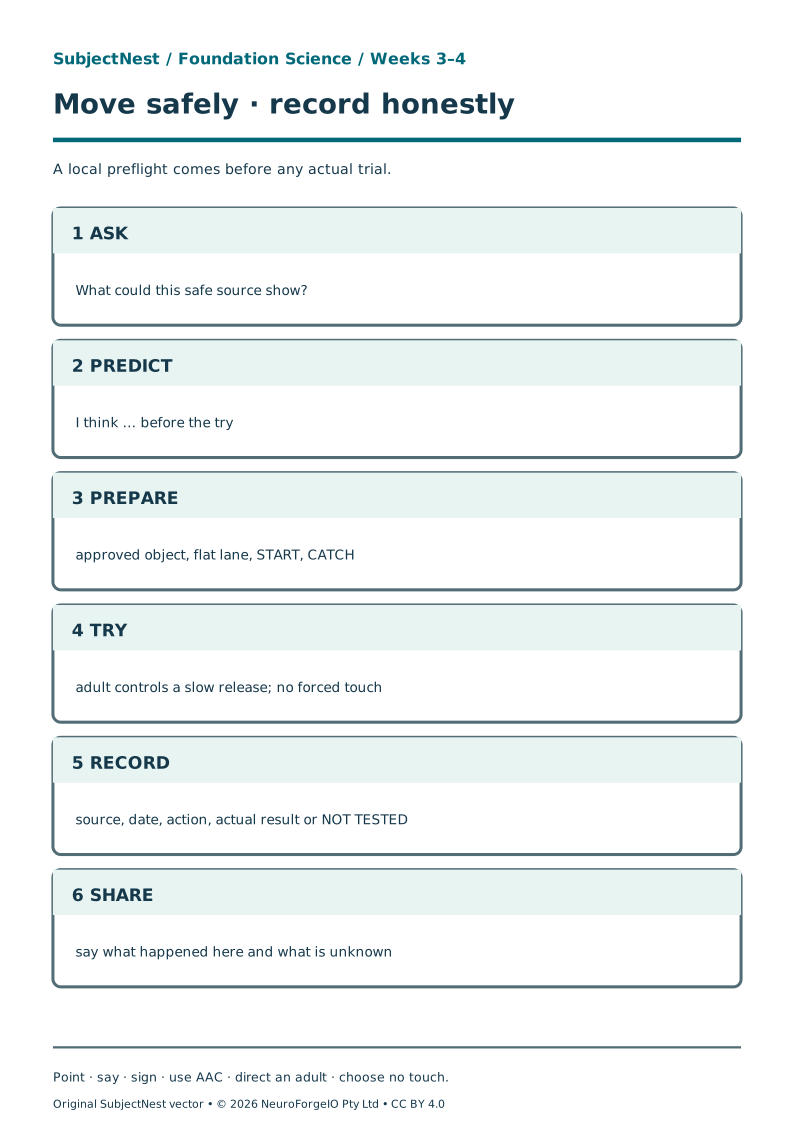
- safe-motion: header “Move safely · record honestly”; subtitle “A local preflight comes before any actual trial.” Six top-to-bottom boxes: “1 ASK · What could this safe source show?”; “2 PREDICT · I think … before the try”; “3 PREPARE · approved object, flat lane, START, CATCH”; “4 TRY · adult controls a slow release; no forced touch”; “5 RECORD · source, date, action, actual result or NOT TESTED”; “6 SHARE · say what happened here and what is unknown”. Tactile: six large numbered cards read in this order, with a broad flat strip only for PREPARE.
- motion-question: header “Ask before the object moves”; subtitle “Keep prediction apart from a result.” Six blank boxes: “SOURCE + LOCAL DATE”; “OBJECT + VERIFIED MATERIAL OR UNKNOWN”; “QUESTION ABOUT THIS TRY”; “PREDICTION BEFORE TRY”; “APPROVED ACTION + WHO RELEASES”; “ACTUAL RESULT OR NOT TESTED”. Tactile: six large labelled panels with a raised divider after the fourth; adult scribes exact dictated content.
- motion-log: header “What happened in this try?”; subtitle “An arrow is a record only after an actual observed movement.” Six blank boxes: “SOURCE + DATE + ACCESS”; “START + CATCH + LANE SURFACE”; “OBJECT + VERIFIED MATERIAL OR UNKNOWN”; “RELEASE ACTION + WHO”; “ACTUAL PATH / STOP / OTHER · OR NOT TESTED”; “WHAT A DRAWING CANNOT SHOW”. Tactile: six labelled panels in order, with a broad START-to-CATCH strip under panel 2; no endpoint is supplied.
- motion-model: header “A drawing of a possible path”; subtitle “INVENTED MODEL · not an observation of this room.” A horizontal outlined lane has START left, CATCH right, a large circle outline at START, and one arrow pointing right that ends before CATCH. Footer: “The model gives no real object, material, speed, push or result.” Tactile/read-aloud: exact Model M description above; no real result is implied.
- compare-factors: header “What stayed the same?”; subtitle “One changed factor is a stronger comparison. List other changes.” Six blank boxes: “QUESTION + PREDICTION”; “SOURCE/DATE · OBJECT A + OBJECT B”; “SAME: lane, release, shape, size, material?”; “DIFFERENT: shape, size, material, other?”; “ACTUAL A + B RESULTS OR NOT TESTED”; “CAUTIOUS CLAIM + WHAT ELSE TO CHECK”. Tactile: six broad labelled panels; adult reads a pair in the same A/B order and transcribes.
- evidence-report: header “Tell the source, then the finding”; subtitle “Use an actual dated record or label a fictional practice case.” Five blank boxes: “SOURCE + DATE + ACTUAL / ADULT REPORT / MODEL”; “MY QUESTION + PREDICTION”; “WHAT WAS DONE / WHAT THE SOURCE SHOWS”; “WHAT I CAN SAY IN THIS TRY”; “ONE UNKNOWN + NEXT SAFE CHECK”. Tactile: five large numbered cards. Child may dictate privately or point to exact phrases; no public performance is required.
Record truth: DIRECT means a child actually accessed the moving object through a sense in a safe trial; ADULT REPORT means an adult described what they observed; MODEL means only paper information. None are interchangeable. A child who cannot directly see the movement may still reason carefully from an attributed report, ask questions and direct the investigation. Keep the evidence type honest rather than treating one access route as lesser participation.
Original models, protocols and descriptions © 2026 NeuroForgeIO Pty Ltd, CC BY 4.0.