Optional genuine observation · prepare before children arrive
Choose two distinct actual plants and two distinct actual animals only if school policy, access and safeguarding allow. A teacher may use two safely visible known plants on school grounds; keep children on an approved path and never collect leaves or seeds. For animals, a genuine distant live view is usable only if animals appear naturally without lure or disturbance. A rights-cleared, provenance-known real photograph is often more dependable; label it PHOTO OF AN ACTUAL ANIMAL, name its source/date if known and limit claims to what that view shows. Do not call a photo a live encounter. A projected source needs an equivalent accessible description that states it is an adult's report if the child did not see it. Check local hazards, allergies, sun/heat, mobility routes, privacy, image rights and species-safety instructions. No child touches, smells, tastes, picks, feeds, follows, frightens or names an uncertain species. Adults stop or change route if safety or access changes. If no approved sources exist, write REAL OBSERVATION NOT AVAILABLE and use the complete model below; do not substitute stock photos of unknown licence or guessed memories.
Record one local date for the lesson and four distinct subject IDs (P1/P2, A1/A2), origin, image creator/licence if applicable, live versus photo versus ADULT REPORT, actual view/crop, child access, exact visible feature and NOT VISIBLE / UNCLEAR as needed. Two crops of P1 are still one plant. A lack of visible ears or leaves in a view is not proof of absence. If a child predicts before the view, write their exact earlier words and order; only then compare with a later observation. A source report is attributed, not a child direct sensory observation. A real photo supports only visible depicted features; a photo-only route is not a live natural-world investigation. A model card, tactile diagram or an adult's remembered animal is never an actual AC9SFI02 investigation. Store child records privately; no child photographs or public upload.
For classification, state one observable feature and one view (for example “pointed leaf tips visible in these two plant views”). Sort only subjects actually viewed into feature seen, feature not visible in this view, or unclear/not viewed; retain each ID. A rule can group within plants or within animals, and a shape can cross those categories. A counterexample revises a broad rule. We do not infer biology, habitat, identity or a universal law from one drawing/photo. An actual plant and animal may have differently named structures that share a pointed outline; name the structures rather than treating leaf and ear as the same part.
Complete original FICTIONAL MODEL · The notebook with four drawings
This is a made-up paper notebook, not a field report or picture of named species. The invented author labels two pages PLANT DRAWINGS and two ANIMAL PUPPET DRAWINGS. Those labels are the author's fiction; the pictures cannot verify living identity. Large original pictorial page.
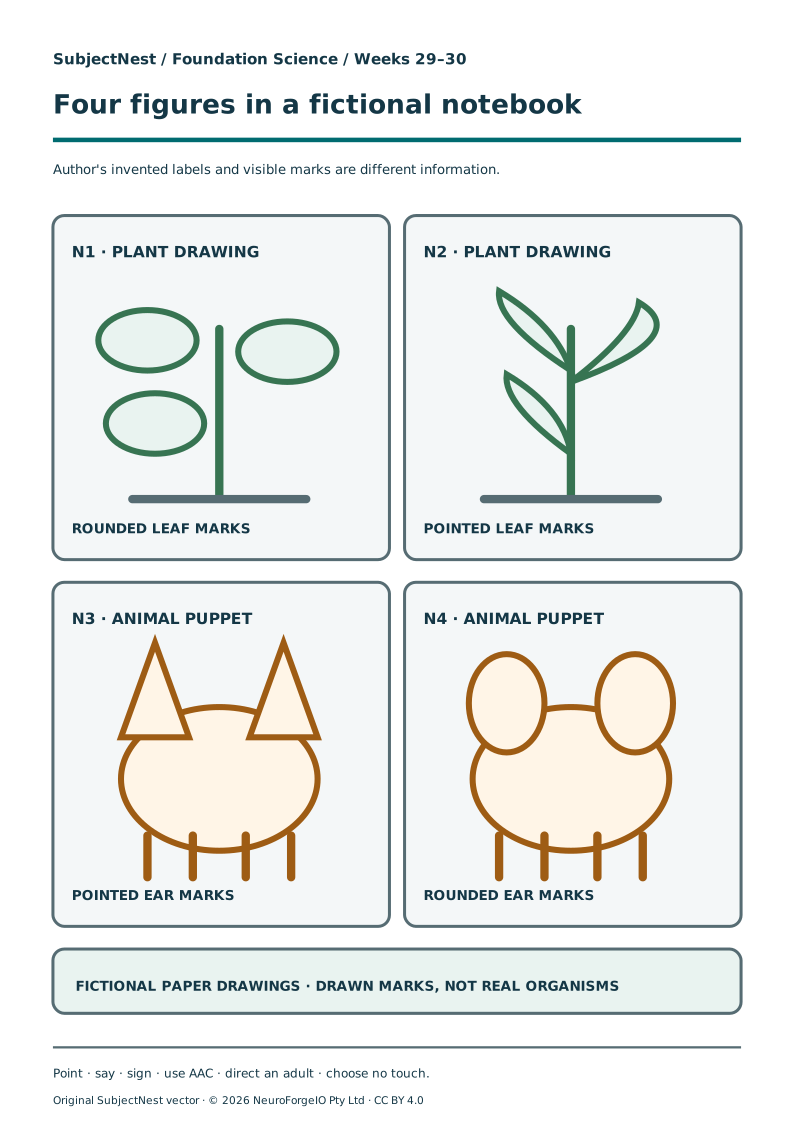
- N1, plant drawing: one upright thick stem mark and three broad oval leaf marks with rounded ends. Its bottom is cut off by the page; roots are NOT VISIBLE.
- N2, plant drawing: one upright thick stem mark and three long narrow leaf marks with pointed ends. Its bottom is cut off too; roots are NOT VISIBLE.
- N3, animal puppet drawing: one rounded head/body, two triangular pointed ear marks and four short leg marks. The puppet has no stated real-world identity.
- N4, animal puppet drawing: one rounded head/body, two curved round ear marks and four short leg marks. The puppet has no stated real-world identity.
The invented author writes a first rule: “Every drawing with a pointed outer part is an animal drawing.” N2 is a paper counterexample: its pointed parts are leaf marks, while its fiction label is plant drawing. A safer model-only description is “N2 and N3 both show pointed outer marks; N1 and N4 show rounded outer marks in these drawings. A pointed outline alone does not tell us the author's plant/animal label.” Do not say this proves anything about every actual plant or animal. Under a different stated rule, N1 and N2 share drawn stem-and-leaf features; N3 and N4 share drawn leg marks. One drawing can belong to more than one valid feature grouping when the rule changes.
Notebook claim C: “N1 has no roots because none are drawn.” This overreaches. The lower page is cut off; write ROOTS NOT VISIBLE IN THIS DRAWING, not absent. Notebook claim D: “The pointy drawing must be a real animal.” This overreaches twice: pointy marks cross the notebook's labels and a drawing is not real observation. The exact wording is useful for identifying an unsupported jump, not for testing species knowledge.
Invented conversation: A child asks the fictional notebook author, “What did you mean by pointed, and which drawings were you comparing?” The author answers, “I meant outer marks that end in a tip in N2 and N3. I was comparing my paper drawings.” This is an invented attributed answer. A real source discussion may use an adult's actual words with consent, but the story supplies no real interview or listener response.
Six aids · exact ordered read-aloud and tactile equivalents
Every tactile route uses broad secured shapes/lines attached by an adult. No loose tokens, sharp plant parts or animal specimens. Touch is an option, never a condition for participation. A raised paper drawing stays a model. Large print and AAC may use these exact orders and labels.
- Four notebook figures: top row N1 and N2, bottom row N3 and N4. N1: stem plus three broad rounded leaf outlines; N2: stem plus three narrow pointed leaf outlines; N3: round body with two pointed triangle ear outlines and four legs; N4: round body with two rounded ear outlines and four legs. Read FICTIONAL PAPER DRAWINGS, then N1 to N4, then DRAWN MARKS, NOT REAL ORGANISMS. Tactile route: adult fixes four large separate panels with raised stem/leaf or head/ear/leg geometry and exact labels; child may indicate by gaze, voice, sign or AAC.
- Pointed rule sort: four little pictured copies start in an UNSORTED tray, two large empty bins say POINTED OUTER MARK SEEN and ROUNDED OUTER MARK SEEN, and a distinct blank COUNTEREXAMPLE + SOURCE box sits below. Read source label, rule, unsorted drawings, both bins and counterexample prompt in that order. Tactile: secure all drawings in the unsorted tray before the child directs adult placement; nothing is pre-sorted.
- Four-source gate: four blank broad panels P1/P2/A1/A2 under REAL SOURCE ONLY IF VERIFIED with space for LIVE / PHOTO / ADULT REPORT, local date, origin/rights, actual view and child access. Read P1, P2, A1, A2 then STOP OR MODEL ONLY. Tactile: raised blank panel borders; do not imply a source was supplied.
- Two-pair log: paired blank plant panels at top, animal panels below; each says VISIBLE FEATURE / NOT VISIBLE / UNCLEAR with a separate SOURCE + DATE line. Read each pair left to right. Tactile: four fixed blank boxes, adult-directed scribing and category labels spoken; no observed outcome is printed.
- Revise-rule board: three linked large fields FIRST RULE, COUNTEREXAMPLE + SOURCE, SMALLER RULE / QUESTION. No result is prefilled. Tactile: three secured rectangles in reading order, with a broad arrow between them.
- Feature-share strip: six linked fields SOURCE TYPE + DATE, WHAT I NOTICE, MY RULE, COUNTEREXAMPLE, WHAT I CAN SAY NOW, LISTENER RESPONSE OR NONE. Read in that order. Tactile: broad fixed strips, adult transcribes child-directed words; a rehearsed listener line does not count as feedback.
Original model, protocols and aid descriptions © 2026 NeuroForgeIO Pty Ltd, SubjectNest, CC BY 4.0. Official sources keep their own terms.