Five 35-minute integrated blocks, Foundation / Queensland Prep. Teacher draft. Pair with English Days 91–95 and mathematics Days 91–95. Keep the three evidence streams separate. This guide revisits motion and fair comparison; it is not a claim that a five-day test meets a whole science standard.
Question: Does changing only the paper surface in our approved tabletop setup change where this one large paper ring stops? The teacher pretests a broad, low desk ramp with a substantial rim/stop tray, a large paper ring that cannot be swallowed, one starting line, smooth paper and a ridged paper overlay. No child stands on furniture, launches from a height, uses a marble/ball bearing, or chases an object. An adult handles anything the local risk check requires. If the physical setup is unavailable or unsafe, use the original fictional record below and mark real-investigation evidence not observed. That route still supports asking, comparing and explaining an example.
Materials and setup: same ring, same ramp, same start line and release without a push; only the paper surface changes. Use four attempts, two per surface, alternating smooth/ridged if feasible. Put a large S or R card and attempt number by each stop mark. Agree on a page orientation and use a paper strip to show near/far by direct comparison; do not claim a ruler measurement or a universal material rule. If the ring tips, leaves the ramp or a trial is disrupted, mark interrupted and repeat only if safe. Every actual observation is written as seen; an unchanged or mixed outcome is legitimate. The teacher records date, actual equipment and any changed condition.
| Day | Thirty-five-minute teaching route | Evidence and next move |
|---|---|---|
| 91 · Ask | 5 min recall an earlier roll/slide question; 6 min show two safe paper surfaces; 8 min children pose or select a question and predict near/far/same; 10 min co-plan what stays the same using picture/word cards; 6 min each child records a prediction by voice, AAC, mark or drawing. | Keep prediction before the result. If a child says the surface is the same object, let them touch/inspect both papers by an agreed route, then restate the one change. |
| 92 · Prepare | 5 min revisit the prediction; 7 min model adult release and stop tray; 8 min learners place/predict start and stop-mark labels on a paper model; 10 min adult rehearses one safe no-push release while children identify any changed condition; 5 min revise the plan. | Save a labelled setup diagram. If start line, ring or slope moved, record the difference and reset before claiming a fair comparison. |
| 93 · Try | 5 min state safety roles; 15 min adult-led alternating four attempts with a quiet observation route; 7 min children place one labelled stop mark per valid attempt; 5 min compare strips only where marks are clear; 3 min record an exact result or unclear. | Save raw marks, including repeated/interrupted attempts. Ask “What did we see in these tries?” Do not infer a fixed rule if stops vary. |
| 94 · Compare | 5 min reread predictions; 8 min place smooth and ridged marks side by side; 8 min children say what stayed steady and what changed; 9 min make a short spoken, drawn or AAC explanation; 5 min ask what another try could check. | Compare prediction with actual record. If mixed, say mixed. If no real test happened, compare only the labelled fictional record, never “our class found”. |
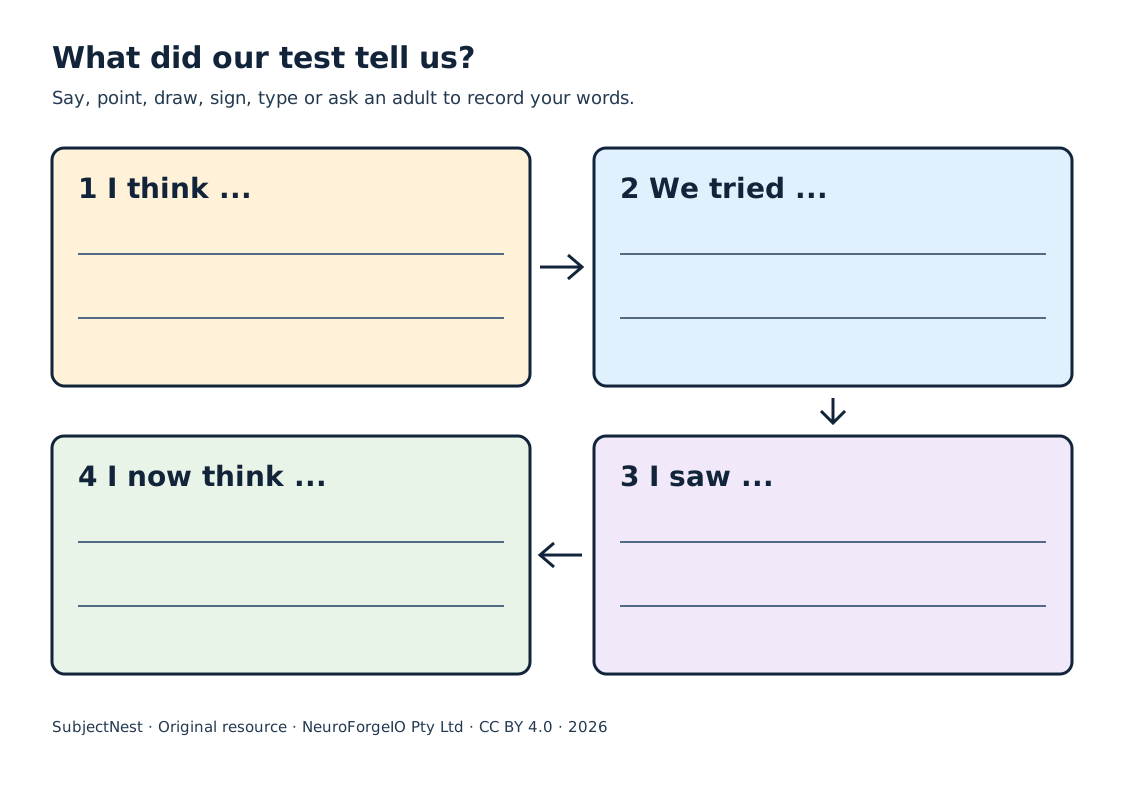
| 95 · Share | 5 min set a private/partner audience option; 8 min child selects one question, prediction and observed mark; 9 min makes a four-box explanation using the English mat; 8 min listener points to evidence and asks one question; 5 min child states a possible next safe check. | Record the child's actual explanation, exact cue and evidence source. Ask another teacher to inspect whether the assertion matches the marks before a public display. |
Fictional fallback record (original): On an invented paper ramp with a large ring, smooth attempts stopped at marks 2 and 3 from the start, while ridged attempts stopped at 2 and 2. These numbers are ordered mark labels, not centimetres. A fair statement is “In this fictional four-try record, one smooth attempt reached a farther labelled mark; three attempts stopped at mark 2.” It is not enough to assert that smooth always goes farther or ridges always slow a ring. Use this only if the real setup is unavailable, and label it invented at every display.
Proposed national links: AC9SFU02 (movement factors), AC9SFI01–AC9SFI05 (question/predict, safe observations, records, comparison and sharing), and AC9TDEFP01 if learners meaningfully propose/evaluate a safer observation setup. Exact Foundation code/text checked in the official ACARA v9 workbook, retrieved 29 September 2026, SHA-256 db446882d2c00cf7c085a03e250e2442fda6c44011fc114680c46c1dc7a822c3. These are partial teaching links. Check the locally adopted syllabus and school safety process. This original sequence does not include First Nations place knowledge; any local knowledge requires school-approved knowledge-holder input.
Access: describe the ramp, surfaces, stop marks and changes aloud; offer a close-up stable view, tactile paper surface samples, a nonvisual numbered mark strip, lower sensory load and child-controlled pointing/AAC. A child may participate in planning/recording without touching the device. Do not infer a fixed learning style from a preferred route. Store identifiable records privately.
Original guide, scenario and fictional record © 2026 NeuroForgeIO Pty Ltd, CC BY 4.0. Credit SubjectNest by NeuroForgeIO Pty Ltd, link source/licence and note changes. ACARA keeps its own terms. Educator, accessibility, local syllabus and safety review pending.